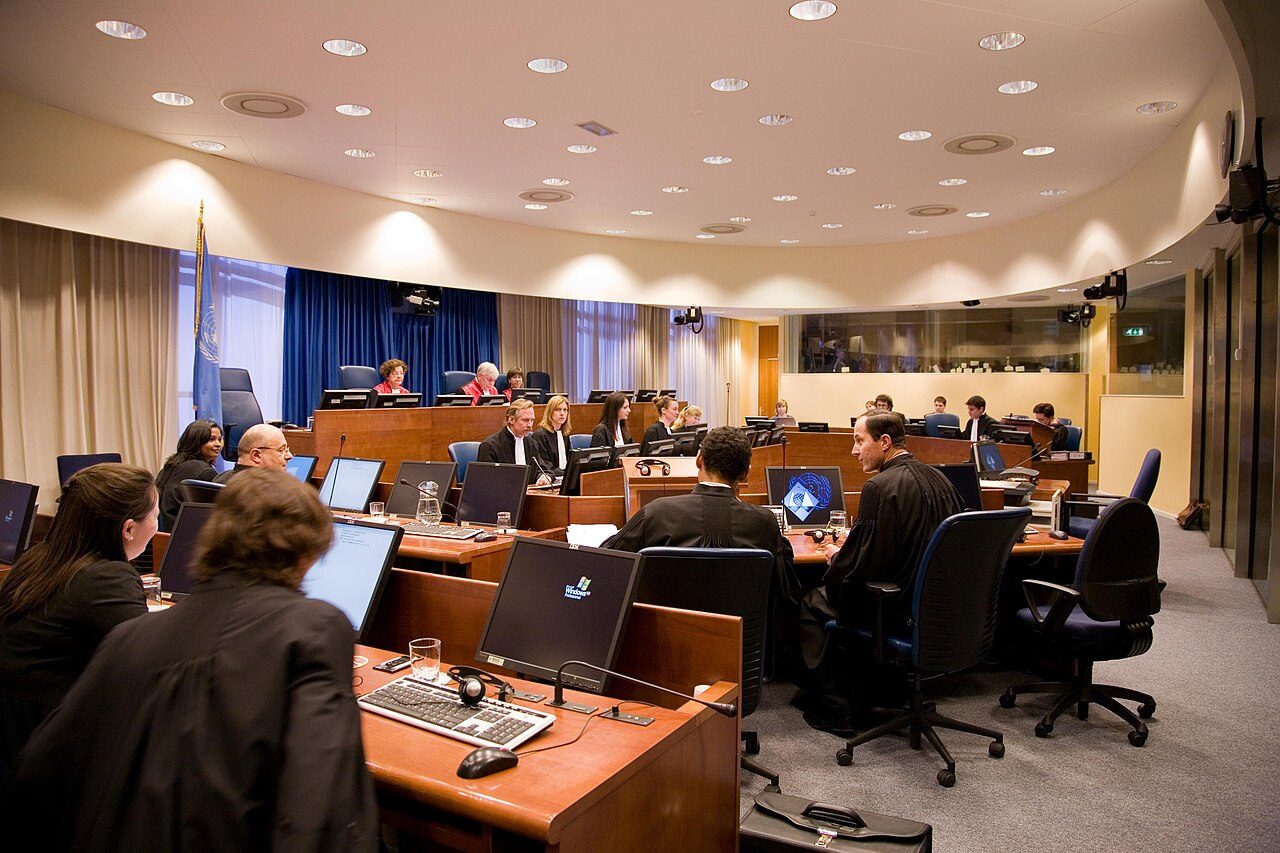
Courtroom 1 of the ICTY in session, The Hague
Courtroom 1 of the International Criminal Tribunal for the former Yugoslavia in The Hague, where the crimes of the Bosnian war were tried over more than two decades. Photo: UN ICTY · CC BY 2.0 · via Wikimedia Commons

A Court Built for a War in Progress

In May 1993, with the war still raging, the UN Security Council created the International Criminal Tribunal for the former Yugoslavia (ICTY) — the first international war-crimes court since Nuremberg and Tokyo. Over the next twenty-four years it indicted 161 individuals and built the most complete judicial record of any modern atrocity. Alongside it, the International Court of Justice (ICJ) heard Bosnia's case against Serbia under the Genocide Convention. Between them, these courts did not merely judge the Bosnian genocide; they reshaped the international law of mass atrocity.

The Genocide Convention

The 1948 Convention on the Prevention and Punishment of the Crime of Genocide defines genocide as enumerated acts — killing, causing serious harm, inflicting destructive conditions of life, and others — "committed with intent to destroy, in whole or in part, a national, ethnical, racial or religious group, as such." The decisive and most demanding element is the dolus specialis: the specific intent to destroy the group. It is this requirement that separates genocide from the grave but distinct categories of crimes against humanity and war crimes, and that made the legal question at the heart of the Bosnian cases so consequential.

Landmark Judgments

Tadić (1997) — the foundation

The first trial completed by the ICTY, arising from the Prijedor camps, established the Tribunal's jurisdiction and foundational principles of international criminal law — including that the laws of war apply to internal conflicts.

Kunarac (2001) — sexual violence as a crime against humanity

The Foča judgment was the first international conviction to treat rape and enslavement as crimes against humanity in their own right, recognizing that systematic sexual violence is an instrument of atrocity. See Sexual Violence and the Foča Precedent.

Krstić (2001; Appeals 2004) — genocide named

The Tribunal's determination that the Srebrenica massacre constituted genocide. The Appeals Chamber resolved the "in part" question by holding that the targeted part must be substantial, and that the destruction of the men of Srebrenica, combined with the forcible transfer of the women and children, was intended to destroy the community as such.

Command responsibility

The Tribunal entrenched the doctrine of command responsibility — that superiors are criminally liable for failing to prevent or punish the crimes of their subordinates — and the concept of the joint criminal enterprise, by which the architects of a coordinated campaign bear responsibility for its results across many municipalities (as in the conviction of the ARK leader Radoslav Brđanin for crimes throughout the Bosanska Krajina).

The siege and the crime of terror

In Galić (2003), arising from the siege of Sarajevo, the Tribunal articulated the war crime of inflicting terror on a civilian population as an end in itself.

The leadership convicted

Ultimately Radovan Karadžić (2016) and Ratko Mladić (2017) were each convicted of genocide for Srebrenica, among many other crimes. The HVO leadership of Herzeg-Bosnia was convicted in Prlić et al. (2013/2017) for the campaign against the Bosniaks of Herzegovina.
The ICJ: Bosnia v. Serbia (2007)

In the only inter-state genocide case ever decided, the International Court of Justice held on 26 February 2007 that genocide had been committed at Srebrenica, and that Serbia had violated the Genocide Convention by failing to prevent it and to punish the perpetrators — though it declined to find the Serbian state itself directly responsible for committing the genocide, in part because key Serbian military archives were withheld from the Court. The judgment confirmed the genocide while leaving the question of state responsibility a matter of enduring scholarly and political debate.

Scholarly Analysis

The narrowness of the legal finding

Both courts confined the label "genocide" to Srebrenica, classifying the 1992 campaign in the Krajina and the Podrinje as crimes against humanity and persecution rather than genocide. The distinction turned not on the scale of the destruction — which was in some municipalities more demographically complete than at Srebrenica — but on the courts' assessment of provable intent to destroy as opposed to intent to expel. Many scholars regard this as drawing too fine a line, and the gap between the legal and the historical understanding of the genocide remains one of the central debates in the field.

Why even-handedness matters

The Tribunal prosecuted crimes by all parties — Serb, Croat, and Bosniak forces alike, in proportion to their proven conduct. This even-handedness is precisely what gives its findings about the genocide their authority: a court that convicted only one side could be dismissed as victors' justice, whereas a record built on the universal application of the law is far harder for denialists to wave away.

A legacy beyond the Balkans

The Bosnian jurisprudence — on genocidal intent, on rape as a crime against humanity and an instrument of genocide, on command responsibility, on the crime of terror — has shaped the prosecution of atrocities worldwide, from Rwanda to the permanent International Criminal Court. The courtroom in The Hague rewrote the law under which future genocides will be judged.

Sources and References

ICJ, Bosnia and Herzegovina v. Serbia and Montenegro, Judgment of 26 February 2007 (summary). Available at: icj-cij.org — summary of the judgment

IRMCT / ICTY case archive (Tadić, Krstić, Kunarac, Galić, Brđanin, Karadžić, Mladić, Prlić). Available at: irmct.org

See also Perpetrators & Justice for case-by-case profiles, and the place pages for detailed citations.