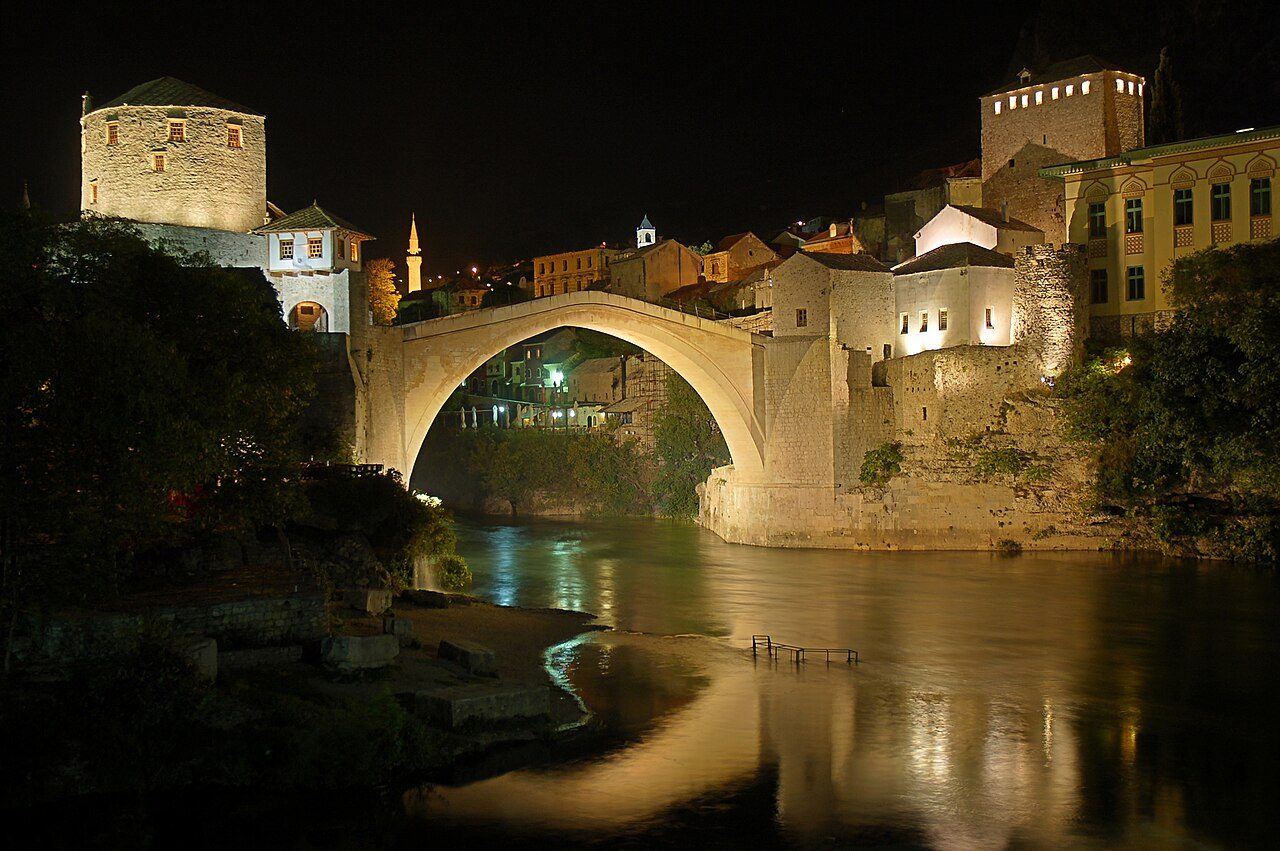
The rebuilt Stari Most (Old Bridge) over the Neretva river in Mostar, illuminated at night
The reconstructed Stari Most over the Neretva, reopened in 2004 after the original 16th-century bridge was destroyed by HVO shelling in November 1993. Photo: BáthoryPéter · CC BY-SA 3.0 / GFDL · via Wikimedia Commons

At a glance

Location
Mostar, the principal city of Herzegovina, on the Neretva
Period
9 May 1993 – April 1994 (HVO siege of East Mostar)
Perpetrators
The Croatian Defence Council (HVO) of Herzeg-Bosnia, with support from elements of the Croatian Army (HV)
Victims
Bosniak civilians of East Mostar
Detention
The Heliodrom camp (Rodoč) and other facilities; thousands of Bosniak men detained
Cultural destruction
Ten mosques damaged or destroyed; the 1566 Stari Most bridge destroyed on 9 November 1993
Legal status
Crimes against humanity, grave breaches; found part of a joint criminal enterprise to create Herzeg-Bosnia
Key case
Prlić et al. (six HVO/Herzeg-Bosnia leaders)

Summary

Mostar, the largest city in Herzegovina and a celebrated symbol of Ottoman-era coexistence, was torn apart in 1993 by the Croat–Bosniak war. After fighting jointly against Serb forces in 1992, the HVO turned on its Bosniak former allies, expelling Bosniaks from the western part of the city and laying siege to the Bosniak-concentrated eastern bank from 9 May 1993. For eleven months the HVO bombarded East Mostar with artillery, cut off humanitarian aid, detained thousands of Bosniak men in camps such as the Heliodrom, and destroyed the city's Ottoman heritage — culminating in the demolition of the sixteenth-century Stari Most, the Old Bridge, on 9 November 1993.

The Siege, the Camps, and the Bridge

The HVO drove Bosniaks from West Mostar into the besieged east, where the trapped population endured shelling, sniping, hunger, and the loss of water and power — conditions echoing the Serb siege of Sarajevo, here imposed by Croat forces. Thousands of Bosniak men and boys were detained at the Heliodrom, a former aviation base at Rodoč, and at other sites, where they were held in harsh conditions and used for forced labour, often on the front lines.

The destruction of the Stari Most on 9 November 1993 — an HVO tank firing on the graceful single arch until it collapsed into the Neretva — became the war's most resonant image of cultural destruction. The bridge had stood for 427 years and joined the city's two banks and its communities. The ICTY, in the Prlić case, reached a carefully qualified conclusion: it accepted that the bridge had been used by the Bosnian army and so could be considered a military target, but found that its destruction nonetheless inflicted disproportionate harm on the Bosniak civilian population of Mostar — for whom it was a lifeline and a symbol.

The Legal Reckoning

The Prlić et al. case (IT-04-74) tried six leaders of Herzeg-Bosnia and the HVO — Jadranko Prlić, Bruno Stojić, Slobodan Praljak, Milivoj Petković, Valentin Čorić, and Berislav Pušić — for crimes against humanity and war crimes in Mostar and across Herzeg-Bosnia. All six were convicted (the trial judgment in 2013, upheld in 2017), and the Tribunal found the existence of a joint criminal enterprise aimed at the ethnic engineering of a Croat territory, in which the leadership of neighbouring Croatia was implicated. The case is also remembered for its dramatic close: on hearing his appeal dismissed in the courtroom in November 2017, Slobodan Praljak took poison and died.

Scholarly Analysis

The murder of a bridge

The destruction of the Stari Most is the textbook case for the concept of cultural destruction as a dimension of ethnic cleansing. The bridge had no lasting military value commensurate with its annihilation; what it had was meaning. It was the physical embodiment of Mostar as a shared, plural city — the very thing the project of ethnic separation needed to destroy. To topple it was to declare that the old, mixed Mostar was finished. The bridge's reconstruction and 2004 reopening, using original techniques and stone from the same quarries, made it equally a symbol of the refusal to accept that verdict.

Two sieges, one method

Mostar deserves to be read alongside Sarajevo. The methods were strikingly parallel — encirclement, bombardment of a trapped civilian population, severance of utilities and aid — but the perpetrator here was the HVO, not the VRS. This parallel is analytically important: it shows that the siege-as-instrument-of-cleansing was not the property of any one nationalism but a shared technique of the war. It also complicates the politics of memory, since the besiegers of Mostar were backed by a state, Croatia, that was simultaneously a victim of Serb aggression elsewhere.

Joint criminal enterprise and the role of Croatia

The Prlić judgment's finding of a joint criminal enterprise to carve out an ethnically Croat Herzeg-Bosnia — with the involvement of figures in the Croatian state — mirrors, on a smaller scale, the structures of responsibility identified in the Serb campaign. It establishes that the central tool of accountability in this war, the concept of organized collective criminality reaching to the political summit, applies to the Croat–Bosniak conflict no less than to the assault on the Bosniaks by Serb forces.

Heliodrom: 262 Days

The HVO interned Bosniak men at the Heliodrom, a former JNA base near Mostar, in conditions one survivor called "hell." Ramiz Tiro, arrested on 30 June 1993, found a room packed with hundreds of men on bare concrete; by his release in 1994 he had spent 262 days inside and lost thirty-three kilograms. Selection for forced labour at the front line meant, he said, "guaranteed death" — trucks that left in the morning with sixty detainees returned in the evening with forty or fifty. Some ten thousand people passed through the Heliodrom; at least fifty-four were killed or died of mistreatment. It was during this siege, on 9 November 1993, that an HVO tank brought down the four-century-old Old Bridge.

Sources: Al Jazeera — a Croat concentration camp survivor; "Heliodrom camp," Wikipedia.

Sources and References

"Siege of Mostar," Wikipedia. Available at: https://en.wikipedia.org/wiki/Siege_of_Mostar

"Stari Most," Wikipedia (destruction and reconstruction). Available at: https://en.wikipedia.org/wiki/Stari_Most

RFE/RL, "Over Troubled Water: The Fall And Rise Of Mostar's Bridge." Available at: rferl.org — Mostar's Bridge

See also the ICTY judgment in Prosecutor v. Prlić et al. (IT-04-74), accessible through the IRMCT case archive, and the related entries on Ahmići and Čapljina & Stolac.