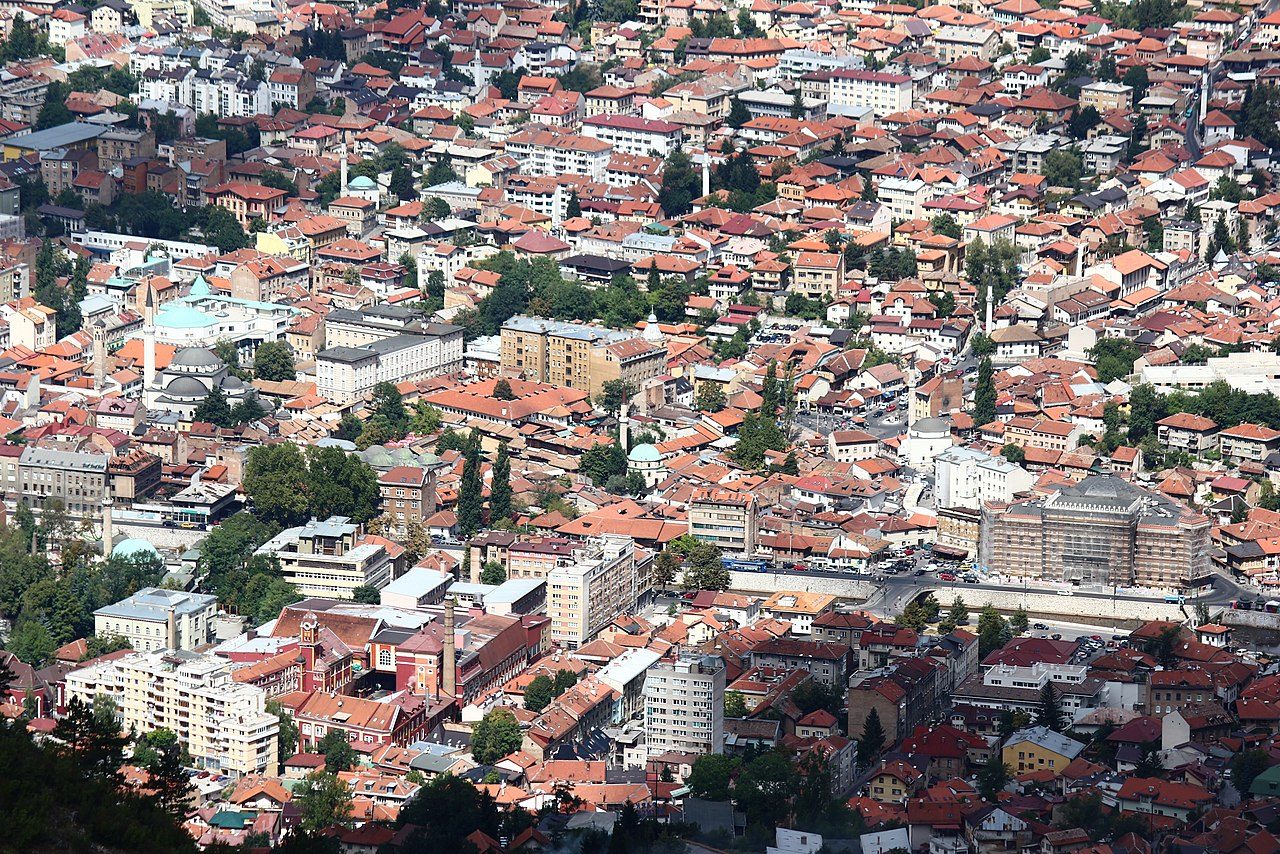
View of Sarajevo from the slopes of Mount Trebević
Sarajevo seen from Mount Trebević — one of the surrounding heights from which the VRS besieged and shelled the city for 1,425 days. Photo: Julian Nyča · CC BY-SA 3.0 · via Wikimedia Commons

At a glance

Location
Sarajevo, the capital of Bosnia and Herzegovina
Period
5 April 1992 – 29 February 1996 (1,425 days)
Perpetrators
The VRS Sarajevo-Romanija Corps, under Gen. Stanislav Galić and later Gen. Dragomir Milošević
Victims
The multi-ethnic civilian population of the city, predominantly Bosniak
Killed
~11,541 residents commemorated (including 1,601 children); a demographic study counts 13,952 killed in the siege, of whom 5,434 were civilians; 50,000+ wounded
Signature crimes
Sustained shelling and sniping of civilians; the two Markale market massacres (1994, 1995)
Legal status
Crimes against humanity and war crimes (terror against a civilian population)
Key cases
Galić (life); Dragomir Milošević (29 years); Karadžić; Mladić

Summary

From 5 April 1992 until 29 February 1996, the capital of Bosnia and Herzegovina was encircled and besieged by the Army of Republika Srpska from the surrounding hills. For 1,425 days — longer than the sieges of Leningrad or Stalingrad — roughly 350,000 trapped residents endured artillery and mortar bombardment, sniper fire aimed at people fetching water or crossing the street, and the deliberate deprivation of food, water, electricity, and heat. The siege was not an attempt to capture the city so much as a campaign to terrorize and punish its population.

The ICTY found that the VRS conducted a deliberate campaign of "terror" against the civilian population of Sarajevo — a legal characterization that places the siege among the defining atrocities of the war.

Terror as a Method

The instruments of the siege were shelling and sniping. Thoroughfares such as the boulevard that became known as "Sniper Alley" were lethal to cross; markets, water-collection points, funerals, and bread queues were targeted. The dead included around 1,601 children. Two attacks on the Markale market in the city centre came to symbolize the siege:

  • Markale I (5 February 1994) — a single mortar shell killed 68 people and wounded more than 140.
  • Markale II (28 August 1995) — mortar shells killed 43 and wounded scores more. This second massacre was a precipitating factor in NATO's Operation Deliberate Force, the air campaign that helped bring the siege and the war toward an end.

The exact toll of the siege is the subject of careful demographic work. The figure commemorated by the city — embodied in the "Sarajevo Red Line" of 11,541 empty chairs laid out along the main street in 2012 — is 11,541 killed, including 1,601 children. A separate demographic study placed total deaths connected to the siege at 13,952, of whom 5,434 were civilians, the remainder soldiers of the defending and besieging forces.

The Legal Reckoning

  • Prosecutor v. Stanislav Galić (2003) — the commander of the Sarajevo-Romanija Corps for most of the siege was convicted of crimes against humanity and of the war crime of inflicting terror on a civilian population, and sentenced to life imprisonment on appeal.
  • Prosecutor v. Dragomir Milošević (2007) — Galić's successor was convicted for the terror campaign of 1994–1995, including the second Markale massacre, and sentenced to 29 years.
  • The siege also formed a major component of the genocide-and-persecution convictions of Radovan Karadžić and Ratko Mladić.

Scholarly Analysis

The crime of terror

Sarajevo gave international criminal law one of its most important modern articulations of the war crime of "terror" — the deliberate infliction of fear on a civilian population as an end in itself. The Galić judgment established that targeting civilians not to achieve a military objective but to terrorize them is a distinct and prosecutable crime. The siege thus matters not only for its scale but for what it added to the legal vocabulary of atrocity: it named and condemned the strategy of making ordinary life — crossing a street, drawing water, burying the dead — an act of mortal danger.

The siege and the question of genocide

The siege of Sarajevo is generally classified as crimes against humanity and war crimes rather than genocide, and this is analytically apt: its aim was to subjugate and terrorize a city, not to destroy a group as such. Yet Sarajevo cannot be separated from the genocidal campaign that surrounded it. It was the capital whose multi-ethnic survival the architects of the "ethnically pure" project sought to break, and the suffering of its people was the centrepiece of the war's assault on the very idea of a shared Bosnian society. To study Sarajevo is to study what the genocide was against: coexistence itself.

The world as witness

Uniquely among the sites in this catalogue, Sarajevo was besieged in full view of the international press, which remained in the city throughout. The siege was televised nightly to a watching world. That this did not produce decisive intervention until 1995 makes Sarajevo, like Srebrenica, a central case in the study of bystander response — the gap between witnessing atrocity and acting to stop it.

Markale: 5 February 1994

On 5 February 1994 a single 120-millimetre mortar shell — fired, the courts found, from Bosnian Serb positions — struck the crowded Markale market in the centre of Sarajevo, killing 68 people and wounding more than 140. The survivors carry it still. Isma Aljukić, then 72, lost a leg: "There was complete silence on Feb. 5, 1994. There was no sound of bullets at all. So I went to the market to get food for my children, as my husband was at the front." Abid Kočević regained consciousness to find his leg "twisted backwards." The massacre prompted a NATO ultimatum; a second shelling of Markale in August 1995 would help trigger the air campaign that finally ended the siege.

Sources: Anadolu Agency — anniversary of the Sarajevo market massacre; "Markale massacres," Wikipedia.

Sources and References

"Siege of Sarajevo," Wikipedia. Available at: https://en.wikipedia.org/wiki/Siege_of_Sarajevo

IRMCT, "The Siege of Sarajevo" (feature). Available at: irmct.org — The Siege of Sarajevo

"Markale massacres," Wikipedia. Available at: https://en.wikipedia.org/wiki/Markale_massacres

See also the ICTY judgments in Prosecutor v. Galić (IT-98-29) and Prosecutor v. Dragomir Milošević (IT-98-29/1), accessible through the IRMCT case archive.