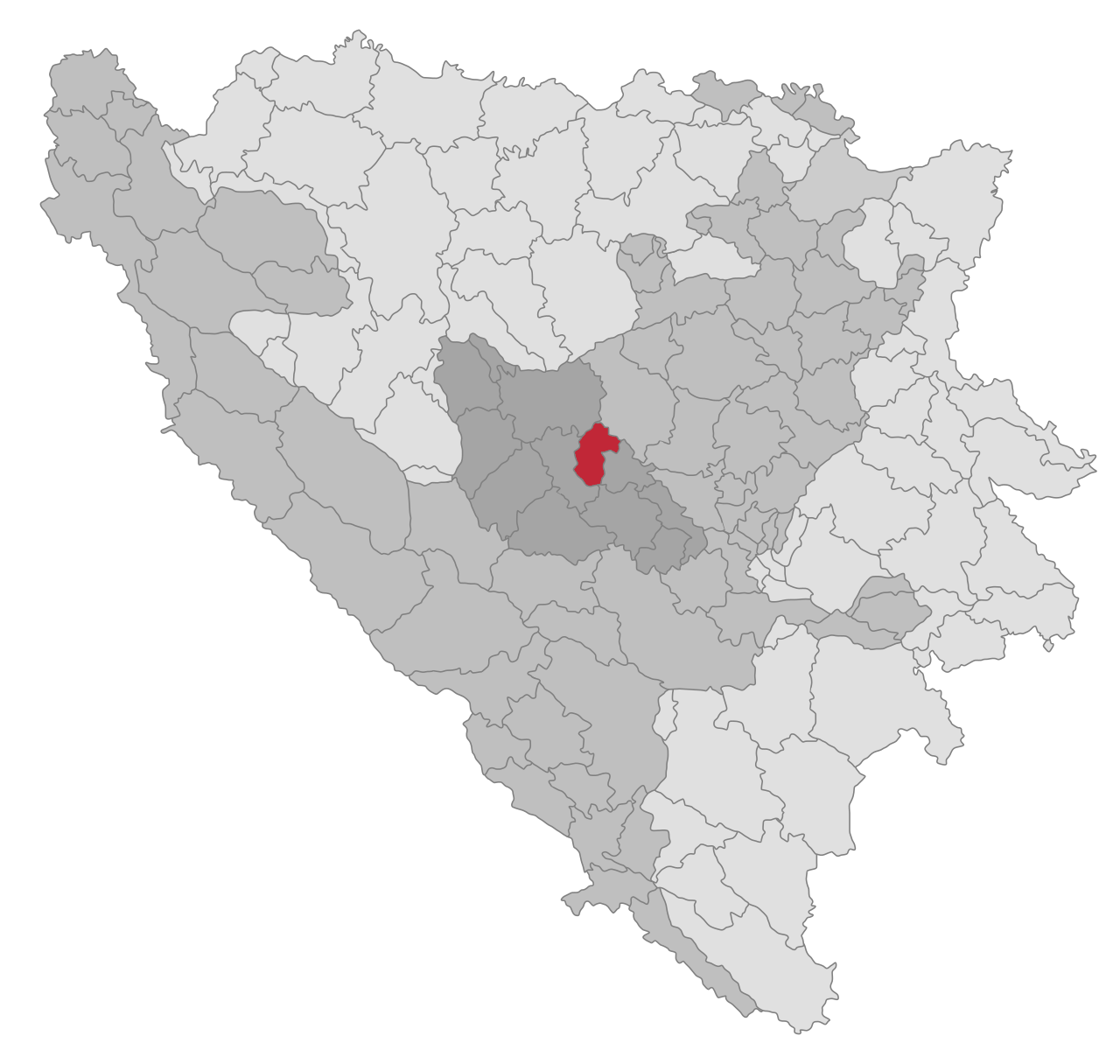
Location of the Vitez municipality within Bosnia and Herzegovina
Location of the Vitez municipality in the Lašva Valley of central Bosnia; the village of Ahmići was massacred here on 16 April 1993. Map: Julian Nyča · CC BY-SA 3.0 · via Wikimedia Commons

At a glance

Location
Ahmići, Vitez municipality, Lašva Valley, central Bosnia
Date
16 April 1993
Perpetrators
The Croatian Defence Council (HVO) — forces of the Croatian Community of Herzeg-Bosnia
Victims
Bosniak (Bosnian Muslim) civilians
Killed
~116 villagers, mostly elderly people, women and children; 17 children, including a three-month-old infant
Context
The culmination of the Lašva Valley ethnic cleansing; a coordinated dawn attack on several villages at once
Legal status
Crimes against humanity, war crimes
Key cases
Kordić (25 years); Blaškić; others

Summary

This catalogue is centred on the genocide against the Bosniaks, but a scholarly account must record that atrocities were committed in more than one direction. The Croat–Bosniak war of 1992–1994 — a conflict within the wider war, between former allies — produced its own campaign of ethnic cleansing, carried out by the forces of the self-declared Croatian Community of Herzeg-Bosnia against Bosniak civilians in central Bosnia and Herzegovina. Its single most notorious crime was the massacre at Ahmići.

At dawn on 16 April 1993, HVO forces attacked the village of Ahmići and several neighbouring settlements in the Lašva Valley. In a matter of hours they killed around 116 Bosniak civilians — overwhelmingly the elderly, women, and children — and burned the village and its two mosques. The ICTY found that this was a planned attack on a civilian population, intended to drive Bosniaks from the valley.

The Attack

At about 5:30 a.m., HVO units launched a simultaneous assault on Vitez, Stari Vitez, Ahmići, Nadioci, Šantici, Pirići, Novaci, Putiš, and Donja Večeriska. Ahmići, which had no military significance, bore the worst of it. Soldiers moved house to house, killing families in their homes and setting the buildings alight; victims were shot, and some were burned alive. Among the dead were 17 children, including the three-month-old Sead Ahmić. Both of the village's mosques were destroyed, the minaret of the lower mosque dynamited so that it fell across the road. The image of Ahmići's ruins — documented by British UN peacekeepers who arrived in the aftermath — became one of the defining records of the central-Bosnian war.

The Legal Reckoning

Ahmići generated a series of ICTY convictions establishing that the massacre was a crime against humanity and that it was planned at a senior level:

  • Prosecutor v. Dario Kordić (2001) — the political leader of the central-Bosnian Croats was found to have authorized the attack and sentenced to 25 years.
  • Prosecutor v. Tihomir Blaškić — the HVO regional commander was convicted in connection with the Lašva Valley crimes (his sentence later substantially reduced on appeal as responsibility was reassessed).
  • A number of direct perpetrators (members of the Vitezovi and Jokeri units and others) were also tried.

Scholarly Analysis

The war within the war

Ahmići is essential to an honest account precisely because it disrupts a simple binary. For roughly a year, the Bosnian government's mainly Bosniak forces and the Croat HVO — nominal allies against the Serb assault — turned on one another, and the HVO pursued the ethnic homogenization of areas it claimed for Herzeg-Bosnia. The methods mirrored those used against Bosniaks elsewhere: coordinated attacks on villages, the killing of civilians, the destruction of mosques, and expulsion. To document Ahmići is to insist that the moral framework applied to the war be consistent — that the killing of civilians is a crime irrespective of the ethnicity of the perpetrator.

Planning and the chain of command

The legal significance of Ahmići lies in the finding that it was planned. The simultaneity of the dawn attacks across nine locations, the targeting of a militarily worthless village, and the conviction of a political leader for authorizing it together establish that the massacre was not the rampage of undisciplined troops but an instrument of policy. This is the recurring lesson of the entire war, applied here to its Croat–Bosniak chapter: mass atrocity is organized from above.

Abdulah Ahmić's Morning

Abdulah Ahmić was a young man when HVO soldiers came to Ahmići before dawn on 16 April 1993. Woken at half past five by artillery, he watched from his house as soldiers doused a neighbour's home with gasoline. His father and brother were murdered in front of him, and he survived only by feigning death — until the soldiers, noticing he was alive, agreed to fetch dynamite to blow him up, and he fled. Through the fog he heard his mother's voice for the last time, crying: "They killed my husband and my sons." He lived to testify against Dario Kordić at The Hague in 1999. Of the 116 killed at Ahmići that morning, 32 were women and 11 were children, the youngest a baby of three months.

Sources: ICTY — Abdulah Ahmić; "Ahmići massacre," Wikipedia.

Sources and References

"Ahmići massacre," Wikipedia. Available at: en.wikipedia.org/wiki/Ahmići_massacre

SENSE Centre, "Ahmići — 48 Hours of Ashes and Blood." Available at: ahmici.sensecentar.org

University of Birmingham, "Remembering the Victims of Ahmići 30 Years On" (2023). Available at: birmingham.ac.uk — Remembering Ahmići

See also the ICTY judgments in Prosecutor v. Kordić & Čerkez (IT-95-14/2) and Prosecutor v. Blaškić (IT-95-14), accessible through the IRMCT case archive, and the related entries on Mostar and Stupni Do.