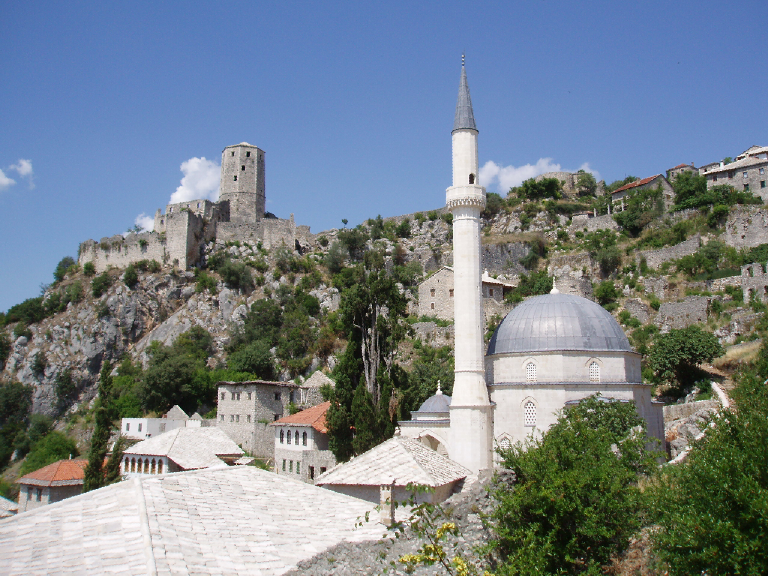
The Ottoman walled town of Počitelj with its mosque and fortress
The Ottoman town of Počitelj, in Čapljina municipality on the Neretva. Its Bosniak community was expelled and its heritage damaged during the 1993 HVO campaign in the lower Neretva valley. Photo: "Live Forever" · CC BY-SA 3.0 / GFDL · via Wikimedia Commons

At a glance

Location
Čapljina and Stolac, lower Neretva valley, Herzegovina
Period
1993 (chiefly summer–autumn)
Perpetrators
The Croatian Defence Council (HVO) of Herzeg-Bosnia
Victims
Bosniak civilians
Detention
The Dretelj camp (near Čapljina) and the Gabela camp — thousands of Bosniak men held in extreme conditions
Cultural destruction
Mosques and the Ottoman heritage of Stolac destroyed; the historic town devastated
Legal status
Crimes against humanity; part of the Herzeg-Bosnia joint criminal enterprise
Key case
Prlić et al. (IT-04-74)

Summary

In the lower Neretva valley south of Mostar, the municipalities of Čapljina and Stolac were subjected in 1993 to the HVO's campaign to clear Herzegovina of its Bosniak population. Bosniak men were arrested en masse and confined in the notorious Dretelj and Gabela camps, while women, children, and the elderly were expelled. Stolac, a town of exceptional Ottoman architectural heritage, was emptied of its Bosniaks and its mosques destroyed. The lower-Neretva campaign formed an integral part of the project for which the Herzeg-Bosnia leadership was convicted at The Hague.

The Camps and the Emptied Towns

The Dretelj camp, a former JNA facility near Čapljina, and the Gabela camp held thousands of Bosniak men and boys in conditions described by survivors and monitors as brutal: severe overcrowding, hangars and underground tunnels baking in the Herzegovinian summer heat, near-starvation, denial of water, beatings, and killings. Deaths resulted from the conditions as well as from direct violence. The detentions were the male counterpart to the expulsion of the rest of the Bosniak population.

At Stolac, one of the oldest urban settlements in the region, the destruction was cultural as well as human: the town's historic mosques — including the sixteenth-century Čaršija (Emperor's) mosque — were demolished, and its Bosniak inhabitants driven out, in an effort to erase the Ottoman-Islamic character of a town that had embodied it for centuries.

The Legal Reckoning

The crimes in Čapljina and Stolac, including the operation of the Dretelj and Gabela camps and the destruction of religious property, were established as part of the joint criminal enterprise litigated in Prosecutor v. Prlić et al. (IT-04-74), in which six senior figures of Herzeg-Bosnia and the HVO were convicted of crimes against humanity and war crimes across Herzegovina and central Bosnia. The Tribunal found that the camps and expulsions were instruments of a deliberate plan to create an ethnically Croat-dominated territory.

Scholarly Analysis

The camp returns — under a different flag

Dretelj and Gabela are sobering precisely because they replicate, under HVO control, the camp system that the world had condemned when it was revealed at Serb-run Omarska and Trnopolje a year earlier. The same logic — concentrate the men of a targeted community, brutalize them, expel the rest — was here put into practice by the other side of the Croat–Bosniak front. The recurrence of the camp as the central instrument of cleansing, irrespective of perpetrator, is one of the most important and disquieting findings to emerge from the geography of this war.

Stolac and the war on heritage

The destruction of Stolac extends the theme of cultural erasure seen at Banja Luka and Mostar into Herzegovina's Croat–Bosniak theatre. Stolac was among the most architecturally significant Ottoman towns in Bosnia; its deliberate de-Islamization demonstrates that the assault on cultural memory was, again, a shared method rather than the signature of one party. The post-war reconstruction of Stolac's mosques, like that of the Ferhadija and the Stari Most, belongs to the long, contested work of reversing that erasure.

Inside Dretelj

At the Dretelj camp near Čapljina — a former JNA barracks whose warehouses held between four and seven hundred men apiece — the HVO interned Bosniak men through the summer of 1993; the population peaked at around 2,270 on 11 July. In the mid-July heat the guards locked detainees up for days without food or water. The survivor Ramiz Suta described men driven to drink urine and filthy water, held for 105 days without a blanket; another counted sixteen blows from a military boot on each side of his body and said that "if ribs were made of steel they would have broken." At least four men died of beatings or gunshots.

Sources: "Dretelj camp," Wikipedia; Balkan Insight — The Untold Story of the Dretelj Horrors.

Sources and References

"Dretelj camp," Wikipedia. Available at: https://en.wikipedia.org/wiki/Dretelj_camp

"Gabela camp," Wikipedia. Available at: https://en.wikipedia.org/wiki/Gabela_camp

"Lašva Valley ethnic cleansing" and "Siege of Mostar," Wikipedia (Herzeg-Bosnia campaign context). Available at: en.wikipedia.org/wiki/Siege_of_Mostar

See also the ICTY judgment in Prosecutor v. Prlić et al. (IT-04-74), accessible through the IRMCT case archive, and the related entry on Mostar.