← The Bosnian Genocide / Bosanska Krajina
The administrative capital of the Krajina campaign — where a city was “cleansed” almost without a shot fired
Banja Luka, Bosnia's second city, occupies a special place in this catalogue: it was the command centre of the northwestern campaign rather than one of its battlefields. As the seat of the self-declared Autonomous Region of Krajina, Banja Luka was where the policies executed in Prijedor, Sanski Most, Ključ, Kotor Varoš, and Bosanski Novi were formulated and coordinated. And yet the city was itself the scene of one of the war's most complete acts of ethnic cleansing — carried out, almost uniquely, without front-line fighting.
No battle was fought in Banja Luka. Instead its Muslim and Croat inhabitants — roughly 30 percent of the pre-war population — were dismissed from their jobs, stripped of legal protection, subjected to harassment, detention, and the destruction of their religious heritage, and driven out. The city's Muslim population fell from around 30,000 to a few thousand.
The mechanism of Banja Luka's cleansing was administrative rather than overtly military. Non-Serbs were removed from employment and from the health-insurance and legal systems; in at least one documented instance they were required to wear white armbands, and they were pressured to sign over their property and pledge loyalty to the Serb authorities as a condition of being allowed to leave. This was expulsion engineered through paperwork and intimidation — a slower, quieter violence than the massacres of the eastern enclaves, but with the same end.
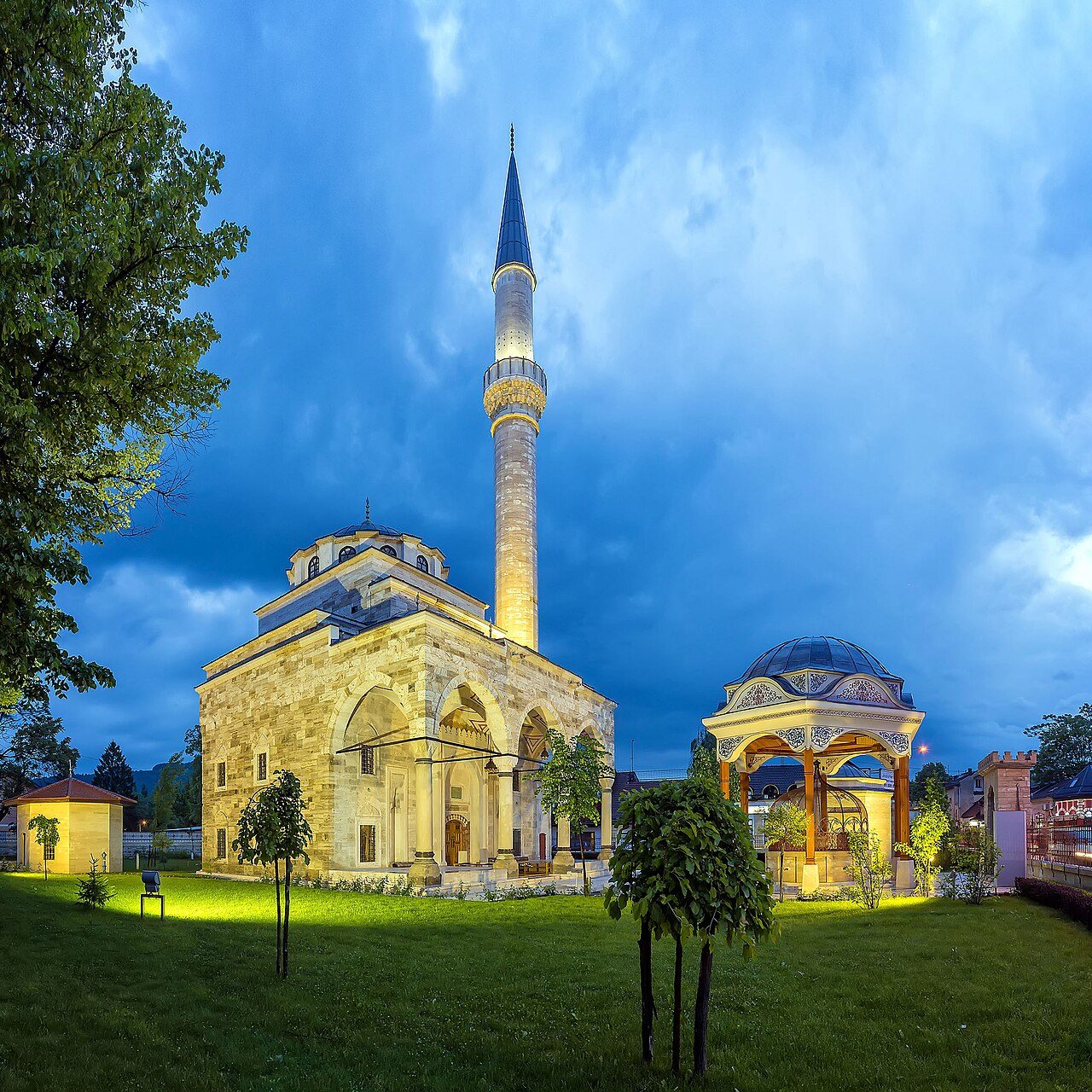
It was nonetheless accompanied by hard force. The Manjača camp, on the mountain south of the city, held thousands of men deported from across the Krajina — from Prijedor, Sanski Most, Ključ, and elsewhere — in conditions of starvation, beating, and killing, until international pressure and the ICRC forced its closure. And in a deliberate assault on memory itself, Banja Luka's Ottoman heritage was destroyed: on the night of 6–7 May 1993 the sixteenth-century Ferhadija and Arnaudija mosques were dynamited within minutes of each other, two of the sixteen mosques razed in the city during the war.
For detailed treatments on this site, see the Ferhadija Mosque of Banja Luka and the Banja Luka Resolution.
The Banja Luka leadership stood at the centre of the ICTY's Krajina cases. Radoslav Brđanin, president of the ARK Crisis Staff, was convicted in 2004 of persecution, torture, deportation, and the wanton destruction of religious institutions across the region — a conviction explicitly grounded in the regional, coordinated nature of the campaign. General Momir Talić, commander of the 1st Krajina Corps, was jointly indicted but died during his trial. The crimes of the ARK also formed part of the genocide and persecution cases against Karadžić and Mladić.
Banja Luka demolishes the comfortable misconception that ethnic cleansing is a by-product of combat — something that happens when armies clash and order breaks down. No army clashed in Banja Luka. The expulsion of a third of its population was a policy, implemented by a functioning administration in a city under firm control, through ordinances, dismissals, and engineered terror. This is perhaps the purest demonstration in the entire war that the destruction of communities was the aim of the campaign, not its collateral damage.
The dynamiting of the Ferhadija — a UNESCO-listed masterpiece of Ottoman architecture that posed no military threat whatsoever — exemplifies what scholars term "cultural genocide" or "memoricide": the deliberate erasure of the physical traces of a community's centuries-long presence. To destroy a population's mosques, graveyards, and monuments is to attempt to make it as though they had never lived there at all, foreclosing return by erasing the landscape of belonging. The mosque's painstaking reconstruction and 2016 reopening is, in this light, an act of restoration that is also a refusal of that erasure.
Finally, Banja Luka demonstrates the importance of the supra-municipal layer of organization. The conviction of Brđanin for crimes committed by others across many municipalities established a crucial principle of accountability: that those who run the administrative apparatus of a cleansing campaign bear criminal responsibility for its region-wide results, even when their own hands never touched a victim.
On the bleak mountain plateau south of the city, the Manjača camp held the men deported from across the Krajina — from Sanski Most, Ključ, Prijedor, and Kotor Varoš. At its peak in mid-1992 it held some 3,700 prisoners; between 4,500 and 6,000 non-Serbs passed through in all. Detainees subsisted on starvation rations and a few litres of water a day, endured routine beatings and forced labour, and died — hundreds, by the courts' finding, in the summer of 1992 alone. When the International Committee of the Red Cross gained access in July, it judged the camp "totally unsuitable" for holding anyone; on 18 December 1992 it was closed and the last 418 detainees released under ICRC auspices.
Sources: "Manjača camp," Wikipedia; ICTY, Prosecutor v. Stanišić & Župljanin (IT-08-91).
"Ferhat Pasha Mosque (Banja Luka)," Wikipedia (destruction and reconstruction of the Ferhadija). Available at: en.wikipedia.org — Ferhat Pasha Mosque
Balkan Insight, "Bosnia's Banja Luka, My Ethnically Cleansed Hometown" (2025). Available at: balkaninsight.com — Banja Luka
RFE/RL, "In Banja Luka, A Mosque Rises From The Rubble" (2016). Available at: rferl.org — Banja Luka mosque
See also the ICTY judgment in Prosecutor v. Brđanin (IT-99-36), accessible through the IRMCT case archive, and on this site the Ferhadija Mosque and the Banja Luka Resolution.