← The Bosnian Genocide / Bosanska Krajina
The takeover, the camps at Omarska, Keraterm, and Trnopolje, and the destruction of Kozarac — the events that gave the world the phrase “ethnic cleansing”
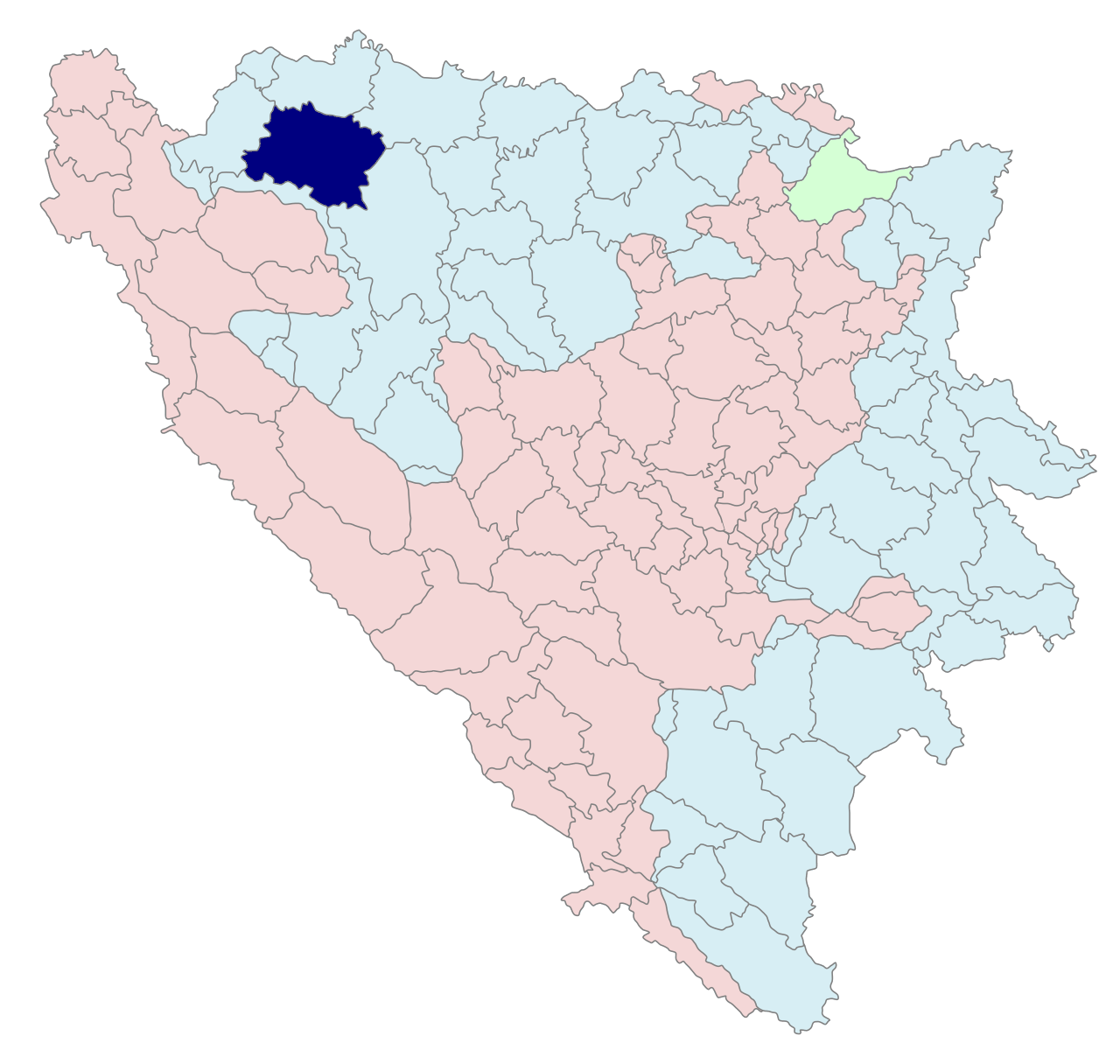
The municipality of Prijedor, in northwestern Bosnia, was home before the war to a Bosniak and Croat majority living alongside a large Serb minority. After Bosnian Serb forces seized the town on 30 April 1992, they implemented one of the most thoroughly documented campaigns of persecution of the entire war: the mass arrest of the non-Serb population, the establishment of the Omarska, Keraterm, and Trnopolje detention camps, the destruction of Bosniak towns such as Kozarac, mass killing, torture, and sexual violence, and the deportation of the survivors. Within months Prijedor's non-Serb communities had been all but eliminated.
It was the images smuggled out of Trnopolje and Omarska in August 1992 — emaciated men behind barbed wire — that brought the term "ethnic cleansing" into global usage and shattered the claim that the camps did not exist. Prijedor also produced Prosecutor v. Tadić, the first full trial conducted by the ICTY.
Following the seizure of the municipal institutions, Bosnian Serb authorities ordered non-Serbs to mark their houses with white flags and to wear white armbands — a measure of identification with chilling historical resonance. In late May 1992, after token armed resistance, Serb forces shelled and stormed the predominantly Bosniak town of Kozarac, killing large numbers of civilians and driving out the survivors. The captured population was funnelled into three principal camps:
Precise death tolls for the camps are difficult to fix because of the destruction and concealment of remains, but the orders of magnitude are well established. ICTY proceedings found that more than 1,500 killings occurred in the municipality, with over 1,200 people taken to the camps still listed as missing. Estimates of the dead at Omarska alone range widely: the camp detainees' association recorded roughly 700 killed among the approximately 6,000 who passed through, while US State Department officials cited by the journalist Roy Gutman gave a far higher figure of 4,000–5,000. The Research and Documentation Center documented more than 3,000 dead and missing across the municipality as a whole.
The discovery in 2013 of the Tomašica mass grave near Prijedor — among the largest found in Bosnia, containing the remains of hundreds of victims — confirmed both the scale of the 1992 killings and the deliberate effort to conceal them, as bodies had been moved from primary graves and reburied.
Prijedor is among the most heavily litigated locations of the war:
In total, the ICTY convicted more than a dozen individuals in connection with Prijedor. Notably, the courts declined to characterize the Prijedor crimes as genocide, finding crimes against humanity and persecution but not the specific genocidal intent required by the Convention — a determination that remains a focus of scholarly criticism.
Prijedor occupies a singular place in the moral vocabulary of the late twentieth century: the camps revealed here in August 1992 made "ethnic cleansing" a household term. Yet the phrase has always been double-edged. Coined as a euphemism by the perpetrators, it entered international usage as a description of their crimes — but its very existence as a separate category has at times provided a rhetorical off-ramp from the word "genocide," allowing observers to acknowledge mass atrocity while avoiding the legal and political obligations that the harder word entails.
What the Prijedor record documents with unusual clarity is the administrative character of the campaign. The white armbands, the marking of houses, the crisis-staff orders, the categorization of detainees into "investigation" groups at Omarska — these were not the products of spontaneous rage but of municipal governance turned to the purpose of destroying a community. The convictions of civilian officials such as Stakić, alongside camp guards and paramilitaries, reflect this: Prijedor demonstrates that genocide and ethnic cleansing are crimes of organization, requiring clerks and mayors as much as gunmen.
The refusal of the ICTY to label Prijedor genocide, in contrast to Srebrenica, frames one of the central debates in the study of the Bosnian war. Demographically, the destruction of the Prijedor Bosniak community was more complete than at Srebrenica; the difference lay in the courts' assessment of provable intent to destroy rather than to expel. Many scholars argue that this draws too fine a line, and that the 1992 campaign in the Krajina and the Podrinje shared the genocidal logic later recognized at Srebrenica.
For three months the camps of Prijedor operated unseen. That changed on 6 August 1992, when a television crew led by ITN's Penny Marshall and the reporter Ed Vulliamy reached Omarska and then Trnopolje. Blocked at gunpoint from the parts of Omarska where most prisoners were held, they filmed emaciated men at Trnopolje's barbed-wire fence. One of them, a gaunt young man named Fikret Alić, his ribs jutting over a sunken stomach, became — in Vulliamy's words — "probably the most familiar figure in the world" that summer; British newspapers ran his image over the headline "Belsen 1992." The broadcast forced the camps into the conscience of the world, even as it failed to close them.
Sources: "Fikret Alić," Wikipedia; Balkan Insight — British Journalist Recalls Skeletal Prisoners.
ICTY, "Ethnic Cleansing in Prijedor" (Bridging the Gap with local communities), and the case background materials. Available at: icty.org/…/prijedor and "Ethnic Cleansing in Prijedor" (PDF)
Human Rights Watch, "The Unindicted: Reaping the Rewards of Ethnic Cleansing in Prijedor" (1997). Available at: refworld.org/…/34972
"Omarska camp," Wikipedia. Available at: https://en.wikipedia.org/wiki/Omarska_camp
"Prijedor ethnic cleansing," Wikipedia. Available at: https://en.wikipedia.org/wiki/Prijedor_ethnic_cleansing
See also the ICTY judgments in Prosecutor v. Tadić (IT-94-1), Prosecutor v. Stakić (IT-97-24), and Prosecutor v. Kvočka et al. (IT-98-30/1), accessible through the IRMCT case archive.