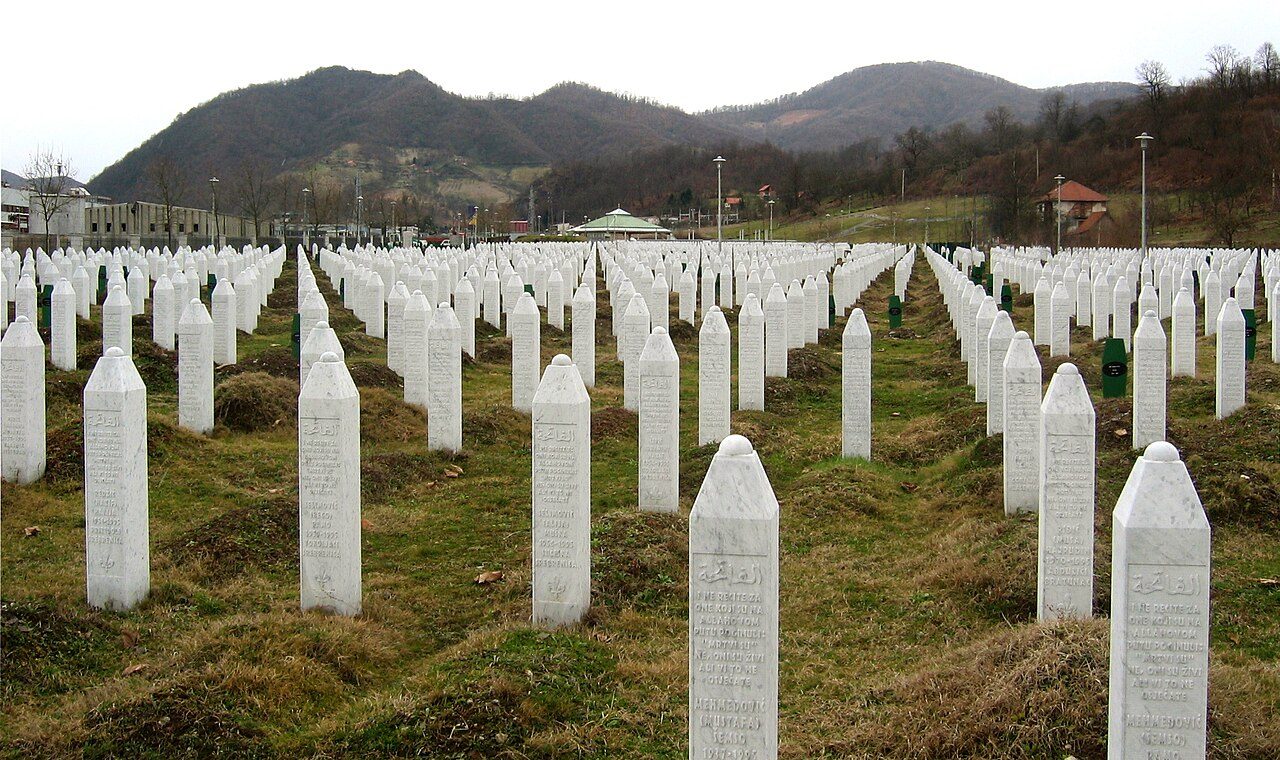
Rows of white gravestones at the Srebrenica-Potočari Genocide Memorial Center
The Srebrenica–Potočari Memorial Center, where the identified victims of the July 1995 genocide are buried. Photo: Michael Büker · CC BY-SA 3.0 · via Wikimedia Commons

At a glance

Location
Srebrenica, eastern Bosnia (Podrinje / Drina valley)
Period
11–22 July 1995 (mass executions 13–17 July)
Perpetrators
Army of Republika Srpska (VRS) and Bosnian Serb police, under Gen. Ratko Mladić
Victims
Bosniak (Bosnian Muslim) men and boys
Killed
8,372 named on the memorial; ~8,000 estimated; ~7,000 identified by DNA
Displaced
~25,000–30,000 women, children and elderly deported from Potočari
Legal status
Genocide — ICTY (Krstić, 2004) and ICJ (2007)
Key cases
Krstić; Popović et al.; Karadžić; Mladić

Summary

In the second week of July 1995, units of the Army of Republika Srpska (VRS) under the command of General Ratko Mladić overran the United Nations "safe area" of Srebrenica in eastern Bosnia. Over the following days — principally between 13 and 17 July — VRS and Bosnian Serb police forces systematically separated, detained, transported, and executed Bosniak men and boys, while forcibly deporting the women, young children, and elderly. More than 8,000 victims were killed in a coordinated operation that the courts have found was designed to destroy the Bosniak community of Srebrenica as such.

Srebrenica is the most fully adjudicated atrocity of the war and the touchstone of its legal history: it is the single episode that both the International Criminal Tribunal for the former Yugoslavia (ICTY) and the International Court of Justice (ICJ) have definitively classified as genocide within the meaning of the 1948 Genocide Convention.

The Enclave and Its Fall

By 1993 Srebrenica had become an overcrowded refuge for tens of thousands of Bosniaks driven from the surrounding Drina-valley municipalities — Bratunac, Vlasenica, Zvornik, Višegrad — during the ethnic cleansing of 1992. In April 1993 the UN Security Council, by Resolution 819, declared Srebrenica a "safe area" to be "free from any armed attack or any other hostile act." The enclave was nominally protected by a lightly armed Dutch UNPROFOR battalion (Dutchbat) but was never demilitarized in any meaningful sense, and it remained under siege.

On 6 July 1995 the VRS launched operation "Krivaja '95" against the enclave. UN air support was requested and largely withheld; the Dutch battalion did not resist the advance. Srebrenica fell on 11 July. Tens of thousands of Bosniaks fled to the UN compound at Potočari, while a column of perhaps 10,000–15,000 men and boys attempted to break through the forest toward Bosnian-government-held Tuzla — a march during which many were ambushed, shelled, captured, or killed.

The Killings

At Potočari, beginning on 12 July, VRS soldiers separated men and boys aged roughly twelve to seventy from their families under the pretext of screening for "war criminals." Women, children, and the elderly were loaded onto buses and expelled toward Bosniak-held territory. The detained men, together with thousands captured from the column, were bused to detention sites and then to execution grounds across the Bratunac and Zvornik municipalities.

The mass executions were carried out at identifiable sites whose names recur throughout the forensic and judicial record: the warehouse at Kravica, where hundreds were murdered with automatic weapons and grenades; the fields at Orahovac (Lažete); the Branjevo Military Farm and the nearby Pilica cultural centre; the dam at Petkovci; and Kozluk. In an attempt to conceal the crime, the VRS later exhumed many primary graves with heavy machinery and reburied the commingled remains in dozens of secondary graves — an effort that scattered single bodies across multiple sites but that also, paradoxically, produced forensic evidence of the deliberate cover-up.

Counting the Dead

The figure inscribed on the memorial stone at the Potočari–Srebrenica Memorial Center is 8,372. Estimates of those killed cluster around 8,000 men and boys; the ICTY referred to "more than 7,000" and "up to 8,000" in successive judgments. The International Commission on Missing Persons (ICMP), using DNA matching of remains recovered from primary and secondary graves, has identified the remains of roughly 7,000 individuals — a figure that continues to rise as fragmentary remains are reassociated and as new graves are located. Victims are interred each 11 July at Potočari as identifications are completed.

The uniqueness of the demographic profile of the dead — overwhelmingly males of all ages, seized solely on the basis of sex and ethnicity — was itself central to the courts' finding of genocidal intent: the destruction of the community's men was understood as calculated to bring about the physical end of the group in that region.

The Legal Reckoning

Srebrenica generated the most consequential body of genocide jurisprudence since Nuremberg:

  • Prosecutor v. Radislav Krstić (2001; Appeals Chamber, 2004) — the ICTY's first determination that the Srebrenica massacre constituted genocide. Krstić, a VRS corps commander, was ultimately convicted of aiding and abetting genocide.
  • Prosecutor v. Popović et al. (2010) — convictions of senior VRS security officers, including Vujadin Popović and Ljubiša Beara, for genocide.
  • Prosecutor v. Radovan Karadžić (2016) and Prosecutor v. Ratko Mladić (2017) — the political and military leaders of Republika Srpska were each convicted of genocide for Srebrenica, among other crimes.
  • International Court of Justice, Bosnia and Herzegovina v. Serbia and Montenegro (26 February 2007) — the ICJ held that genocide had been committed at Srebrenica, and that Serbia had violated the Genocide Convention by failing to prevent it and to punish the perpetrators, though it did not find the Serbian state itself directly responsible for committing the genocide.

In 2024 the UN General Assembly designated 11 July as the International Day of Reflection and Commemoration of the 1995 Genocide in Srebrenica.

Scholarly Analysis

Why the "in part" mattered

The legal genius and the moral controversy of Srebrenica both lie in the Genocide Convention's phrase "in whole or in part." The Bosniaks of Srebrenica were a numerically small fraction of the Bosniak people, and only the men were killed. The Krstić Appeals Chamber resolved this by holding that the targeted part must be substantial and that significance may be qualitative as well as quantitative: the Bosniaks of Srebrenica were emblematic of the Bosniaks generally, and their elimination, combined with the forcible transfer of the women and children, would ensure that the community could not reconstitute itself. The destruction of the men was thus the destruction of the group in that place.

Genocide as the culmination of a process

Srebrenica is often narrated as a discrete five-day event. A scholar must situate it instead as the endpoint of a three-year process. The men killed in 1995 were, in large measure, the survivors of the 1992 cleansing of eastern Bosnia who had concentrated in Srebrenica precisely because everywhere else had already been "cleansed." The enclave's destruction completed the ethnic re-engineering of the Podrinje that had begun in 1992. Treating July 1995 in isolation risks obscuring this continuity — and obscuring the question, much debated among scholars, of whether the genocidal intent so plainly present in 1995 was also operative in the earlier campaign.

The failure of protection

Srebrenica was not an atrocity committed in a remote place beyond the reach of the international community. It occurred inside a declared UN safe area, in the presence of UN peacekeepers, under the gaze of an international system that had assumed responsibility for the population's safety. The 1999 report of the UN Secretary-General concluded that the tragedy "will haunt our history forever." For the field of genocide studies, Srebrenica is therefore not only a case of perpetration but a case study in the failure of deterrence, the hazards of under-resourced peacekeeping, and the gap between the rhetoric of "never again" and the politics of intervention.

Survivor Accounts and the Forensic Record

The scale of Srebrenica is most fully grasped through the individual histories that compose it. Saliha Osmanović buried her youngest son, Edin, on 6 July 1995, killed by a shell as the VRS advanced on the enclave; within days her husband Ramo and her son Nermin were captured and killed during the flight toward Tuzla. The footage of Ramo, forced by his captors to call his son out of the woods, became one of the war's most haunting documents. Ramo's remains were recovered from the Zeleni Jadar mass grave in 2008 and Nermin's from Snagovo; both were identified and buried at the Potočari Memorial Centre.

Recovering and naming the dead has been the work of decades. The International Commission on Missing Persons (ICMP) collected blood samples from 22,160 relatives of 7,773 reported victims and, from the bone recovered from the primary and secondary graves, established more than 7,000 unique genetic profiles; by its accounting close to 6,900 individuals have been identified by DNA — a forensic achievement that is also, definitively, a refutation of denial. New victims are still recovered and buried at Potočari each 11 July.

Sources: ICMP — DNA profiling and the Srebrenica identifications; Remembering Srebrenica — Saliha Osmanović.

Sources and References

ICJ, Application of the Convention on the Prevention and Punishment of the Crime of Genocide (Bosnia and Herzegovina v. Serbia and Montenegro), Summary of the Judgment of 26 February 2007. Available at: https://www.icj-cij.org/node/103898

ICTY / IRMCT, "ICTY Remembers: The Srebrenica Genocide (1995–2015)." Available at: https://www.irmct.org/specials/srebrenica20/

United Nations, "About the 1995 Genocide in Srebrenica." Available at: https://www.un.org/en/observances/srebrenica-genocide-commemoration-day/about

Council of Europe, Commissioner for Human Rights, "The long fight for justice for the victims of the Srebrenica Genocide." Available at: coe.int/…/srebrenica

"Srebrenica massacre," Wikipedia (overview and consolidated casualty and identification figures). Available at: https://en.wikipedia.org/wiki/Srebrenica_massacre

See also the ICTY judgments in Prosecutor v. Krstić (IT-98-33), Prosecutor v. Popović et al. (IT-05-88), and the genocide convictions in Prosecutor v. Karadžić (IT-95-5/18) and Prosecutor v. Mladić (IT-09-92), all accessible through the IRMCT case archive.