The Srebrenica-Potočari Genocide Memorial Center
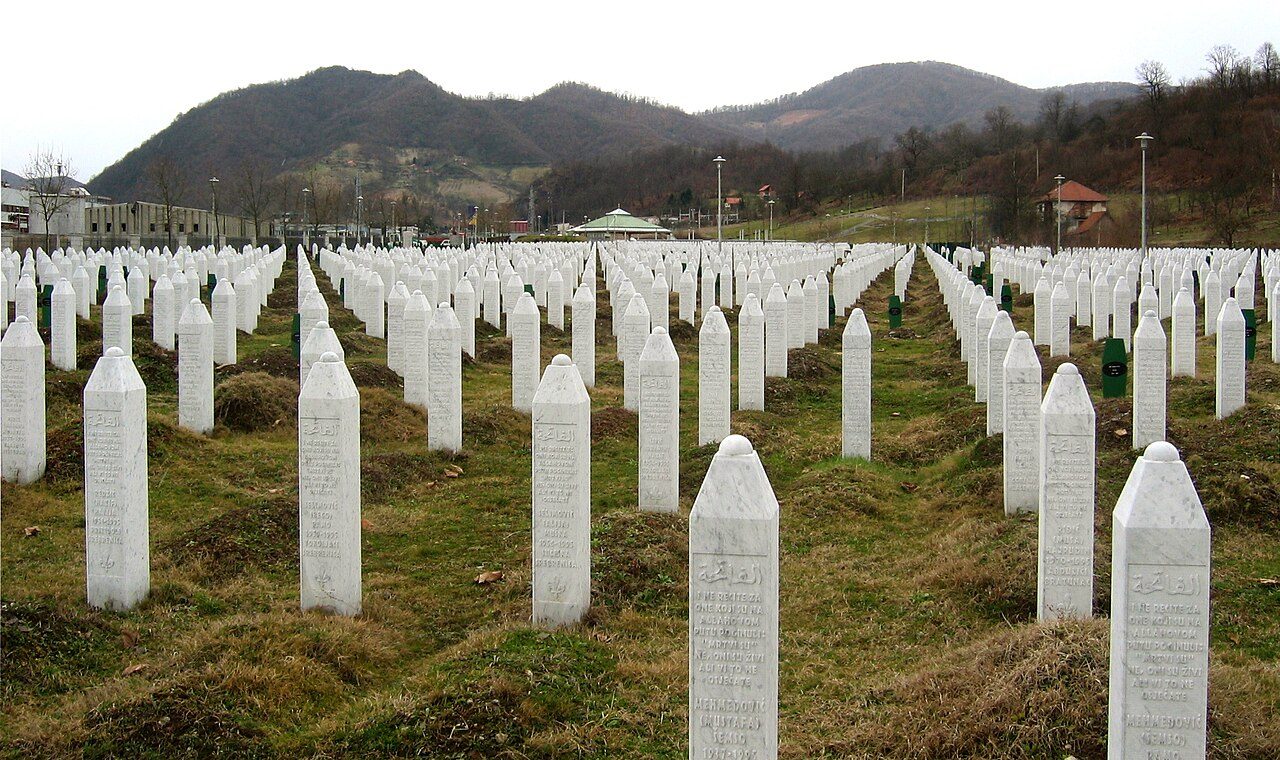
The Potočari memorial. Even as the dead are buried each 11 July, the genocide that killed them is officially denied a short distance away. Photo: Michael Büker · CC BY-SA 3.0 · via Wikimedia Commons

Denial as the Last Act

The scholar of genocide Gregory Stanton placed denial as the final stage of every genocide — "among the surest indicators of further genocidal massacres." In Bosnia, denial is not a fringe phenomenon but a feature of official policy in Republika Srpska and a recurrent theme in Serbian politics. Three decades after the events documented across this site, the contest is no longer over what happened — the judicial and forensic record is overwhelming — but over whether it may be named, mourned, and remembered.

The Forms of Denial

Outright denial

The flat assertion that the Srebrenica genocide did not occur, or that the courts that established it are biased. A 2018–2019 Republika Srpska commission, convened expressly to revisit the events, dismissed the findings of the ICTY and the ICJ.

Minimization

The reduction of the death toll, the recasting of victims as combatants, or the framing of mass killing as the regrettable excess of war. The careful demographic work of the courts and the Research and Documentation Center — a name-by-name accounting of the dead — was built precisely to make such minimization impossible.

Inversion and false equivalence

The presentation of the genocide as a "civil war" in which all sides suffered equally, erasing the asymmetry that the documentary record establishes — that the campaign against the Bosniaks was systematic and, at Srebrenica, genocidal. This is why this site documents crimes by all parties while insisting that equivalence is itself a form of distortion.

Glorification

The honouring of convicted war criminals as heroes — murals of Ratko Mladić, student dormitories and streets named for perpetrators, official commemorations — which transforms denial from passive omission into active celebration.
The War Over Memory

Denial operates on the landscape itself. At Višegrad, local authorities ordered the word "genocide" removed from a memorial inscription at the Stražište cemetery. Across Republika Srpska, the mosques and graveyards destroyed during the war — the markers of centuries of Bosniak presence — have in many places not been rebuilt, completing the erasure the cleansing began. Survivors who return to "cleansed" municipalities to mark anniversaries are sometimes met with hostility or official obstruction.

Against this, memory has its own instruments. The Potočari Memorial Center buries the identified dead each 11 July. The "Sarajevo Red Line" of 11,541 empty chairs laid along the city's main street in 2012 made the toll of the siege visible. The reconstruction of the Ferhadija, the Old Bridge, and the Aladža mosque are acts of counter-erasure. And in 2024 the UN General Assembly designated 11 July as an international day of commemoration — a resolution that Serbia and Republika Srpska campaigned against, demonstrating that the politics of memory remains live at the highest levels.

Scholarly Analysis

Why denial is dangerous, not merely offensive

Denial is not only an injury to survivors; it is, in the analysis of genocide scholars, a structural risk. By rehabilitating the perpetrators and their project, denial keeps alive the ideology that produced the violence and signals that such crimes carry no lasting cost. The honouring of convicted criminals in the entity their crimes created is not a closing of the past but a holding-open of its possibilities.

The role of the documentary record

This is why documentation — the patient assembly of adjudicated facts, casualty figures, named perpetrators, and sources — is itself a form of prevention. The purpose of a project like this one is not only to honour the dead but to build a record so detailed and so anchored in evidence that denial cannot proceed unchallenged. Against the erasure that the genocide intended, the answer is to remember in specifics: place by place, name by name.

Sources and References

UN, "About the 1995 Genocide in Srebrenica" and the 2024 General Assembly resolution on the International Day of Commemoration. Available at: un.org — Srebrenica commemoration

Gregory H. Stanton, "The Ten Stages of Genocide," Genocide Watch.

Research and Documentation Center (IDC/RDC), Sarajevo — the Bosnian Book of the Dead, the name-by-name census of war deaths.

See also the related entries on Srebrenica and Višegrad, and the record of justice.