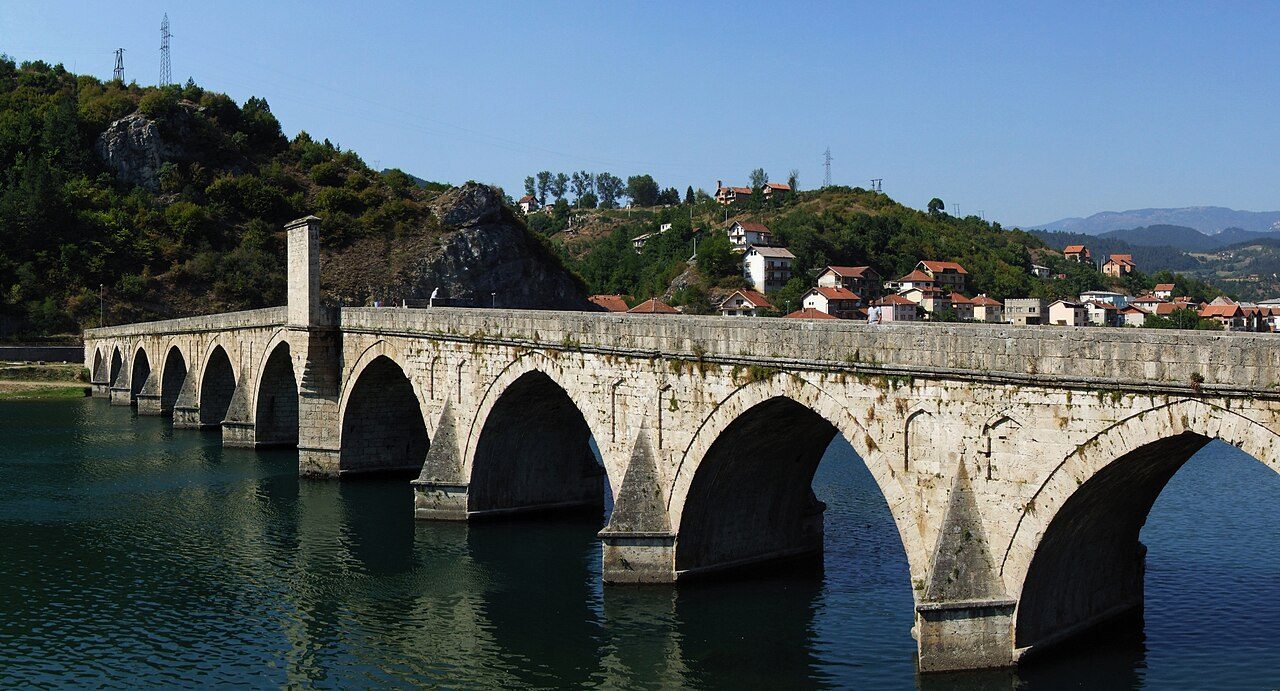
The Mehmed Paša Sokolović Bridge over the Drina river at Višegrad
The Mehmed Paša Sokolović Bridge over the Drina at Višegrad (completed 1577). In 1992 Bosniak civilians were murdered on the bridge and thrown into the river below. Photo: Pudelek (Marcin Szala) · CC BY-SA 3.0 · via Wikimedia Commons

At a glance

Location
Višegrad, eastern Bosnia (Drina valley)
Period
April 1992 onward (the house fires, June 1992)
Perpetrators
Local Serb forces and the paramilitary group of Milan and Sredoje Lukić
Victims
Bosniak civilians — men, women and children
Killed
~3,000 Bosniak civilians (ICTY est., incl. ~600 women, 119 children); Milan Lukić convicted for ≥132; 300+ remains recovered from Lake Perućac (2010)
Key sites
Mehmed Paša Sokolović Bridge; Pionirska Street fire (~59); Bikavac fire (~60–70)
Legal status
Crimes against humanity and war crimes
Key cases
Milan & Sredoje Lukić; Vasiljević

Summary

Višegrad, immortalized in Ivo Andrić's novel The Bridge on the Drina, became in 1992 the scene of one of the war's most ferocious campaigns of extermination against its Bosniak inhabitants. After the town was seized in April 1992, local Serb forces and a paramilitary group led by the cousins Milan and Sredoje Lukić conducted months of killings, rapes, and expulsions. Victims were murdered on the Ottoman-era Mehmed Paša Sokolović Bridge and thrown into the Drina; others were burned alive in houses deliberately set ablaze. By the war's end Višegrad's Bosniak community, roughly two-thirds of the pre-war population, had been almost entirely destroyed or driven out.

The Bridge and the Fires

Through the spring and summer of 1992, the bridge over the Drina became a killing site. Day after day, the ICTY found, Bosniak civilians — men, women, and children — were brought to the bridge and the riverbank, shot, and thrown into the water; the Drina carried so many bodies downstream that staff at a hydroelectric dam downriver had to clear corpses from the reservoir.

Two atrocities in particular came to define Višegrad:

  • The Pionirska Street fire (14 June 1992) — some 70 Bosniaks, many from the village of Koritnik, were herded into a house on Pionirska Street. A device was thrown in and the house was set alight; those who tried to flee were shot. Around 59 people were killed, with only a handful surviving.
  • The Bikavac fire (late June 1992) — a still larger group, perhaps 60 to 70 Bosniaks, was forced into a house in the Bikavac district, the exits barricaded, and the building burned. There were almost no survivors.

The witness Zehra Turjačanin, who survived the Bikavac fire with catastrophic burns, gave testimony that proved central to the later convictions.

Counting the Dead

According to figures cited at the ICTY, around 3,000 Bosniak civilians were killed in Višegrad during the war, including some 600 women and 119 children. Milan Lukić was found responsible for the deaths of at least 132 named victims, but the courts and historians regard the true toll as far higher, much of it never individually documented because bodies were carried away by the Drina. When the waters of the Perućac reservoir downstream were lowered for dam maintenance in the summer of 2010, the remains of more than 300 victims were recovered from the riverbed and banks — a grim, belated confirmation of the bridge killings.

The Legal Reckoning

  • Prosecutor v. Milan Lukić and Sredoje Lukić (IT-98-32/1, judgment 2009) — Milan Lukić was sentenced to life imprisonment for crimes against humanity and war crimes, including the Pionirska Street and Bikavac fires and numerous murders; the Trial Chamber described the fires as exemplifying "the worst acts of inhumanity that one person may inflict upon others." Sredoje Lukić received a long prison term.
  • Prosecutor v. Mitar Vasiljević (IT-98-32) — a member of the Lukić group was convicted for his role in the killing of Bosniak men on the bank of the Drina (the Drina River incident).

Scholarly Analysis

The face-to-face atrocity

If Srebrenica represents industrialized killing — the assembly-line transport and execution of thousands — Višegrad represents its opposite pole: intimate, performative, and local. The perpetrators knew their victims; they killed neighbours on the bridge their families had crossed for generations. The deliberate use of fire, the choice of public landmarks, and the months-long duration of the terror mark Višegrad as a campaign meant to be witnessed — designed to brand the landscape itself with the message that Bosniak life there was over.

The Drina as accomplice and archive

The river is central to Višegrad's meaning. It served the perpetrators as a means of disposal that would erase the evidence of their crimes; and yet, decades later, the lowering of the Perućac reservoir returned the dead to the surface. The river thus became both the instrument of concealment and, finally, an archive of the atrocity — a reminder that the effort to make mass killing disappear is rarely wholly successful.

Memory and denial

Višegrad today lies within Republika Srpska, and the commemoration of its victims has been a site of ongoing conflict: a memorial inscription at the Stražište cemetery using the word "genocide" was ordered removed by local authorities. The town stands as a case study in how, after the killing ends, the contest shifts to the terrain of memory — who may mourn, in what words, and in whose presence.

The Sole Survivor of Bikavac

The Bikavac fire of late June 1992 had only one survivor: Zehra Turjačanin, who escaped the burning house with catastrophic burns and later testified before the ICTY. She recalled that there were many children inside, the youngest less than a year old. "The people inside were burning alive," she told the court. "They were wailing, screaming." Outside, she saw the armed men lying in the grass nearby, seemingly intoxicated, "playing music very, very loud so no one could hear the sound of the burning people screaming inside," before they ran off. Her testimony was central to the conviction of Milan Lukić, sentenced to life imprisonment.

Source: "Bikavac fire," Wikipedia; Prosecutor v. Milan Lukić and Sredoje Lukić (IT-98-32/1).

Sources and References

"Višegrad massacres," Wikipedia (overview, casualty figures, Perućac recoveries). Available at: en.wikipedia.org/wiki/Višegrad_massacres

"Pionirska Street fire," Wikipedia. Available at: https://en.wikipedia.org/wiki/Pionirska_Street_fire

Institute for War and Peace Reporting, "Visegrad: On the Trail of Vasiljevic." Available at: iwpr.net/global-voices/visegrad-trail-vasiljevic

Al Jazeera, "Višegrad's rape camps: Denial and erasure" (2020). Available at: aljazeera.com — Višegrad's rape camps

See also the ICTY judgments in Prosecutor v. Milan Lukić and Sredoje Lukić (IT-98-32/1) and Prosecutor v. Vasiljević (IT-98-32), accessible through the IRMCT case archive.