← The Bosnian Genocide / Herzegovina · Croat–Bosniak war
HVO cleansing in the Rama valley — the Lapsunj massacre, the expulsions of 1993, and the human shields of Makljen
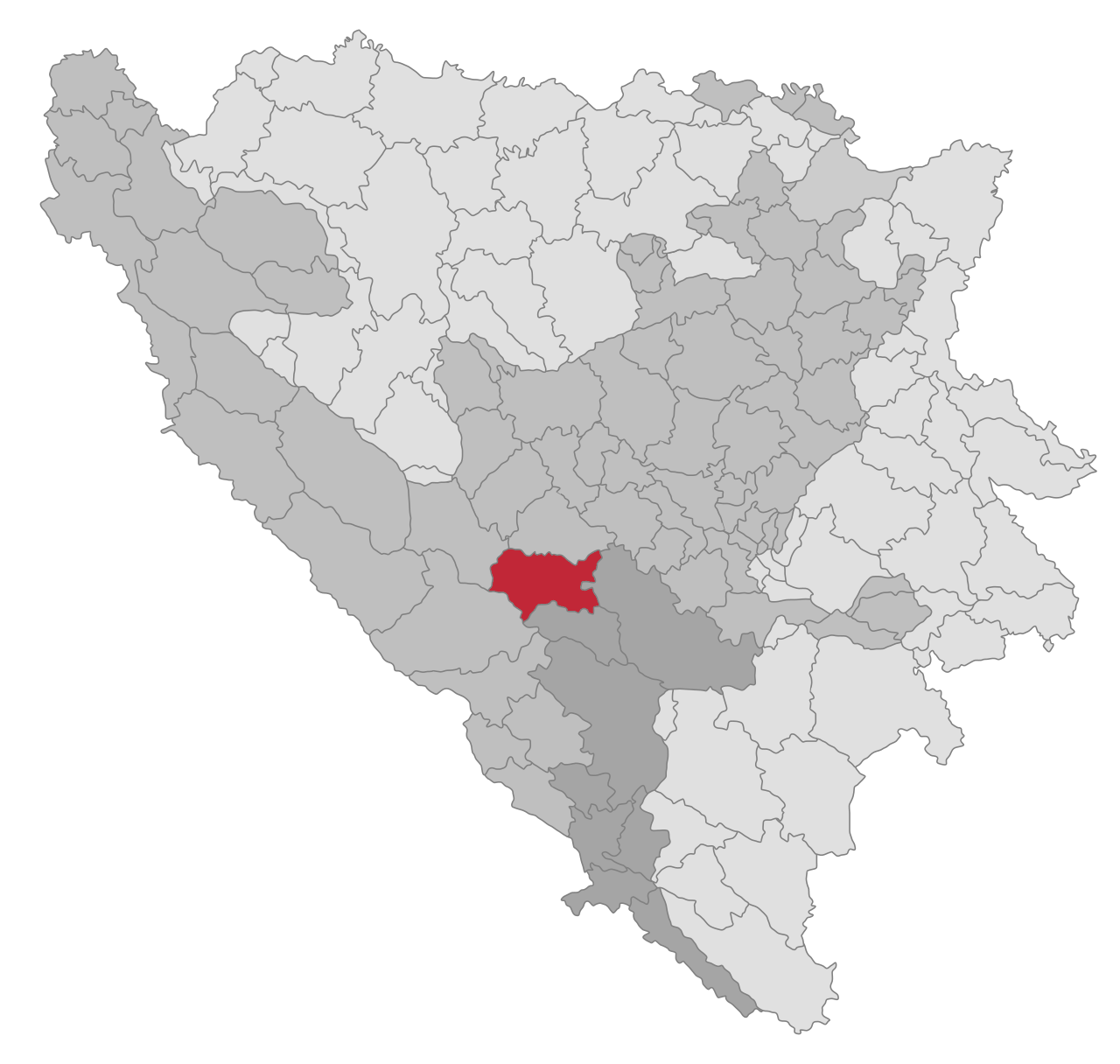
Prozor, in the Rama valley of northern Herzegovina, was an early and persistent target of the HVO's campaign against the Bosniaks during the Croat–Bosniak war. The town was attacked in October 1992 — shelled with tanks and artillery, the Bosniak quarters hit by more than a thousand projectiles — and over the course of 1993 its Bosniak population was almost entirely expelled. The campaign was punctuated by massacres, mass detention, and the use of prisoners as human shields.
The first large massacre came early: at Lapsunj on 23 August 1992, HVO forces killed 21 Bosniak civilians. After the HVO's victory in the Battle of Prozor that October, the Bosniak population of the municipality was progressively driven out. During 1993 the expulsion became near-total: around a thousand military-age Bosniak men were taken to detention camps in Prozor and western Herzegovina, and on 28 August 1993 the remaining civilians were loaded onto trucks and expelled through the village of Kučani.
One episode captures the character of the campaign. On 31 July 1993, members of the HVO "Rama" brigade military police took more than fifty detainees from the camp in the Prozor Secondary School Centre to Crni Vrh on Makljen and forced them to serve as human shields against ARBiH positions. A group of 26 managed to flee to government-held territory; the rest were shot from behind by the HVO.
The crimes in Prozor and the Rama valley were charged as part of the systematic Herzeg-Bosnia campaign in the ICTY case Prosecutor v. Prlić et al. (IT-04-74), in which six HVO and Herzeg-Bosnia leaders were convicted of crimes against humanity and the existence of a joint criminal enterprise to ethnically engineer a Croat-dominated territory. Individual perpetrators of the Prozor crimes have also been prosecuted before the courts of Bosnia and Herzegovina.
Prozor demonstrates that the methods catalogued elsewhere on this site under Serb perpetration — the shelling of civilian quarters, the camp, the human shield, the mass expulsion — were reproduced in full by the HVO against the Bosniaks of Herzegovina. The human-shield killing at Makljen is the near-exact analogue of the crimes at Doboj and Vogošća. This convergence of method across perpetrators is one of the most significant analytical findings of the war's geography: ethnic cleansing had a common grammar, deployed by whichever force pursued an ethnically pure territory.
To document Prozor with the same rigour applied to Prijedor or Foča is a matter of method. The Genocide Institute holds that the gravity of a crime is measured by what was done to its victims, not by the identity of the perpetrator. The Bosniaks of the Rama valley were expelled, detained, and murdered in a planned campaign; that this was carried out by Croat rather than Serb forces changes the chapter of the war to which it belongs, but not its character as a crime against humanity.
On 31 July 1993 the military police of the HVO's "Rama" brigade took more than fifty Bosniak prisoners from the camp at the Prozor secondary school to Crni Vrh on Makljen, tied them together with wire, and drove them ahead of the line as human shields against the Bosnian army. About twenty-six broke free and reached government-held territory; the rest were shot from behind. The bodies of twenty-three of them were exhumed from a secondary mass grave at Lapsunj in 1998. Each year survivors and families hike to Crni Vrh in their memory.
Sources: "Battle of Prozor (1992)," Wikipedia; Sarajevo Times — Hike to Crni Vrh.
"Battle of Prozor (1992)," Wikipedia. Available at: en.wikipedia.org/wiki/Battle_of_Prozor_(1992)
"Croat–Bosniak War," Wikipedia (Prozor and the Rama valley campaign). Available at: en.wikipedia.org/wiki/Croat–Bosniak_War
See also the ICTY judgment in Prosecutor v. Prlić et al. (IT-04-74), accessible through the IRMCT case archive, and the related entries on Mostar and Ahmići.