← The Bosnian Genocide / Eastern Bosnia · the upper Drina
The cleansing of the far southeastern corner — the Mostina hunting lodge, the killings of Rudo, and another community erased
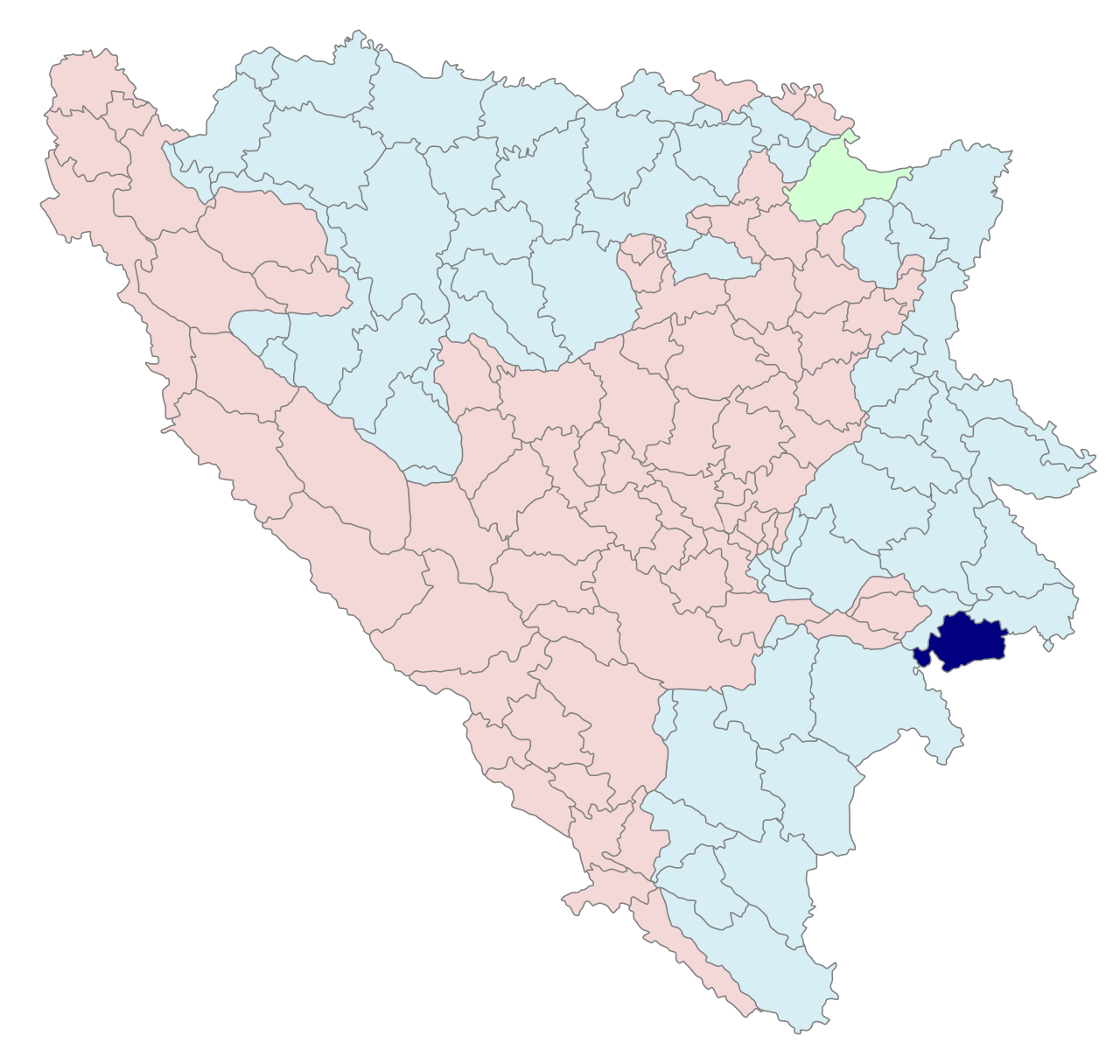
In the far southeastern corner of Bosnia, where the country meets Serbia and Montenegro along the upper Drina, the small Bosniak communities of Čajniče and Rudo were destroyed in 1992. As in neighbouring Foča, Višegrad, and Kalinovik, Serb forces detained, killed, and expelled the Bosniak population and demolished its mosques. Crimes in Rudo, Čajniče, and Kalinovik centred on detention sites including the "Mostina" hunting lodge, the police station in Čajniče, and local schools. Around a hundred people were killed in the Rudo municipality, and the cleansing of Bosniaks from both Rudo and Čajniče was carried out in full.
The pattern in Čajniče and Rudo followed the now-familiar template of the Podrinje: the seizure of the municipalities in the spring of 1992, the rounding-up of Bosniak men into improvised camps — here a hunting lodge and a police station — the killing of detainees, and the expulsion of the remaining population across the lines or out of the country. The destruction of mosques, including Čajniče's historic Ottoman heritage, accompanied the removal of the people, completing the erasure. These were small communities, and their annihilation produced no single famous massacre; they were nonetheless "cleansed" as thoroughly as any place in Bosnia.
Čajniče and Rudo are the last pieces in the geography of the eastern-Bosnian cleansing. Together with Foča, Višegrad, Rogatica, Kalinovik, Vlasenica, Zvornik, Bratunac, and Srebrenica, they complete a continuous belt of "cleansed" territory running the length of the Drina — precisely the contiguous, ethnically homogeneous corridor along the Serbian border that the campaign was designed to create. Seen on a map, the individual municipalities resolve into a single deliberate design. This is why even the smallest of them must be documented: each is a tile in a mosaic whose overall picture is the strategic objective of the genocide.
Čajniče and Rudo belong to the great wave of expulsions of April–August 1992, during which, by one accounting, some 70 percent of all the war's displacements occurred as Serb forces attacked dozens of municipalities and drove out their non-Serb inhabitants. The speed and breadth of this assault — an entire region transformed in a single summer — is itself evidence of coordination and intent, and the quiet erasure of communities like these is the granular reality beneath the statistic.
At the Mostina hunting lodge near Čajniče, Bosniak civilians — seized in the town and its villages, or on the road toward Pljevlja in Montenegro as they tried to flee — were killed through 1992; forty-two died there. The largest of seven mass graves at Mostina gave up eighteen bodies in September 2002, and sixty victims in all have been exhumed from the site; the youngest was nineteen-year-old Zlatko Bukva. Sulejman Homoraš, himself imprisoned at Mostina and taken out by a Serb the day before an execution, still searches for his uncle and brother-in-law: "I was only 24 hours away from death. As long as I live, I will come here to keep the memory of the people who were killed." Of 138 people reported missing from Čajniče, around 90 have been found; some 48 remain unaccounted for.
Sources: Sarajevo Times — the Mostina crime near Čajniče; CDTP — War Crimes in Čajniče.
Institute for the Research of Crimes Against Humanity (Sarajevo), "The schools in Podrinje were death camps." Available at: iziz.unsa.ba — schools in Podrinje
"Ethnic cleansing in the Bosnian War," Wikipedia (Rudo, Čajniče, and the April–August 1992 wave). Available at: en.wikipedia.org/wiki/Ethnic_cleansing_in_the_Bosnian_War
See also the related entries on Foča, Višegrad, and Kalinovik.