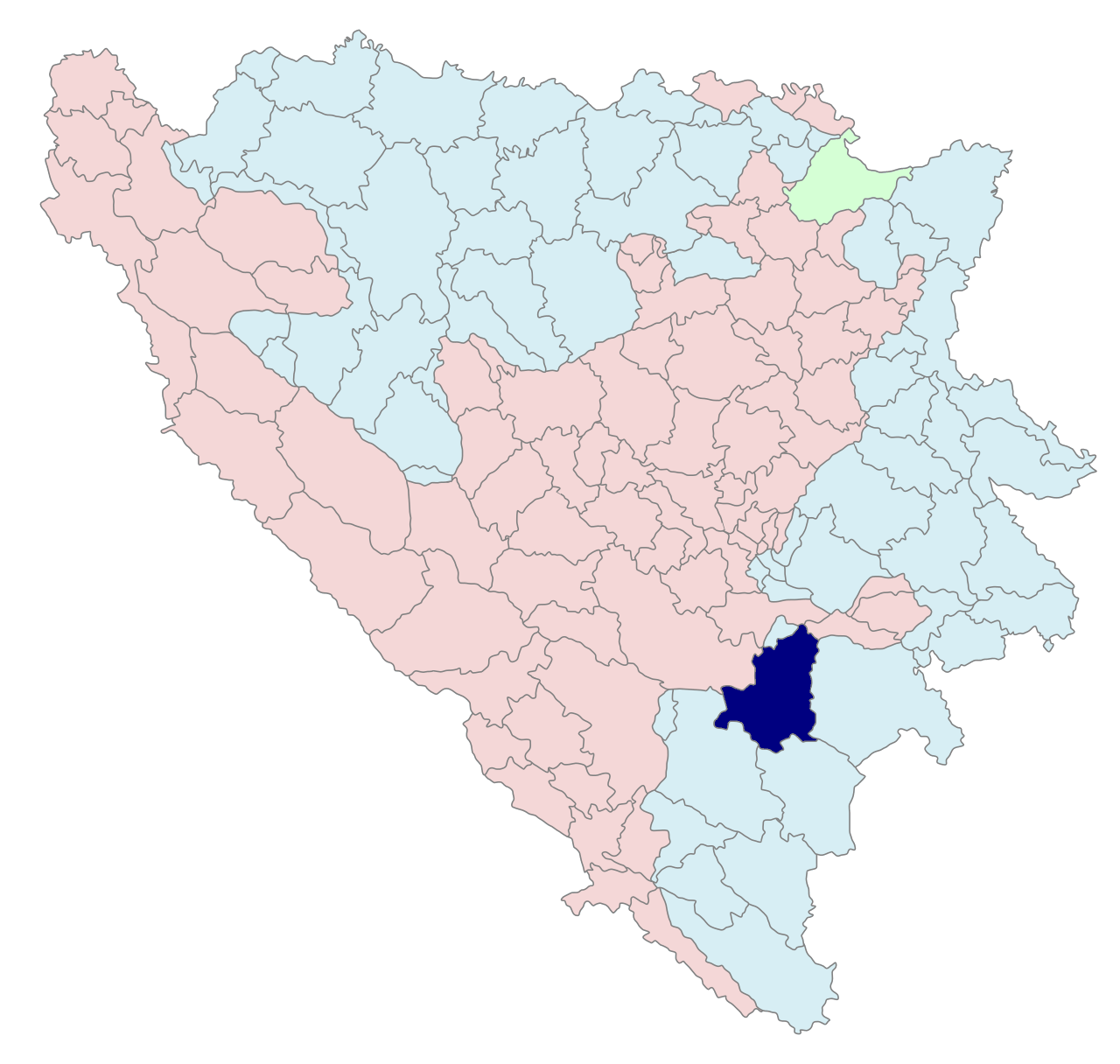
← The Bosnian Genocide / Southeastern Bosnia
The cleansing of a highland municipality — the school, the Barutni Magacin camp, and the burning of the dead
Kalinovik, a small, high-lying municipality in southeastern Bosnia near Foča, was cleansed of its Bosniak population during 1992. After the Serb takeover, Bosniaks were driven from their homes and detained, and a substantial number were murdered. Two detention sites dominate the record: the town's primary school, through which more than a thousand women, children, and men were "processed," and the Barutni Magacin, a former ammunition depot used to hold men. The killings at Kalinovik were marked by a recurring, deliberate cruelty — the burning of the bodies of executed prisoners.
At the Kalinovik primary school, used as a detention centre for Bosniaks and other non-Serbs, at least 14 people were killed and some 30 women were raped, humiliated, and tortured. At the Barutni Magacin camp, 87 men were killed. The violence culminated in two mass executions whose perpetrators sought to destroy the evidence by fire: on 5 August 1992, 23 Muslim civilians were taken from the Barutni Magacin and shot by firing squad in the village of Tarine, their bodies then burned in a shed; and at a barn known as Tuzlaka in the village of Ratina, 25 men were executed and likewise set alight. According to the Research and Documentation Center, 117 Bosniak civilians — 89 men and 28 women — were murdered in Kalinovik. Many of the municipality's Bosniaks were also transferred to the notorious KP Dom prison in Foča.
The crimes in Kalinovik were prosecuted before the War Crimes Chamber of the Court of Bosnia and Herzegovina. On 21 December 2009, Ratko Bundalo, commander of the VRS Tactical Group in Kalinovik, was found guilty of the persecution, murder, detention, and torture of Muslims between April 1992 and March 1993, and sentenced to 19 years' imprisonment. Đordjislav Aškraba, named as director of the Barutni Magacin detention camp, was acquitted for lack of evidence — an outcome that underscores how difficult individual proof can be even where the broader crime is firmly established.
The repeated burning of the dead at Kalinovik — at Tarine and at Ratina — is more than incidental brutality. The destruction of bodies by fire is an attempt to erase the victim twice over: first to take the life, and then to deny the remains, the grave, and the proof. For the families it compounds loss with the agony of the unrecovered; for the historian it is a deliberate attack on the evidentiary record. The persistence, three decades on, of the "missing" from Kalinovik — bodies never found because they were burned — is the lasting wound of this method.
The transfer of Kalinovik's Bosniaks to the KP Dom in neighbouring Foča situates this small municipality within the larger machinery of the southeastern campaign. Kalinovik did not operate in isolation; it was a node in a regional network of detention and killing that linked the highland villages to the larger centres. This interconnection — victims moved between municipalities, perpetrators operating across boundaries — is itself evidence of coordination, and it is why the documentation of even the smallest places is essential to understanding the whole.
On 5 August 1992, twenty-three Muslim civilians were taken from the Barutni Magacin camp, shot by firing squad in the village of Tarine, and their bodies set alight in a shed; only one man escaped the flames alive. Three days earlier, eight detainees had been tied and taken away, their mutilated bodies later found on Mount Rogoj; at a barn in Ratina, twenty-five more were executed and burned. The witness Zlatka Hadžić told the court that her husband was taken to the Miladin Radojević school on 25 June and then, one evening, "they drove the men from the school building to Barutni Magacin by trucks." Families in Kalinovik still search for forty-two of the missing — and still campaign for the removal of a mural to Ratko Mladić in their town.
Sources: Mirza Hota — War crimes in Kalinovik; Court of Bosnia and Herzegovina, Prosecutor v. Bundalo et al.
"Kalinovik," Wikipedia (wartime ethnic cleansing). Available at: https://en.wikipedia.org/wiki/Kalinovik
Sarajevo Times, "The 31st Anniversary of War Crimes in Kalinovik." Available at: sarajevotimes.com — War Crimes in Kalinovik
Mirza Hota, "War crimes in Kalinovik." Available at: medium.com — War crimes in Kalinovik
See also the Court of Bosnia and Herzegovina judgment in Prosecutor v. Bundalo et al. and the related entry on Foča.