← The Bosnian Genocide / Bosanska Krajina
A town divided across the Una, and the torture rooms of the Petar Kočić school
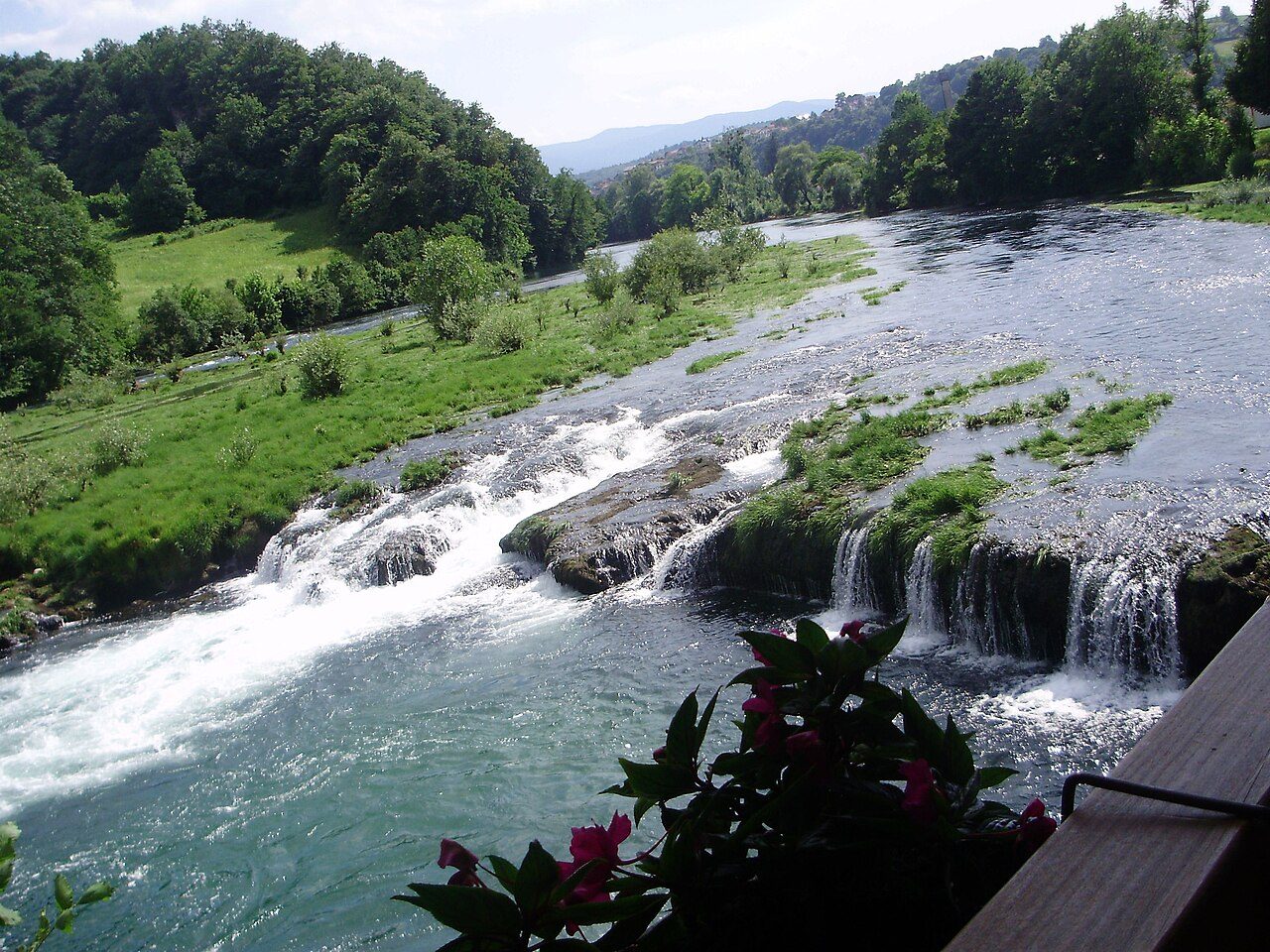
Bosanska Krupa, a Bosniak-majority town straddling the Una river in the far northwest, was split by the front line in 1992: the Serb-held bank was "cleansed" of its Bosniak inhabitants, while the population regrouped on the government-held side. As part of the systematic clearing of the central and western Bosanska Krajina between May and July 1992, Bosniak civilians were killed, expelled, and detained. The town's Petar Kočić school was among the many ordinary civic buildings of the Krajina converted into a place of torture.
At least fifty Bosnian Muslims were detained at the Petar Kočić school in the suburbs of Bosanska Krupa. The conditions documented there are among the most brutal of the war's smaller camps: detainees suffered beatings, rape and sexual abuse, and, in one small room, torture by electric shock — wires from automobile batteries clipped to prisoners' fingers and toes. The detentions accompanied the broader campaign across the municipality, in which Bosniak villages including Arapuša and Jasenica were attacked and their populations driven out. The Petar Kočić school was one of an estimated 650-plus detention sites operated across Bosnia during the war — a measure of how completely the ordinary infrastructure of civic life was turned to the purpose of persecution.
There is a particular horror in the recurrence, across this catalogue, of the school as a site of atrocity — at Bosanska Krupa, at Rogatica, at Kalinovik, at Bratunac. The school is the civic institution most associated with a community's future, with children and continuity. Its conversion into a place where neighbours were tortured with car batteries inverts that meaning entirely, and it speaks to the totality of the campaign: not a single ordinary building was left to its ordinary use where it could serve the work of cleansing. The schoolhouse-as-camp is, in miniature, the whole logic of a society turned against a part of itself.
Bosanska Krupa's division along the Una also illustrates how the war fractured communities at the most intimate, physical level. A single town became two: a "cleansed" Serb-held bank and a crowded government-held remnant, the river between them a front line. The reunification of such places after the war — the return, partial and contested, of expelled populations — remains one of the unfinished tasks of the peace.
"1992 ethnic cleansing of central Bosanska Krajina," Wikipedia. Available at: en.wikipedia.org — central Bosanska Krajina
Balkan Diskurs, "Understanding the Legacy of Concentration Camps in BiH" (2024). Available at: balkandiskurs.com — camps in BiH
Hikmet Karcić, Torture, Humiliate, Kill: Inside the Bosnian Serb Camp System (University of Michigan Press, 2022).
See also the ICTY judgment in Prosecutor v. Brđanin (IT-99-36) and the related entry on the Bihać pocket.