← The Bosnian Genocide / Eastern Bosnia
The 1992 massacres at Glogova and the Vuk Karadžić school, and the municipality’s role as the staging ground for the Srebrenica genocide
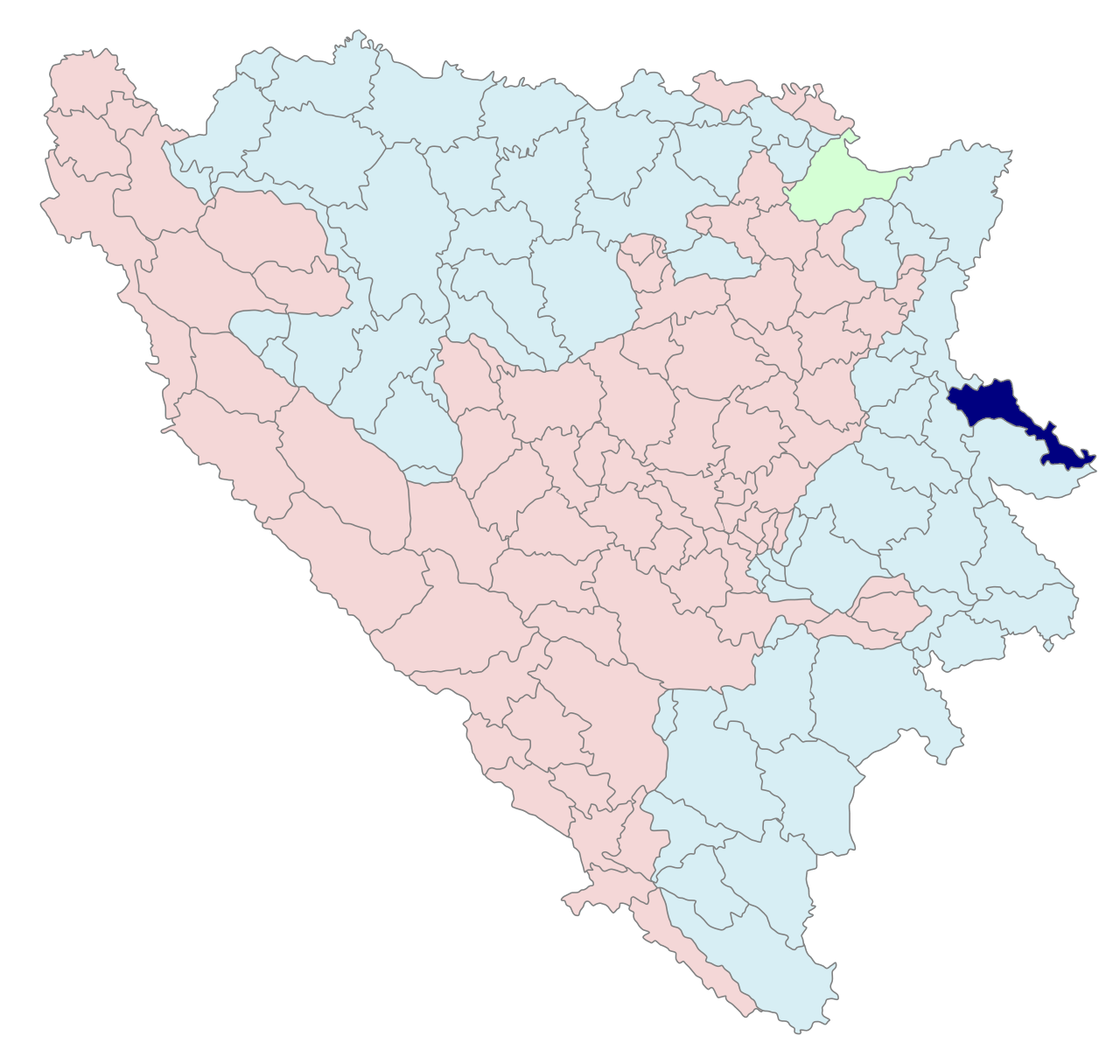
The municipality of Bratunac, immediately north of Srebrenica on the Drina, was twice a centre of mass killing. In the spring of 1992 it was among the first areas of eastern Bosnia to be "cleansed," with the destruction of Bosniak villages such as Glogova and the mass detention and killing of men at the Vuk Karadžić school in the town. Three years later, in July 1995, Bratunac served as the logistical hub of the Srebrenica genocide: it was through Bratunac that the captured men were processed, and several of the principal execution sites — above all the warehouse at Kravica — lie within its boundaries.
Bratunac therefore binds together the two ends of the eastern-Bosnian catastrophe. To study it is to see that 1992 and 1995 were not separate events but the opening and closing movements of a single campaign.
On 9 May 1992, Serb forces — the JNA, the Bratunac Territorial Defence, local police, and paramilitaries from Serbia — attacked the unarmed village of Glogova. Villagers were rounded up at the centre; groups of men were marched to the river and executed, and others forced to carry the bodies before themselves being killed. Around 64 Bosniak civilians were murdered, and the village mosque and houses were destroyed. The operation was ordered by Miroslav Deronjić, head of the SDS-established Bratunac municipal board.
In Bratunac town, hundreds of Bosniak men detained at the Vuk Karadžić primary school and adjacent buildings in May 1992 were beaten and killed over several days — a massacre whose scale (estimates run to several hundred) has only recently been fully documented. These killings were part of the broader destruction across the Srebrenica region in which, according to Bosniak documentation, some 296 villages were razed, around 70,000 Bosniaks were uprooted, and at least 3,166 people were killed in the first three months of the war — the demographic groundwork that swelled the Srebrenica enclave.
When Srebrenica fell on 11 July 1995, Bratunac became the funnel through which the killing was organized. Captured men were held overnight in Bratunac — in the Vuk Karadžić school again, in warehouses, and on buses — before being transported to execution sites. On 13 July, more than a thousand men were murdered in the agricultural warehouse at Kravica, in Bratunac municipality, with automatic weapons and grenades. Bratunac was thus not merely adjacent to the genocide but constitutive of it.
Bratunac is the strongest single piece of evidence for what scholars call the "continuity thesis" — the argument that the genocidal logic recognized by the courts at Srebrenica in 1995 was already operative in the 1992 campaign. The same town, the same school building, and in some cases the same perpetrators appear at both ends of the war. The 1992 killings emptied the countryside and drove its survivors into Srebrenica; the 1995 killings completed the destruction of that concentrated remnant. The legal decision to classify only the 1995 events as genocide, while historically defensible on the question of provable intent, can obscure this underlying unity.
Bratunac also illustrates that genocide is a logistical achievement. The processing of prisoners, the provision of buses and fuel, the selection of warehouses and football fields as killing sites — these required the cooperation of a brigade, a municipality, and a police apparatus. The convictions of brigade officers and municipal officials reflect a crucial principle: those who organize the machinery of mass killing bear responsibility alongside those who pull the triggers.
Survivors remember the Vuk Karadžić school as a slaughterhouse. The Association of Surviving Detainees estimates that around 800 Bosniak men were held there over three days in May 1992, of whom some 300 were killed. Sakib Ahmetović, arrested on 10 May with his sons, described conditions so overcrowded and airless that ten people suffocated on the first day, after which the beatings and killings began. The prosecution witness Mirsad Karić testified that the prisoners were forced to clean human brains and blood from the floor. These were the "forgotten victims" of 1992 — killed three years before the town's name became inseparable from the Srebrenica killing fields.
Sources: Balkan Insight — "Forgotten Victims" (2020); Balkan Insight — the Vuk Karadžić school.
"Glogova massacre," Wikipedia. Available at: https://en.wikipedia.org/wiki/Glogova_massacre
Balkan Insight, "Forgotten Victims: 'Hundreds of Prisoners' Killed by Bosnian Serbs at School" (2020). Available at: balkaninsight.com — Forgotten Victims
Congress of Bosniaks of North America, "Prelude to the Srebrenica Genocide" (regional 1992 documentation). Available at: bosniak.org — Prelude to the Srebrenica Genocide
See also the ICTY judgments in Prosecutor v. Deronjić (IT-02-61), Prosecutor v. Blagojević & Jokić (IT-02-60), accessible through the IRMCT case archive, and the related entry on Srebrenica.