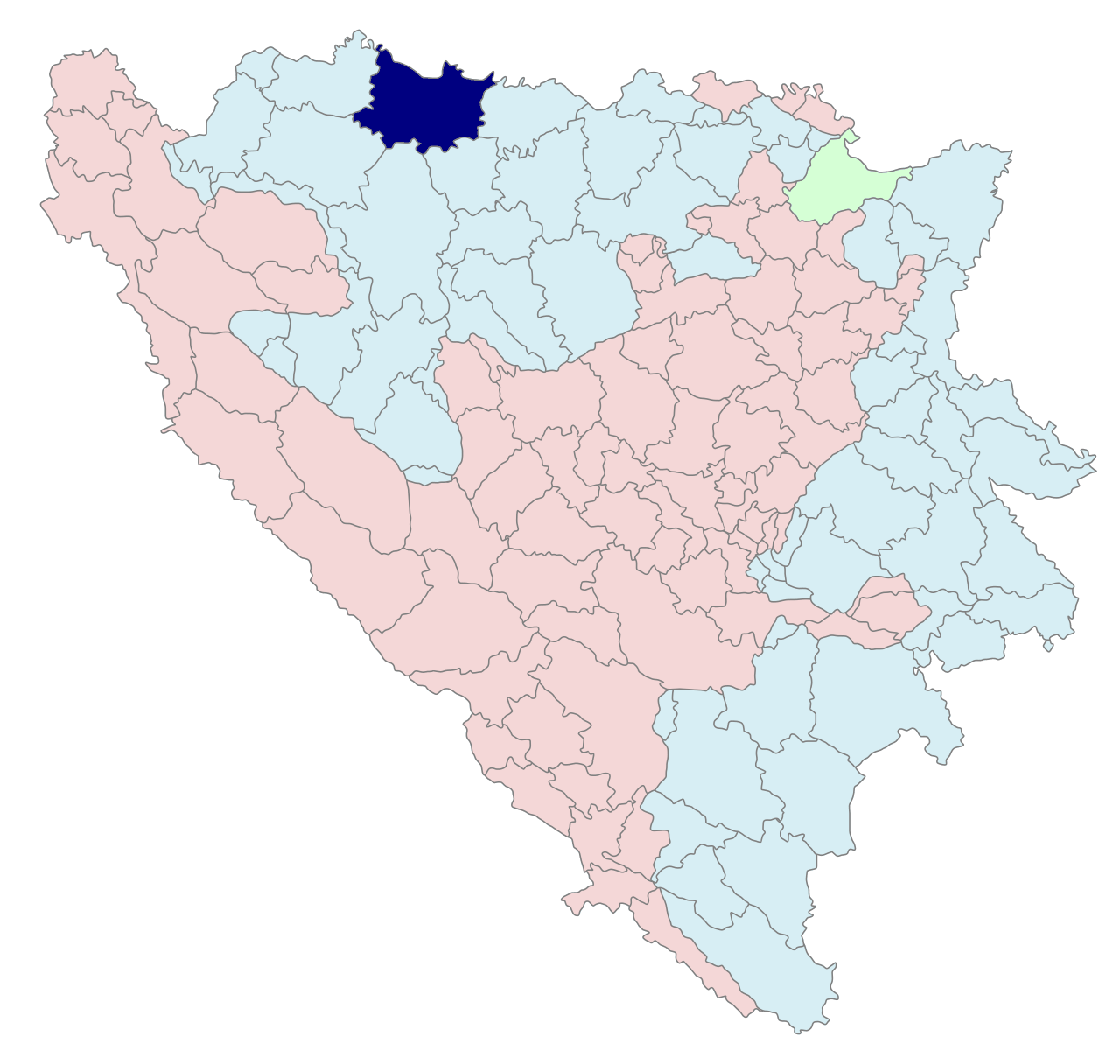
Location of Bosanska Gradiška (Gradiška) municipality within Bosnia and Herzegovina
Location of the Bosanska Gradiška (Gradiška) municipality on the Sava; neighbouring Kozarska Dubica lies just to the west. Map: Andrein · Public domain · via Wikimedia Commons

At a glance

Location
Bosanska Gradiška and Bosanska (Kozarska) Dubica, on the Sava in the northern Bosanska Krajina
Period
1992 (Gradiška shelled and taken 18 August 1992; detention April–December 1992)
Perpetrators
The VRS, Bosnian Serb police, and paramilitaries, within the ARK
Victims
Bosniak and Bosnian Croat civilians
Detention
In Gradiška, a camp at the Red Cross building; detentions of Muslims and Croats through 1992
Cross-border dimension
Authorities coordinated with Serb-held areas of Croatia to cleanse the border zone of non-Serbs
Legal status
Crimes against humanity, persecution (ARK campaign)

Summary

The municipalities of Bosanska Gradiška and Bosanska Dubica (today Kozarska Dubica) lie along the Sava, the river border with Croatia, in the northern Bosanska Krajina. Both were incorporated into the Serb-held Autonomous Region of Krajina and cleansed of their non-Serb populations in 1992. Bosanska Gradiška was shelled and taken in August 1992, and Bosniak and Croat civilians were detained — including at a camp established in the town's Red Cross building — before being expelled. The border position of these municipalities gave the cleansing a distinctive cross-river dimension.

The Sava Border

On 18 August 1992, Bosanska Gradiška was attacked with rocket launchers, artillery, and tanks; after hours of shelling its lightly armed defenders were overcome. Non-Serb civilians were apprehended and detained — a paramilitary group operating from the occupied Red Cross building, assisted by local police, held Muslims and Croats from April to December 1992 — before the population was driven out. Across the river in Serb-held Croatia, a parallel apparatus was at work, and UN documentation recorded that local authorities in the Serb-controlled zones of Croatia coordinated with their counterparts in northern Bosnia, including Bosanska Dubica, to render the border region ethnically homogeneous. The Sava, rather than dividing the two campaigns, became the axis of a single coordinated effort.

Scholarly Analysis

Cleansing as a transnational project

Gradiška and Dubica illustrate that the ethnic engineering of the early 1990s did not respect the borders of the republics. The coordination between Serb authorities in Bosnia and in occupied Croatia to clear the Sava corridor of non-Serbs reflects the underlying ambition of a contiguous Serb-controlled space spanning the former Yugoslav republics. For the study of the war, these border municipalities are evidence that the Bosnian genocide was one front of a larger project, linked across the Sava and the Drina to events in Croatia and to the direction emanating from Belgrade.

The instrumentalization of the Red Cross

The use of a Red Cross building as a detention camp at Gradiška carries a bitter symbolism. The emblem of the Red Cross is, in the laws of war, a universal sign of protection and neutral humanitarian aid. To convert such a building into a place of imprisonment inverts that meaning, much as the conversion of schools and hospitals did elsewhere — a small but telling instance of the campaign's systematic seizure of the institutions of civilized life and their turning to the ends of persecution.

The Camps of the Border Zone

After the shelling and capture of Bosanska Gradiška on 18 August 1992, the town's Muslims and Croats were detained through a network of improvised facilities. A paramilitary group operating from the occupied Red Cross building, assisted by the local police, held non-Serbs from April to December 1992; a second site, at the village school in Podgrace, held Muslims who were — survivors believed — dispatched onward to camps elsewhere in Bosnia. Across the Sava, UN monitors recorded that Serb authorities in occupied Croatia coordinated with their counterparts in northern Bosnia, Bosanska Dubica among them, to clear the border region of non-Serbs, reducing the area's population by roughly a third.

Sources: UN Commission of Experts, Annex VIII — Prison camps; Human Rights Watch, War Crimes in Bosnia-Hercegovina.

Sources and References

UN Commission of Experts (Bassiouni), Annex VIII: "Prison camps" (Bosanska Gradiška, Bosanska Dubica, and cross-border coordination). Available at: phdn.org — Annex VIII: Prison camps

"Bosanska Krajina," Wikipedia (regional overview). Available at: en.wikipedia.org/wiki/Bosanska_Krajina

See also the ICTY judgment in Prosecutor v. Brđanin (IT-99-36) and the related entries on Banja Luka and Prijedor.