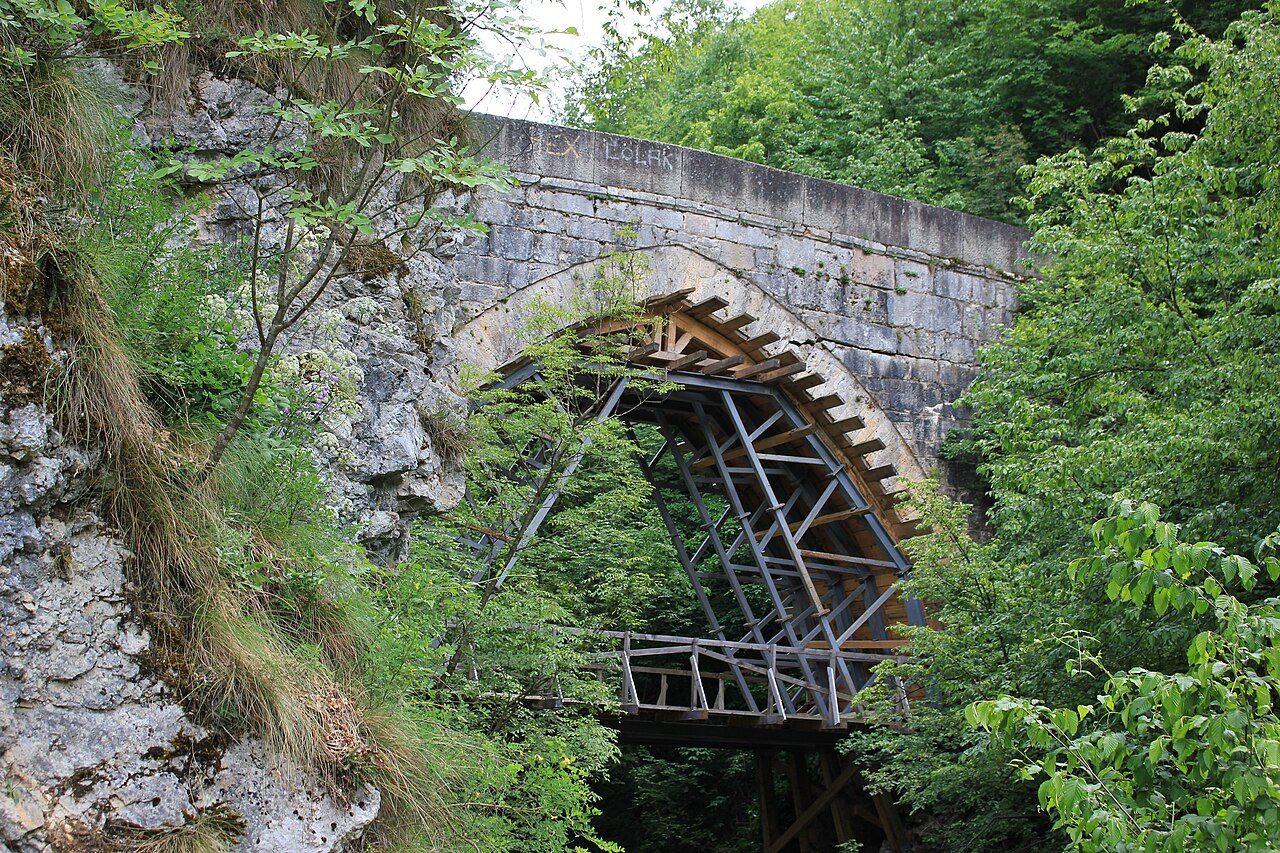
The Ottoman stone bridge over the Žepa river
The Ottoman stone bridge over the Žepa river near Žepa, the enclave that fell to the VRS days after Srebrenica in July 1995. Photo: Julian Nyča · CC BY-SA 3.0 · via Wikimedia Commons

At a glance

Location
Žepa, eastern Bosnia (Podrinje), south of Srebrenica
Period
Siege 1992–1995; the enclave fell on 25 July 1995
Perpetrators
Army of Republika Srpska (VRS), under Gen. Ratko Mladić
Victims
Bosniak civilians and defenders
Killed
~116 Bosniaks killed in connection with the takeover; the population was evacuated under negotiation
Notable crime
Commander Col. Avdo Palić abducted after the fall and murdered (remains identified 2009)
Legal status
War crimes / crimes against humanity (VRS leadership cases)

Summary

Žepa, a small, isolated Bosniak enclave in the mountains south of Srebrenica, was the third of the three eastern UN "safe areas." Days after Srebrenica fell, the VRS turned on Žepa, capturing it on 25 July 1995 after the three-year siege. Its fate diverged from Srebrenica's in one crucial respect: rather than a mass execution of the male population, the outcome at Žepa was a negotiated evacuation of the civilians, brokered under desperate circumstances by the local Bosniak leadership and the enclave's military commander, Colonel Avdo Palić. Some 116 Bosniaks were nonetheless killed, and a number of men were detained; many fighters fled toward Serbia, where they were interned.

The defining crime of Žepa was the fate of Palić himself: having negotiated with the VRS under a flag of truce, he was seized, "disappeared," and murdered.

The Fall and the Evacuation

When the VRS assault came, Žepa's defenders held out only briefly against overwhelming force. With no prospect of relief and the example of Srebrenica before them, the enclave's representatives negotiated the evacuation of the civilian population to government-held territory. The negotiations were conducted in the shadow of the killings then still underway around Srebrenica, and under the threat that Žepa would suffer the same. Buses removed the women, children, and elderly; able-bodied men, fearing capture, attempted to escape across the Drina into Serbia, where many were detained in camps.

Colonel Avdo Palić, who had led both the defence and the negotiations, was taken into VRS custody under circumstances that should have guaranteed his safety. He was never released. His remains were finally identified in 2009, confirming that he had been killed — one of the war's most pointed illustrations of the worthlessness of the perpetrators' guarantees.

Scholarly Analysis

Why Žepa was not a second Srebrenica

The comparison with Srebrenica is unavoidable and instructive. Both enclaves fell within a fortnight to the same army under the same commander. Yet Žepa did not become a second mass grave. The reasons are debated: the smaller population, the more defensible terrain that allowed an orderly negotiation, the timing (the world's attention was beginning to turn toward Srebrenica), and perhaps a calculation by the VRS that a second simultaneous massacre would be politically untenable. The divergence underscores how contingent the scale of atrocity can be — how much, in the moment, hinges on geography, timing, and the choices of individual perpetrators.

The murder of the negotiator

Palić's fate carries a meaning beyond his individual death. He was killed precisely while performing the role — protected interlocutor under a truce — that the laws of war are designed to safeguard. His murder signalled that for the VRS leadership no category of person, however protected in principle, was safe. For the study of genocide it is a reminder that the destruction of a community includes the targeted elimination of its leaders, the people around whom it might otherwise reconstitute itself.

The Fate of Avdo Palić

Colonel Avdo Palić commanded the Bosnian government forces in Žepa throughout the forty-month siege. On 27 July 1995, accompanied by UN peacekeepers, he went to negotiate the enclave's evacuation with Ratko Mladić — and was seized. He was last seen alive in a prison in Bijeljina that September. His fate then remained unknown for fourteen years: his remains, recovered in November 2001 from a mass grave near the village of Vragolovi in the Rogatica municipality, were positively identified by DNA only in July 2009 and buried that August. The crimes at Žepa formed part of the ICTY case against the VRS Main Staff security chief Zdravko Tolimir.

Sources: "Avdo Palić," Wikipedia; Balkan Insight — Remains of Bosnian War Hero Identified.

Sources and References

"Siege of Žepa," Wikipedia. Available at: en.wikipedia.org/wiki/Siege_of_Žepa

Humanitarian Law Center, "Fall of Žepa." Available at: hlc-rdc.org — Fall of Žepa

Balkan Insight, "The Fall of Zepa Showed Bosnian Serb Forces' Cruelty" (2020). Available at: balkaninsight.com — The Fall of Zepa

See also the entry on Srebrenica and the relevant portions of the ICTY judgments in Prosecutor v. Mladić (IT-09-92) and Prosecutor v. Karadžić (IT-95-5/18).