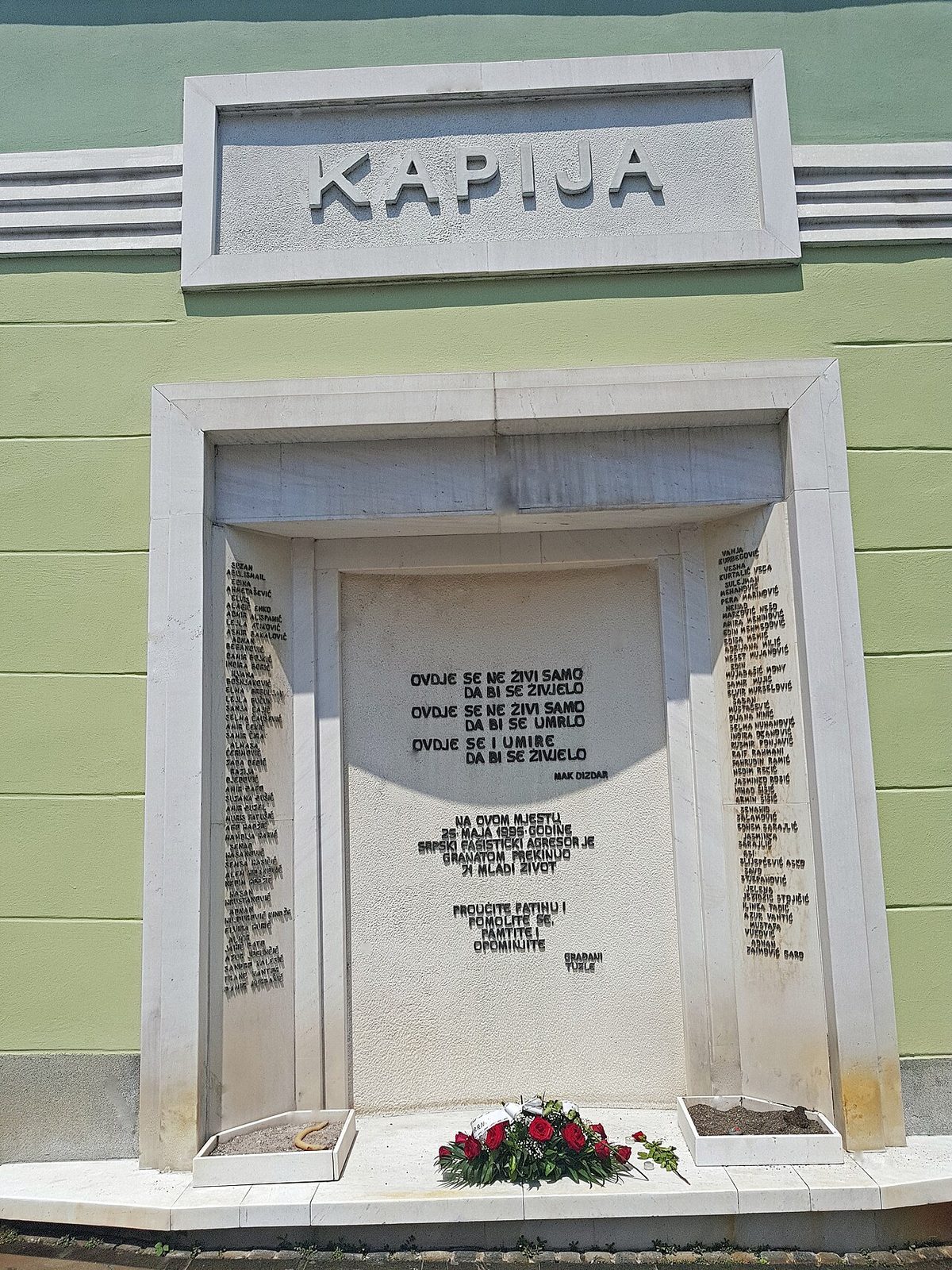
The Kapija memorial gate in Tuzla
The Kapija memorial in Tuzla, commemorating the 71 young people killed by a single VRS shell in the square on 25 May 1995. Photo: KalyEV · CC BY-SA 4.0 · via Wikimedia Commons

At a glance

Location
Kapija square, Tuzla, northeastern Bosnia
Date
25 May 1995, 20:55
Perpetrators
The VRS — a 130 mm shell fired from Tactical Group Ozren positions near Panjik, ~25 km away
Victims
Civilians, the great majority aged 18–25
Killed
71 killed; around 240 wounded
Commemoration
25 May is observed as a Day of Mourning in Bosnia and Herzegovina
Legal status
War crime against civilians
Key case
Novak Đukić (Court of BiH, 2009) — 25 years

Summary

Tuzla, the largest city in northeastern Bosnia, held a distinctive place in the war: it remained under Bosnian government control, retained its multi-ethnic character, and was governed by an administration that explicitly rejected ethnic division. It was also within range of VRS artillery on the surrounding heights. On the warm evening of 25 May 1995, with the city's young people gathered in cafés in the old town, a single high-explosive shell detonated in the crowded Kapija square. It killed 71 people — most of them between 18 and 25 years old — and wounded around 240. It was among the deadliest single attacks on civilians of the entire war.

A Single Shell

The projectile was one of a number of artillery rounds fired at Tuzla between 25 and 28 May 1995 from VRS positions near the village of Panjik on Mount Ozren. The Kapija round struck a square packed with young people enjoying the spring evening. The court that later examined the attack found that it had been deliberately directed at a civilian area with no military justification — an act of terror in the same mould as the shelling of Sarajevo. The victims, overwhelmingly the city's youth, were buried together; their average age made the massacre a particular symbol of futures destroyed.

The Legal Reckoning

Novak Đukić, commander of the VRS Tactical Group Ozren at the time of the attack, was arrested in 2007 and, on 12 June 2009, found guilty by the Court of Bosnia and Herzegovina of ordering the shelling. He was sentenced to 25 years' imprisonment. (The case saw subsequent procedural review of the ballistic evidence, but the massacre itself — its 71 dead and the trajectory of the shell from VRS-held territory — is among the most thoroughly documented attacks of the war.)

Scholarly Analysis

The targeting of coexistence

Tuzla's significance lies partly in what the city represented. Alone among Bosnia's major cities, it sustained throughout the war a functioning multi-ethnic civic identity and a local government committed to it. That a city embodying the alternative to ethnic separation should be shelled in its most public, youthful space is not incidental. The Bosnian genocide was, at its core, a war against the idea of a shared society; Tuzla, and the young of Kapija, stood for exactly that idea. The massacre can be read as an attack not only on bodies but on the proposition that Bosnians of different backgrounds might share a future.

Artillery and the diffusion of responsibility

Kapija also illustrates the peculiar moral and legal challenge of artillery atrocities. A shell fired from twenty-five kilometres away kills anonymously; there is no face-to-face perpetrator, no camp guard, only a firing order and a trajectory. Establishing responsibility requires ballistics, command records, and the reconstruction of a chain of decision. The conviction of a tactical-group commander for a single shell affirms a vital principle: that distance does not dilute culpability, and that those who direct indiscriminate fire onto civilians are as accountable as those who kill by hand.

The Children of the Evening

The shell that struck Kapija on the evening of 25 May 1995 fell on a square full of young people enjoying the spring air; of the 71 killed, most were between eighteen and twenty-five, and the youngest was a two-year-old, Sandro Kalesić. His father Dino remembered: "We were together the entire day. We went to a cafe, and as soon as we sat down and ordered, a grenade hit, and everything disappeared in a single second." Adnan Pirić, a seventeen-year-old handball player who lost his leg, recalled trying to move the friends lying on top of him — "they were already dead." A hospital medic remembered "a mixture of deodorants, because all those children had got spruced up for their night out, when they were supposed to meet their first and, it turns out, last crush."

Sources: Anadolu Agency — 71 victims remembered in Tuzla; Balkan Insight — Bosnian Parents Mourn Child Victims.

Sources and References

"25 May 1995 Tuzla massacre," Wikipedia. Available at: en.wikipedia.org/wiki/25_May_1995_Tuzla_massacre

Sarajevo Times, "Massacre in Kapija in Tuzla: May 25th declared the Day of Mourning in BiH." Available at: sarajevotimes.com — Kapija / Day of Mourning

Balkan Diskurs, "Tuzla Remembers May 25th, 1995" (2023). Available at: balkandiskurs.com — Tuzla Remembers

See also the Court of Bosnia and Herzegovina judgment in Prosecutor v. Novak Đukić and the related entry on the Siege of Sarajevo.