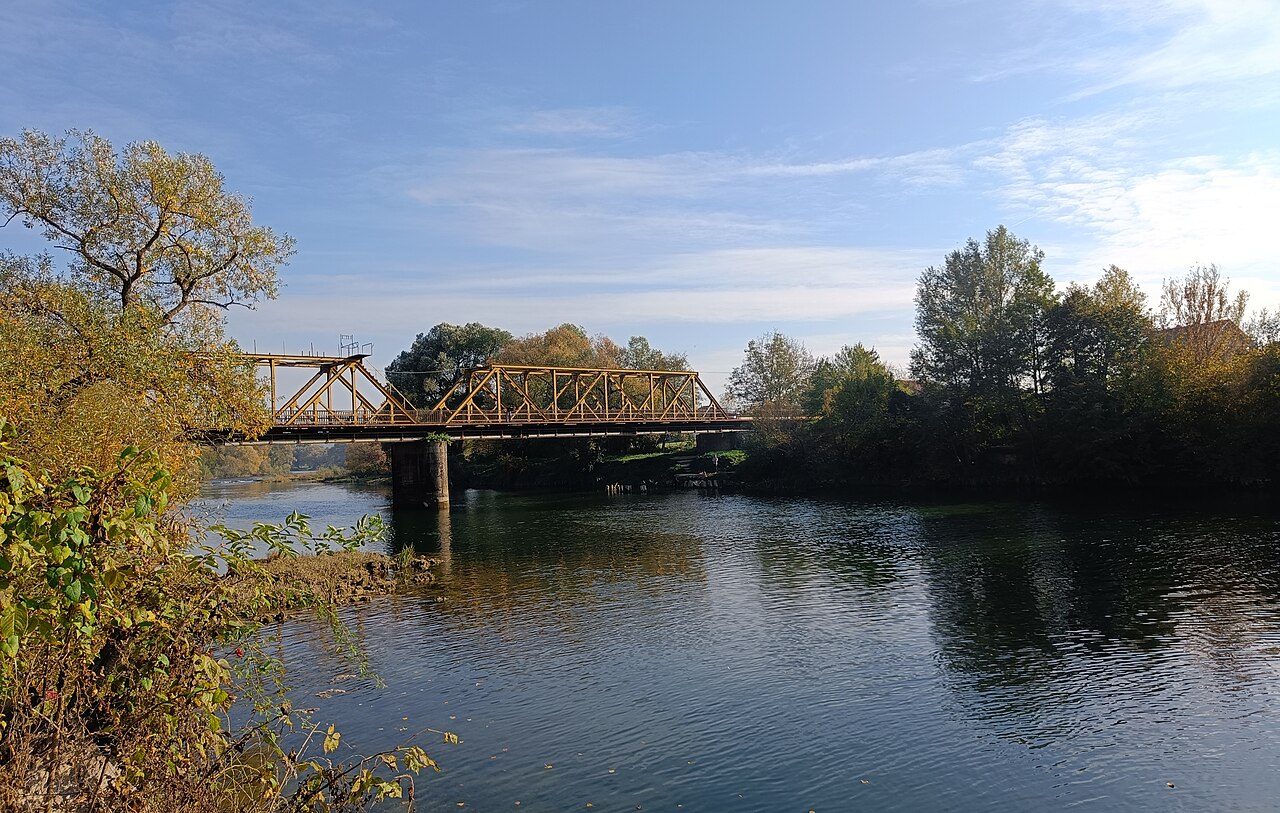
The iron bridge over the Sana river at Sanski Most
The iron bridge over the Sana at Sanski Most. The municipality's Bosniaks were killed and expelled in 1992, including in the Vrhpolje bridge massacre on the same river. Photo: Arnel · CC BY-SA 4.0 · via Wikimedia Commons

At a glance

Location
Sanski Most, northwestern Bosnia (Bosanska Krajina)
Period
April–autumn 1992
Perpetrators
VRS (6th Krajina Brigade), Bosnian Serb police and paramilitaries
Victims
Bosniak and Bosnian Croat civilians
Key sites
Vrhpolje bridge massacre (~19 killed, 31 May 1992); the Hrastova Glavica mass grave
Detention
Detainees held locally and transferred to the Manjača camp
Legal status
Crimes against humanity; the killings figured in the genocide/extermination case against Ratko Mladić
Key cases
Mladić; Brđanin; Jadranko Palija (State Court of BiH, 2007)

Summary

Sanski Most, a mixed municipality southwest of Prijedor, was incorporated into the Serb-controlled Autonomous Region of Krajina (ARK) and "cleansed" of its Bosniak and Croat population through the spring and summer of 1992. Villages were shelled and burned, men were detained and in many cases killed or transferred to the Manjača camp near Banja Luka, and the surviving non-Serb population was expelled. Two sites in particular mark the municipality's suffering: the bridge at Vrhpolje, where Serb soldiers turned the killing of civilians into a game, and the mass grave at Hrastova Glavica.

The Vrhpolje Bridge

On 31 May 1992, VRS soldiers rounded up Bosniak men from the Vrhpolje area. Four were murdered on the way to the bridge over the Sana. At the bridge, the remaining men — some sixteen — were ordered to strip and to jump, one by one, into the river, while the soldiers fired at them in mid-air as a form of sport. There was a single survivor, Rajif Begić, who would later testify against Ratko Mladić at The Hague. The ICTY found Mladić responsible for these killings as part of the campaign to render Serb-controlled Bosnia ethnically homogeneous.

The Vrhpolje killings were not an aberration but one episode in a municipality-wide campaign. The bodies of victims from across Sanski Most were later recovered from the Hrastova Glavica mass grave, one of the larger graves found in the region, which held the remains of scores of people — including, owing to the movement of bodies between sites, victims from neighbouring Prijedor.

The Legal Reckoning

The crimes in Sanski Most were addressed at several levels of justice. At the ICTY they formed part of the case against the VRS commander Ratko Mladić (convicted 2017) and of the persecution case against the ARK political leader Radoslav Brđanin (convicted 2004). At the national level, the State Court of Bosnia and Herzegovina convicted Jadranko Palija in 2007 for war crimes including the Vrhpolje bridge killings. The complementary operation of international and domestic courts in Sanski Most illustrates the layered architecture of post-war accountability.

Scholarly Analysis

Cruelty as message

The Vrhpolje bridge stands out even within the catalogue of 1992 atrocities for the gratuitous, performative sadism of the killing — the transformation of murder into a game. Such cruelty is not incidental to ethnic cleansing; it is functional. Spectacular, humiliating violence broadcasts a message to the surviving community far more powerfully than efficient killing would: it communicates that there is no safety, no dignity, and no future for the group in that place, and so accelerates the flight that is the campaign's true objective.

The single survivor and the burden of testimony

That the Vrhpolje massacre is known in detail at all rests largely on one man, Rajif Begić. The reliance of international justice on the testimony of lone survivors is a recurring and fragile feature of genocide prosecution: where the perpetrators succeed in killing all witnesses, the crime risks vanishing from the record entirely. Begić's survival, and his decision to testify, are a reminder of how much of the documented history of this war depends on individual acts of endurance and courage.

"Don't Dirty the Bridge"

Rajif Begić was one of twenty men marched to the Vrhpolje bridge on 31 May 1992; four were shot on the way, among them a father and son who could not keep up. At the bridge the men were made to strip and jump into the Sana while soldiers fired at them in mid-air. As Begić's turn came, a soldier pushed an automatic weapon into his mouth — and another said: "Don't kill him on the bridge, don't dirty the bridge — he should jump." Begić dived head-first, struck his head on a rock at the riverbed, and climbed out hidden beneath the bridge's central column. The sole survivor of the massacre, he later testified against Ratko Mladić at The Hague.

Source: Institute for War and Peace Reporting — Witness Recalls Sanski Most Bridge Killings.

Sources and References

"Sanski Most," Wikipedia (Vrhpolje bridge massacre and wartime history). Available at: https://en.wikipedia.org/wiki/Sanski_Most

"Ethnic cleansing in the Bosnian War," Wikipedia. Available at: en.wikipedia.org/wiki/Ethnic_cleansing_in_the_Bosnian_War

See also the ICTY judgments in Prosecutor v. Mladić (IT-09-92) and Prosecutor v. Brđanin (IT-99-36), accessible through the IRMCT case archive, and the related entry on Prijedor.