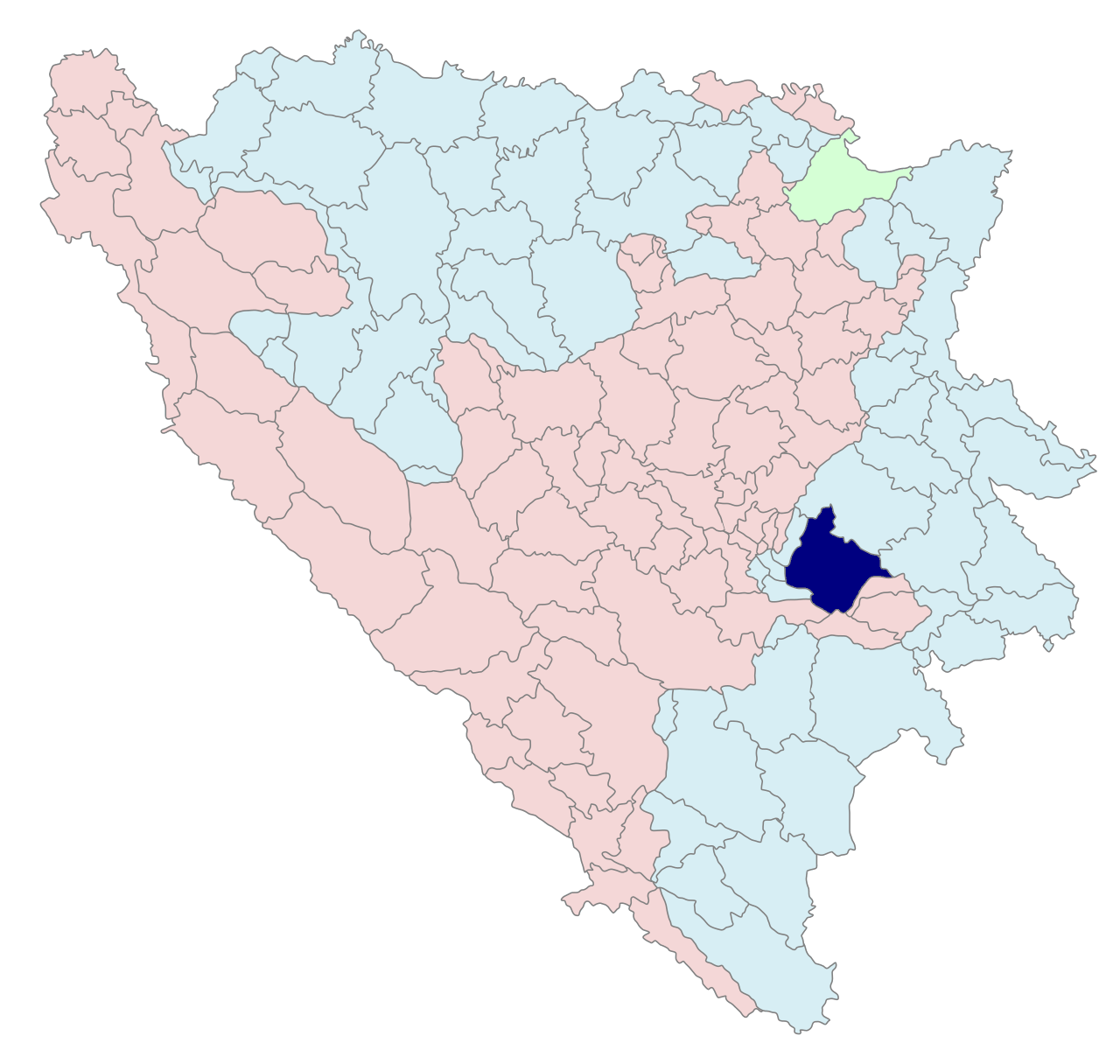
← The Bosnian Genocide / the Sarajevo-Romanija highlands
The cleansing of the Bosniaks of the eastern highlands — in the very seat of the Bosnian Serb wartime authority
The Romanija plateau, the upland country immediately east of Sarajevo, was overwhelmingly Serb-populated and became the heartland of the wartime Bosnian Serb entity — its capital, Pale, was the seat of Radovan Karadžić's leadership. The Bosniaks of the plateau's municipalities — Pale, Sokolac, Han Pijesak, and Šekovići — were small minorities, and in 1992 they were detained, abused, killed, and driven out, in the same pattern applied across Serb-held Bosnia. That this occurred in the very place from which the campaign was directed gives the Romanija cleansing a particular significance.
In Pale itself, Bosniak civilians were unlawfully detained at the town's Public Security Station (police station) and in a gymnasium, where between April and September 1992 they were abused, tortured, and killed before the survivors were expelled. Near Sokolac, the Kula prison held Bosniak inmates, some of whom figured in attempted prisoner exchanges. Han Pijesak, a garrison town that had hosted JNA manoeuvres in the run-up to the war, and Šekovići saw the same sequence of detention and expulsion of their Bosniak inhabitants. By the end of 1992 the small Bosniak communities of the plateau had been effectively erased.
There is a grim coherence in the fact that Bosniaks were detained and killed in Pale, the town where the orders for the wider campaign were issued. It refutes any notion that the cleansing was the work of distant, uncontrolled elements acting beyond the reach of the leadership. The same authority that planned the siege of Sarajevo from the Romanija heights presided over the persecution of the Bosniaks living at its feet. The plateau is, in this sense, the campaign's home ground — and the cleansing of its minorities the local expression of the policy directed from its centre.
Pale, Sokolac, Han Pijesak, and Šekovići produced no Srebrenica, no Prijedor. Their Bosniak populations were too few to fill a notorious camp or a mass grave that would seize the world's attention. Yet their disappearance is part of the same phenomenon: the methodical removal of Bosniaks from every municipality marked for a Serb future, regardless of how small the community or how complete the local Serb majority already was. The thoroughness of the campaign — reaching even these places where no military or demographic necessity could be claimed — is itself among the strongest evidence of its character as a campaign of destruction rather than of war.
In Pale, the seat of the wartime Bosnian Serb leadership, Bosniak civilians were detained at the town's Public Security Station and at a gymnasium between April and September 1992. Around thirty-five Bosniak men were separated and held in the gym, where they were beaten and tortured so severely that several died the same night or the following day. A wartime police chief charged over the detentions was acquitted by the Bosnian courts — one more of the crimes of the Romanija highlands for which no one has been held to account.
Sources: Balkan Insight — Ex-Police Chief Acquitted of Illegal Detentions; USHMM — Eyewitness Testimony.
UN Commission of Experts (Bassiouni), Annex VIII: "Prison camps" (detention facilities on the Romanija plateau, including Pale and the Kula prison near Sokolac). Available at: phdn.org — Annex VIII: Prison camps
Hikmet Karcić, Torture, Humiliate, Kill: Inside the Bosnian Serb Camp System (University of Michigan Press, 2022). Overview: balkaninsight.com — the camp system
See also the ICTY judgments in Prosecutor v. Karadžić (IT-95-5/18) and Prosecutor v. Mladić (IT-09-92), accessible through the IRMCT case archive, and the related entry on Vlasenica.