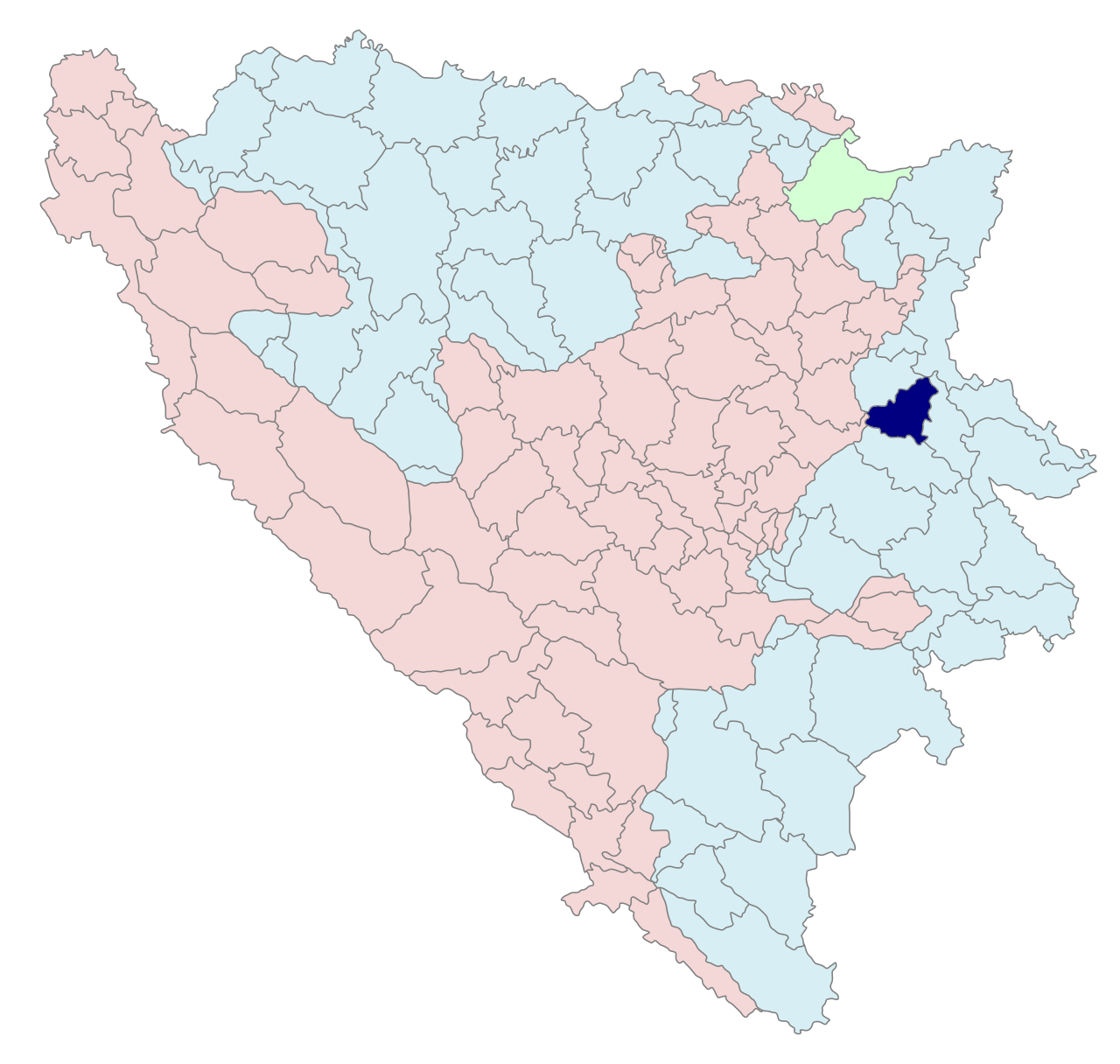
Location of Vlasenica municipality within Bosnia and Herzegovina
Location of the Vlasenica municipality in eastern Bosnia, site of the Sušica camp. Map: Andrein · Public domain · via Wikimedia Commons

At a glance

Location
Vlasenica, eastern Bosnia (Podrinje)
Period
April–October 1992
Perpetrators
VRS and Bosnian Serb police; camp commander Dragan Nikolić ("Jenki")
Victims
Bosniak civilians
Detention
Sušica camp — as many as 8,000 detainees passed through the hangar
Killed
Torture and murder throughout; ~140–150 remaining detainees executed on the night of 30 September 1992; 37 victims later exhumed from the Sušica grave
Legal status
Crimes against humanity
Key case
Dragan Nikolić — the ICTY's first-ever indictment (1994); convicted 2003, 20 years

Summary

Vlasenica, a municipality with a slight Bosniak majority in eastern Bosnia, was seized by Serb forces in April 1992. Its Bosniak population was disarmed, dismissed from employment, and then arrested en masse. The principal instrument of the cleansing was the Sušica camp, a former warehouse and barracks complex on the edge of the town, through which as many as 8,000 Bosniak civilians passed between late May and October 1992. Detainees were starved, tortured, and killed, and women were taken out and raped; when the camp was wound up at the end of September, the last group of detainees was executed.

Sušica holds a particular place in the history of international justice: its commander, Dragan Nikolić, was the subject of the very first indictment issued by the International Criminal Tribunal for the former Yugoslavia.

The Sušica Camp

The detainees — overwhelmingly Bosniak civilians from Vlasenica and the surrounding villages — were held in a single severely overcrowded hangar in deplorable conditions. The ICTY found that the camp's commander, Dragan Nikolić, personally participated in and oversaw a regime of beatings, torture, sexual violence, and killing. Detainees were removed from the hangar and murdered, their bodies disposed of in the surrounding area. On the night of 30 September 1992, as the camp was being closed, the remaining 140 to 150 detainees were loaded onto buses and executed. Decades later, only a fraction of the dead — 37 victims exhumed from one Sušica grave — have been recovered and identified, leaving many families without remains to bury.

The Legal Reckoning

Prosecutor v. Dragan Nikolić (IT-94-2) was the first indictment confirmed by the ICTY, in November 1994 — a symbolic milestone in the establishment of the modern system of international criminal justice. Nikolić was eventually arrested, pleaded guilty to crimes against humanity (persecution, including murder, torture, and sexual violence), and was sentenced in 2003 to 20 years' imprisonment (reduced to 18 on appeal). Other Vlasenica perpetrators have been tried before the War Crimes Chamber of the Court of Bosnia and Herzegovina.

Scholarly Analysis

The camp as a technology of cleansing

Sušica exemplifies the function of the detention camp within the architecture of ethnic cleansing. The camp was not a prison in any ordinary sense — it held no convicts and served no penal purpose. It was a holding and killing facility whose role was to concentrate a community's men in one place so that they could be controlled, terrorized, and, in part, destroyed, while the women and children were expelled. The "throughput" of up to 8,000 people captures the camp's true function: it was a machine for processing a population out of existence in its home region.

A first indictment, a long wait

That the Tribunal's first indictment concerned a camp commander rather than a head of state is itself significant. International justice began at Sušica from the ground up, with the immediate perpetrators of camp atrocities, and worked its way toward the architects only over the following two decades. The long gap between Nikolić's 1994 indictment and his 2003 sentencing — and the still-unrecovered remains of most of his victims — is a measure of how slowly, and how incompletely, accountability follows atrocity.

Survivor Testimony

The Sušica camp is remembered through the testimony of those who survived it. Habiba Hadžić told the ICTY of the men beaten before her eyes — Mevludin Hatinić and a man known as Durmo, beaten until they died; Asim Zildžić carried out on a stretcher with his eye knocked out. The court found that the commander, Dragan Nikolić, personally killed nine detainees and beat others for as long as forty-five minutes at a time with wooden bats, iron bars, axe handles, and rifle butts, and that women of all ages were raped under his authority. He was sentenced to 20 years.

Source: ICTY — Habiba Hadžić; Prosecutor v. Dragan Nikolić (IT-94-2).

Sources and References

"Sušica camp," Wikipedia. Available at: https://en.wikipedia.org/wiki/Sušica_camp

Islamic Relief / Remembering Srebrenica, "Ethnic cleansing: Susica." Available at: srebrenica.islamic-relief.org — Susica

Center for Democracy and Transitional Justice, "The 30th Anniversary of the Closure of the Sušica Camp." Available at: cdtp.org — Sušica

See also the ICTY judgment in Prosecutor v. Dragan Nikolić (IT-94-2), accessible through the IRMCT case archive.