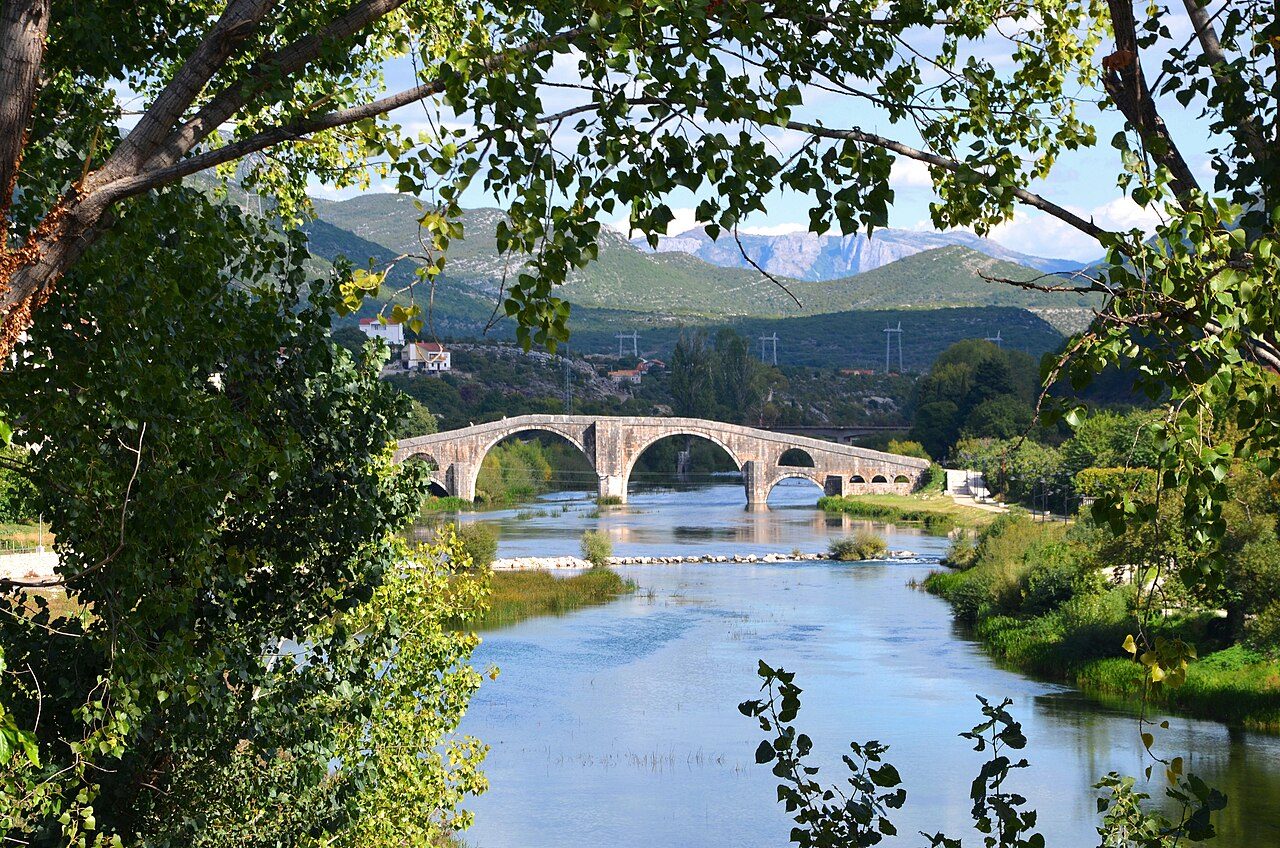
The Ottoman Arslanagić Bridge in Trebinje
The Arslanagić (Perovića) Bridge in Trebinje, one of eastern Herzegovina's Ottoman monuments. The region's Bosniak communities and all its functioning mosques were destroyed in 1992. Photo: Teodora Mijanovic · CC BY-SA 3.0 · via Wikimedia Commons

At a glance

Location
The eastern Herzegovina municipalities of Gacko, Nevesinje, Bileća, and Trebinje
Period
Spring–summer 1992
Perpetrators
The VRS (Herzegovina Corps), Bosnian Serb police and paramilitaries
Victims
The Bosniak minority populations of the region
Killed
Over 100 killed in Gacko alone; killings and detention across the region, survivors expelled
Detention
The Moše Pijade barracks and other sites in Bileća
Cultural destruction
Every functioning mosque in Gacko, Nevesinje, Bileća and Trebinje destroyed
Legal status
Crimes against humanity (ICTY leadership cases; Court of BiH camp prosecutions)

Summary

In the Serb-majority municipalities of eastern Herzegovina, the Bosniaks formed small but ancient minorities — in Nevesinje, for instance, just over fifteen percent of the population before the war. In the spring and summer of 1992 these communities were destroyed. The pattern was the same across Gacko, Nevesinje, Bileća, and Trebinje: Bosniak civilians were killed or detained, the survivors expelled, and every functioning mosque in the region demolished — in many cases, as observers noted, in the complete absence of any military operations. This was ethnic cleansing in its most undisguised form: a policy applied to a defenceless minority for no reason but its existence.

Town by Town

Gacko. More than a hundred Bosniaks were killed in the Gacko area, and many of the rest were taken to detention in nearby Bileća. The town's mosques were destroyed and its Bosniak community erased.

Bileća. The municipality became a centre of detention for the region. Bosniak (and some Croat) civilians were held at the Moše Pijade military barracks, the police station, the student dormitory, and the old prison, where they were beaten and abused. The Court of Bosnia and Herzegovina later convicted several former guards — among them Boris Bošnjak (eight years), Ilija Đajić (three years), and Miodrag Grubačić (eighteen months) — for the mistreatment of detainees.

Nevesinje and Trebinje. In both municipalities the Bosniak population was driven out and the mosques and other Islamic heritage destroyed — in Nevesinje the Catholic churches as well — though no battle was fought there. The systematic character of the destruction across all four municipalities was later reflected in the region-wide campaign to rebuild the mosques of Nevesinje, Gacko, Bileća, Trebinje, Ljubinje, and the surrounding villages.

The Legal Reckoning

The eastern-Herzegovina crimes were charged as part of the systematic, region-wide attack on the non-Serb population in the ICTY cases against the Bosnian Serb leadership (notably Karadžić and Mladić), which encompassed the Herzegovina municipalities within the joint criminal enterprise. At the national level, the War Crimes Chamber of the Court of Bosnia and Herzegovina has prosecuted individual perpetrators of the Bileća camp crimes and other abuses in the region.

Scholarly Analysis

Cleansing without a war

Eastern Herzegovina offers some of the purest evidence that the destruction of the Bosniak communities was a deliberate policy rather than a consequence of combat. In Gacko, Nevesinje, Bileća, and Trebinje there were essentially no military operations — no front line, no contested ground, no armed Bosniak force to speak of. The Bosniak minority was simply too small to resist. That its members were nonetheless killed, interned, expelled, and their every mosque dynamited demonstrates that the violence was not a means to a military end but an end in itself: the removal of a people and the erasure of the evidence that they had ever lived there.

The minority as target

These municipalities also illuminate a particular cruelty of the campaign. Where Bosniaks were a majority, their removal could be rationalized — however falsely — in the language of territorial control. In eastern Herzegovina they were a small minority posing no conceivable threat to Serb dominance. Their destruction therefore cannot be explained by any security logic at all; it can be understood only as the working-out of an ideology that held that no Bosniak presence, however minimal, was tolerable in the desired Serb space. It is the clearest possible refutation of the claim that the cleansing was a reciprocal tragedy of war.

The Moše Pijade Barracks

The Moše Pijade barracks at Bileća, run by the VRS military police, held a few hundred Bosniak and Croat detainees from June to December 1992. When a group of around 140 men was brought from Gacko — from the police station and the Samački hotel — they were made to run a gauntlet of guards wielding batons before being forced into a basement already holding some two hundred prisoners; for three days they were given no food and denied even the use of a toilet, while the beatings went on. At least four of the Gacko men were killed in the camp; another fifty detainees had been brought from the Miladin Radojević school in Kalinovik. Years later the Court of Bosnia and Herzegovina sentenced three of the guards to a combined twenty-one years.

Sources: Hikmet Karcić, Torture, Humiliate, Kill; Balkan Insight — Bileća camp guards convicted.

Sources and References

Balkan Insight, "Convictions Urged for Bosnian Serb Wartime Camp Guards" (2019) and "Bosnian Serb Wartime Camp Guards' Sentences Reduced" (2021) — the Bileća (Moše Pijade) camp case. Available at: balkaninsight.com — Bileća camp guards

Hikmet Karcić, Torture, Humiliate, Kill: Inside the Bosnian Serb Camp System (University of Michigan Press, 2022). Overview: balkaninsight.com — the camp system

ICRC Review, "Cultural heritage and memory after ethnic cleansing in post-conflict Bosnia" (destruction and reconstruction of Herzegovina's mosques). Available at: international-review.icrc.org (PDF)

See also the ICTY judgments in Prosecutor v. Karadžić (IT-95-5/18) and Prosecutor v. Mladić (IT-09-92), accessible through the IRMCT case archive.