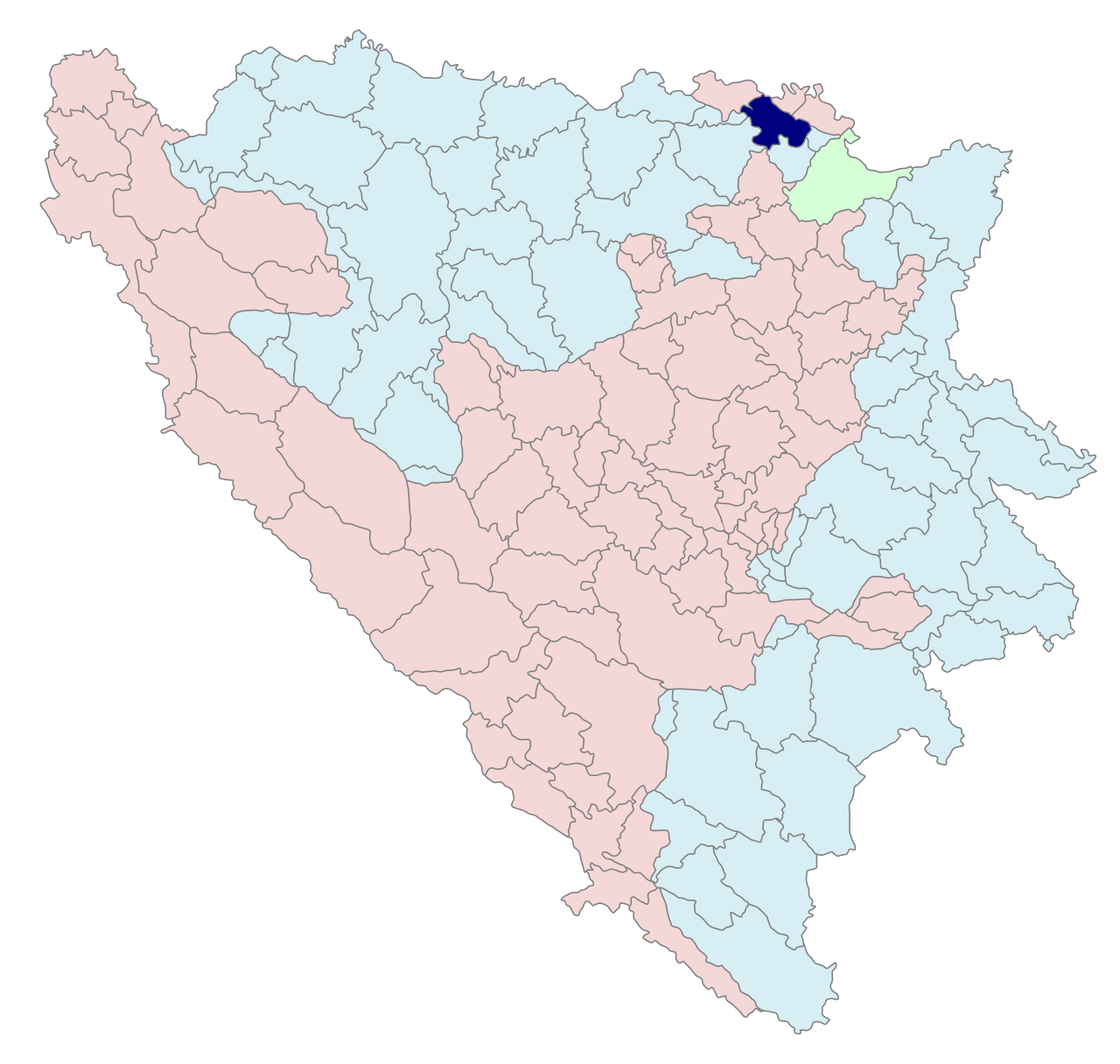
Location of Bosanski Šamac (Šamac) municipality within Bosnia and Herzegovina
Location of the Bosanski Šamac (Šamac) municipality on the Sava, in northern Bosnia. Map: Andrein · Public domain · via Wikimedia Commons

At a glance

Location
Bosanski Šamac, northern Bosnia (Posavina), on the Sava
Period
17 April 1992 – late 1993
Perpetrators
JNA and Serb paramilitary units, with local SDS authorities
Victims
Bosniak and Bosnian Croat civilians
Killed
639 killed or missing in the municipality (RDC), of whom 126 were civilians
Displacement
Of 17,000+ Bosniaks and Croats recorded pre-war, only ~300 remained by 1995
Legal status
Crimes against humanity (persecution, deportation, forcible transfer, forced labour)
Key case
Blagoje Simić (IT-95-9) — 17 years, reduced to 15 on appeal

Summary

Bosanski Šamac, a small municipality at the confluence of the Bosna and Sava rivers, was seized on 17 April 1992 by the JNA and Serb paramilitary units. There followed nearly two years of systematic persecution of the Bosniak and Croat population: arbitrary arrest, detention in inhumane conditions, torture, forced labour, and ultimately deportation. The demographic result was among the most extreme of the war — of more than 17,000 Bosniaks and Croats recorded in the municipality before the war, only around 300 remained by its end.

Although the death toll was lower than in the camps of the Krajina or the killing fields of the Drina, Bosanski Šamac is a paradigmatic case of ethnic cleansing accomplished primarily through persecution and expulsion rather than mass murder — and it produced one of the ICTY's most detailed judgments on the crime of persecution.

Persecution as Policy

The ICTY found that non-Serb civilians in Bosanski Šamac were unlawfully arrested and confined under conditions lacking adequate space, food, and water, and were subjected to cruel and inhumane treatment including torture — beatings, sexual assault, the forcible extraction of teeth, and mock executions. Detainees were used for forced labour, including dangerous work on the front lines, and the population was progressively deported and forcibly transferred out of the municipality. Much of the violence was inflicted by paramilitaries brought in from Serbia, operating in concert with the local authorities.

The Legal Reckoning

Prosecutor v. Blagoje Simić (IT-95-9) — the local Bosnian Serb politician who headed the Šamac Crisis Staff was convicted in 2003 of persecution as a crime against humanity, on the basis of unlawful arrest and detention, cruel and inhumane treatment, forced labour, confinement under inhumane conditions, and deportation and forcible transfer, and sentenced to 17 years. On appeal in 2006, after some findings were re-characterized, his sentence was reduced to 15 years. Co-accused, including paramilitary figures, were also convicted. The crimes featured as well in the case against Slobodan Milošević.

Scholarly Analysis

The 17,000-to-300 measure

The single most eloquent fact about Bosanski Šamac is demographic: a community of over seventeen thousand reduced to three hundred. This is the essence of ethnic cleansing expressed as arithmetic. It also clarifies why the count of the dead, while essential, is an incomplete measure of the crime. Relatively "few" were killed at Šamac; nonetheless the non-Serb community was effectively annihilated as a presence on the land. The crime of persecution — the systematic deprivation of fundamental rights on discriminatory grounds — is the legal category that captures this form of destruction.

The role of imported paramilitaries

Bosanski Šamac, like Bijeljina and Zvornik, illustrates the recurring use of paramilitaries dispatched from Serbia to do the work of cleansing in concert with local Serb authorities. This pattern bears directly on the question of state responsibility: the movement of armed men, weapons, and direction across the border from Serbia into Bosnian municipalities was part of the evidentiary basis on which the broader Serbian role in the war was litigated. Šamac is a small place whose record speaks to one of the largest questions of the conflict.

What "Persecution" Meant

The ICTY's findings on Bosanski Šamac set out, in clinical detail, what the legal category of "persecution" meant for its victims. Non-Serb civilians were unlawfully arrested and confined in conditions the court found cruel and inhumane; the torture inflicted on them included sexual assault, the forcible extraction of teeth, and mock executions, "in order to discriminate on ethnic grounds." Detainees were used as forced labour — digging trenches and building bunkers on the front line, where they were under constant risk of injury and death. On these findings Blagoje Simić, head of the Šamac Crisis Staff, was convicted of persecution as a crime against humanity and sentenced to 15 years.

Source: ICTY — Judgement in Prosecutor v. Simić, Tadić and Zarić (IT-95-9, 2003).

Sources and References

"Bosanski Šamac ethnic cleansing," Wikipedia. Available at: en.wikipedia.org/wiki/Bosanski_Šamac_ethnic_cleansing

ICTY, "Blagoje Simić's appeal partly granted, sentence reduced to fifteen years" (2006). Available at: icty.org — Simić appeal

ICTY, Prosecutor v. Simić et al., Trial Judgment (17 October 2003, PDF). Available at: icty.org — Simić trial judgment

See also the related entry on Brčko.