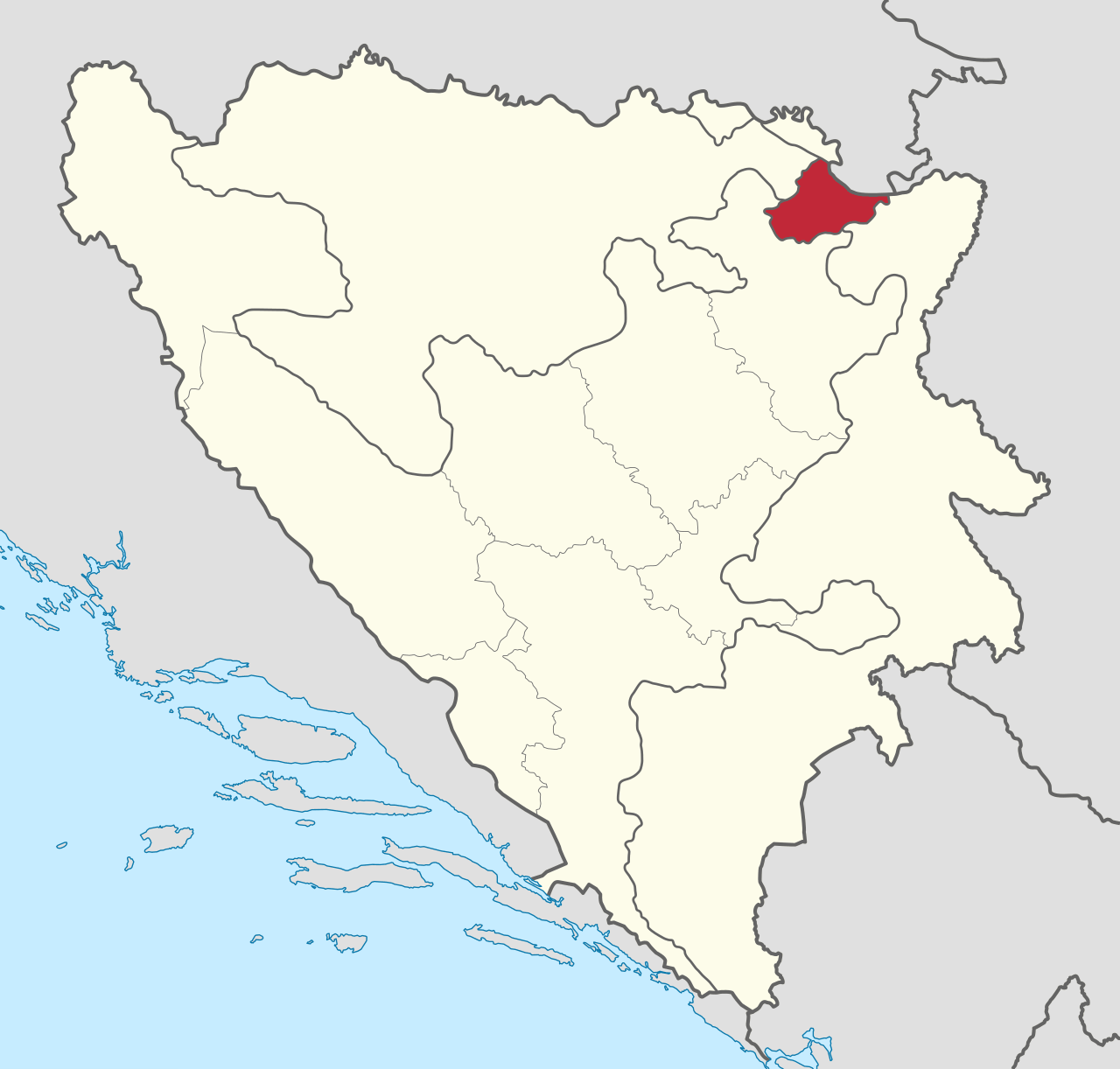
Location of the Brčko District within Bosnia and Herzegovina
Location of the Brčko District on the Sava in northern Bosnia, at the narrowest point of the Posavina corridor. Map: TUBS · CC BY-SA 3.0 · via Wikimedia Commons

At a glance

Location
Brčko, northern Bosnia, on the Sava (Posavina corridor)
Period
From early May 1992 (Luka camp ~7 May – early July 1992)
Perpetrators
JNA, VRS, Bosnian Serb police and paramilitaries; Luka camp run by Goran Jelisić
Victims
Bosniak and Bosnian Croat civilians
Detention
The Luka camp — a warehouse on the Sava where hundreds were confined
Killed
Systematic killings at Luka; Jelisić convicted for 13 named murders, the true toll far higher
Legal status
Crimes against humanity (Jelisić acquitted of genocide on intent grounds)
Key case
Goran Jelisić (IT-95-10) — 40 years

Summary

Brčko, a town of great strategic importance at the narrowest point of the Posavina corridor linking the eastern and western halves of Serb-held Bosnia, was seized in late April–early May 1992. Its Bosniak and Croat population was attacked, expelled, and confined in detention sites, the most notorious of which was the Luka camp, a warehouse complex on the bank of the Sava. From around 7 May until early July 1992, hundreds of Muslim and Croat men — and a small number of women — were held there in inhumane conditions and systematically killed.

The Luka camp produced one of the ICTY's defining early cases, that of its commander Goran Jelisić, who styled himself the "Serbian Adolf."

The Luka Camp

At Luka, detainees were beaten, tortured, and killed, often in the open, with bodies disposed of in the Sava or in mass graves. Goran Jelisić, though not formally senior in rank, exercised the power of life and death over the prisoners; he personally murdered detainees, boasting of his killings and of his hatred for Muslims. The camp operated as a place of extermination and terror in the service of clearing Brčko of its non-Serb population — a goal of particular urgency to the Serb war effort because of the town's role as the chokepoint of the entire northern corridor.

The Legal Reckoning

Prosecutor v. Goran Jelisić (IT-95-10) resulted in a guilty plea to fifteen counts of crimes against humanity and sixteen counts of violations of the laws or customs of war — including the murder of 13 people — and a sentence of 40 years. Significantly, the Trial Chamber acquitted Jelisić of genocide, finding that, although he killed Muslims because they were Muslims, the prosecution had not proved beyond reasonable doubt that he acted with the intent to destroy the group in whole or in part. The Brčko crimes also featured in later cases against the Bosnian Serb leadership.

Scholarly Analysis

The "Serbian Adolf" and the puzzle of intent

The Jelisić judgment is a touchstone in the law of genocidal intent. Here was a man who killed Muslims explicitly because they were Muslims, who relished the role, and who invoked Hitler — and yet who was acquitted of genocide. The reasoning turned on the distinction between discriminatory motive and genocidal intent: hating and killing members of a group is persecution and murder, but genocide additionally requires the purpose of destroying the group as such. A lone, disorganized killer, however hateful, could not be shown to share that overarching plan. The case thus sharpens the boundary that makes genocide the "crime of crimes" — and illustrates why so few individual perpetrators are convicted of it.

Geography as motive

Brčko also demonstrates the strategic logic underlying the cleansing. The town was indispensable to the territorial viability of Republika Srpska, the thread connecting its two wings. That strategic value translated directly into the intensity of the violence against its non-Serb inhabitants: the corridor had to be secured, and securing it meant emptying it. The Luka camp was, in this sense, an instrument of geopolitics as much as of hatred.

The Hangar and the Sava Bridge

One survivor account fixes the method of the Luka camp in memory. A witness described the guards entering the hangar at night, counting the prisoners "from one to three," taking out the first and the third, then on the next round every third — and killing all who were removed; two more were then ordered to carry away the corpses before they too were shot. The killing was repeated, he said, "three nights in a row." At the collapsed Sava bridge, the commander Goran Jelisić — who called himself the "Serb Adolf" and admitted his goal was to kill Muslims — and an accomplice brought a group of unarmed Brčko men to be shot; the only survivor, Dževad Mujkić, swam wounded across the river to Croatia.

Sources: "Goran Jelisić," Wikipedia; ICTY, Prosecutor v. Jelisić (IT-95-10).

Sources and References

"Luka camp," Wikipedia. Available at: https://en.wikipedia.org/wiki/Luka_camp

"Goran Jelisić," Wikipedia. Available at: en.wikipedia.org/wiki/Goran_Jelisić

ICTY, "Bridging the Gap — Brčko" and the Jelisić case information sheet. Available at: icty.org — Bridging the Gap, Brčko

See also the ICTY judgment in Prosecutor v. Jelisić (IT-95-10), accessible through the IRMCT case archive.