A landmark 1995 legal ruling on religious institutional responsibility for crimes against humanity
In 1995, the Serbian Orthodox Church (SPC) lost a landmark lawsuit in Paris after suing the newspapers Libération, Le Monde, and Le Figaro for articles accusing the church of supporting ethnic cleansing and genocide in Bosnia and Herzegovina.
This remains the first and only case in Europe—and likely the world—where a religious institution has been officially found, through judicial proceedings, to have participated in the gravest crimes against humanity and human dignity.
The court's ruling established that French journalists had written the truth: the Serbian Orthodox Church was complicit in the mass suffering of civilian populations, ethnic cleansing, and genocide in Bosnia and Herzegovina.
June 26, 1995
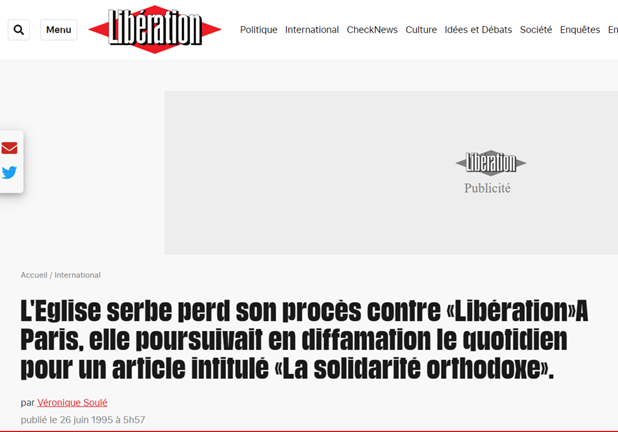
After the Serbian Orthodox Church lost its case before the Paris Court against the newspapers Libération, Le Monde, and Le Figaro—which it had sued for defamation because articles published in those newspapers accused it of supporting ethnic cleansing and the crime of genocide in Bosnia and Herzegovina—the distinguished newspaper Libération published a report on June 26, 1995, detailing the court's decision.
The article, titled "Serbian Orthodox Church Loses Case Against Libération," by Véronique Soulé, is reproduced here in full:
In Paris, the newspaper was sued for defamation over an article titled "Orthodox Solidarity"
The 17th Criminal Chamber of the Paris Court delivered its verdict on Friday regarding the lawsuit filed by the Serbian Orthodox Church against the French newspaper Libération for defamation, following the publication of an article titled "Orthodox Solidarity" on October 12, 1994, in which the author analyzed the position and influence of the Serbian Orthodox Church in relation to the conflict in the former Yugoslavia.
In the spirit of fairness and justice, the Court acquitted Serge July, editor of Libération, and Hélène Despic-Popović, author of the contested article, and rejected the SPC's complaint. The Serbian Orthodox Church has ten days to appeal.
The 17th Chamber, which ruled on the merits of the complaint, particularly emphasized the good intentions of the journalist, which were strongly questioned by the civil party that attempted to portray her as "carried away by blind hatred," with an obvious affinity for primary Manichaeism, calling into question her sincere intentions and knowledge of the circumstances, issues, and essence of the conflict in the former Yugoslavia.
The incriminating remarks, the Court emphasized, were not formulated concisely and clearly, but represented accusations without argumentation.
Referring to the witnesses called by the defense (including Paul Garde, author of "Life and Death of Yugoslavia," researcher Pierre Hassner, and Ivan Đurić, former presidential candidate against Slobodan Milošević), the Court, in its reasoning, considered that they demonstrated "the real connection and role of the SPC" in the war in Bosnia and Herzegovina.
Regarding the defamatory accusations in the article, the Court acknowledged that some facts cited in the article could be of a defamatory nature.
However, these facts are difficult to prove, particularly since the civil party disputes and denies the presence of Patriarch Pavle at the inauguration of the Theology School in Foča, a city that before the war had more than 90% Muslim population (while according to authorized lawyers representing the SPC, that percentage was 60%, per Nathalie Carrere and Vladimir Vukadinović), and the fact that all historic mosques were destroyed. However, the Court emphasized that the author in the article spoke of support for the policy of "ethnic cleansing" and Orthodox solidarity, and not, as the plaintiffs claim, direct and active complicity in crimes against humanity and genocide, which is a significantly more serious accusation.
After the closing statement by Me Lévy, Libération's lawyer, who stated during the May 26 hearing: "These trials are conducted mostly with journalistic silence," the Court finally encouraged journalistic freedoms and freedom of opinion in its commentary:
"If the circumstances supporting ethnic cleansing are supported by the SPC," the verdict concludes, "this should be considered as not exceeding the permissible limits of freedom of expression that are specific and necessary for the analysis of political, sociological, and ideological phenomena of a society."
The detailed reporting by Libération reveals several crucial aspects of the court proceedings:
The Paris Court's reasoning established that discussing a religious institution's support for ethnic cleansing falls within permissible limits of freedom of expression when analyzing political, sociological, and ideological phenomena. This created an important legal precedent for holding religious institutions accountable for political positions that support crimes against humanity.
The Court found that the journalist's work demonstrated good faith and proper research, supported by expert witnesses who established the factual basis for the claims about the SPC's role in the Bosnian conflict.
As Serbian religious analyst Mirko Đorđević documented in his 2010 book Kišobran patrijarha Pavla (The Umbrella of Patriarch Pavle):
"Let us pause over another bitter cup: they took him to the burned-out Foča, which they then called Srbinje, and the European press wrote—especially Le Monde, Figaro and Libération in Paris—that the SPC in Bosnia supports ethnic cleansing. The patriarch's name was also mentioned, so the SPC filed a lawsuit in Paris against those newspapers. Painful and sad. Many testified at the trial in Paris, including historian Paul Garde and Serbian Byzantologist Ivan Đurić. Bishop Atanasije Jevtić defended the SPC, and he did it so 'well' that the trial ended with a judicial condemnation of the SPC. No, said the judge, facts are facts, and French truth cannot be silenced."
The expert witnesses at the trial were:
The Serbian Orthodox Church was represented by Bishop Atanasije Jevtić, Bishop of Zahumlje and Herzegovina—a notorious Greater Serbian fascist, war agitator, and ardent admirer of Slobodan Milošević who actively advocated for the creation of "Greater Serbia." He also served as the first rector of the Serbian Orthodox "Spiritual Academy 'Saint Basil of Ostrog'" in ethnically cleansed Foča (which Serbs renamed "Srbinje" after occupation).
After hearing arguments from both sides, the Paris court delivered its verdict: the newspapers were not guilty. They had not slandered the Serbian Orthodox Church, nor had they published misinformation or falsehoods regarding the war events in Bosnia and Herzegovina and the activities of the Serbian church and Patriarch Pavle.
The journalists had written the truth, and the SPC was co-responsible for the mass suffering of civilians—for ethnic cleansing and genocide in Bosnia and Herzegovina.
According to the official 1991 census, the Foča municipality had 18,315 Serbs (45.2% of the population). However, as part of the war of conquest and ethnic cleansing plan, this area—located in eastern Bosnia and Herzegovina on the border with Montenegro and Serbia—was subjected to brutal attacks by the Yugoslav "People's Army" (JNA) and Serbian forces, primarily from Serbia, beginning in April 1992.
On April 7, 1992, Serbian aggressors attacked the Foča area with artillery and captured it by April 16-17. During this operation:
It is crucial to note that at this time in the Foča municipality, as in all of eastern Bosnia, there were no defensive armed formations whatsoever. This was pure aggression against an unprotected population.
The "Partizan" sports hall was converted into a prison from which women and girls were taken every night to private homes or hotels where they were systematically raped for months. After these events in Foča, the international community recognized that rape was one of the means of ethnic cleansing.
Victims were tortured, starved, subjected to physical violence and psychological abuse, and lived in extremely unsanitary, inhumane conditions.
We must not forget that in Foča and throughout the Podrinje region during World War II, Chetniks carried out planned and mass slaughters of Muslims and Croats, especially in the areas of Foča, Goražde, Rogatica, Višegrad, Čajniče, and Kalinovik, with the aim of their permanent removal from these territories.
According to the latest (still incomplete) data, Chetniks killed over 45,000 Muslims and Croats in Bosnia and Herzegovina during World War II in ethnic cleansing operations—sparing neither women, children, nor the elderly. They destroyed hundreds of Catholic churches and mosques, devastated, burned, and plundered over 300 villages and small towns, committed thousands of rapes, and conducted merciless terror through torture and mass executions.
Fifty years later, something similar occurred. Civilians again suffered at the hands of the same aggressor in the same areas.
After a series of failed attempts to stop the war, the Contact Group (consisting of representatives from Britain, Russia, Germany, the United States, and France) proposed a peace agreement to the three parties in Bosnia and Herzegovina in early summer 1994. The proposal would territorially divide BiH, with 49% going to Serbs and the remaining 51% to Muslims and Croats.
The plan was accepted by Croats and Muslims (Bosniaks), but not by Serbs.
Since the Serbian aggressor controlled over 70% of the state's territory at that time, the proposal was flatly rejected at the July 4, 1994 session of the so-called "People's Assembly" of the "Republika Srpska."
The Serbian Orthodox Church particularly fiercely opposed accepting this peace solution and stopping the war. At the aforementioned session of Karadžić's "parliament," Metropolitan Amfilohije Radović of Montenegro and the Littoral spoke very harshly, saying it was "the decimation of the Serbian people" and "a sentence to hanging."
On July 5, 1994 (one day after the "People's Assembly" of the so-called Republika Srpska rejected the Contact Group proposal), the Episcopal Conference of the SPC issued its "Appeal to the Serbian People and World Public," calling on all Serbs to rise in defense of "Serbian lands" and with repeated claims that the Serbian people have a legitimate right to their "Republic of Serbian Krajina" and "Republika Srpska."
Bishop Atanasije Jevtić of Zahumlje and Herzegovina (the same person who defended the SPC in the Paris court) stated in August that this and similar plans would never be accepted, even at the cost of "bombing."
To make the matter certain and avoid surprises, Patriarch Pavle soon embarked on a tour of "Republika Srpska" in August 1994, fiercely agitating against accepting the Contact Group plan and any other similar agreement. The Serbian Orthodox Church was still firmly advocating for the creation of "Greater Serbia," which would include all of Bosnia and Herzegovina and the then-occupied territory of the Republic of Croatia. Any deviation from this goal was considered "betrayal of national interests."
Touring ethnically cleansed areas of BiH, Patriarch Pavle held "funeral services," "panikhidas," and liturgies for "Serbian victims," and in his "sermons" repeatedly reminded people of the "genocide against Serbs." In Foča (which had been renamed "Srbinje"), he opened the "Spiritual Academy 'Basil of Ostrog'" where the SPC would educate young theologians and prepare them for the priesthood.
The patriarch did not see the rivers of blood flowing around him and was not scandalized by the mass slaughters and evil committed by his compatriots, nor did he speak about it. For him, that part of Bosnia-Herzegovina's reality did not exist.
The tour culminated with a visit to Pale on August 14, where the patriarch blessed Radovan Karadžić and Ratko Mladić, broke bread with them, and held a liturgy. The leader of the Serbian church urged them to maintain "unity with Serbia" and resolve political disagreements with Belgrade, and not to accept any peace proposals, especially the latest one. He particularly appealed that "borders cannot be set between brothers on both sides of the Drina."
The Contact Group peace plan was rejected two weeks later in a referendum in "Republika Srpska" (August 28, 1994) with 96.66% voting "against."
All of this, especially what the patriarch and his Serbian Orthodox Church were doing, caused outrage in Western Europe—since the facts about what had happened in Foča two years earlier were already well known. Many newspapers, especially in France, published articles accusing the Serbian church of being responsible for the crimes of genocide and ethnic cleansing. Many articles specifically named Patriarch Pavle as guilty.
As already stated, the SPC filed a lawsuit and lost in court—but learned nothing from it, as it stubbornly continued on the same path of extremism, hatred, and exclusivity.
Today, there is no information anywhere on the internet or in the media about this black stain on the face of the SPC. The Greater Serbian clique ensures that everything that could harm the image of Serbia and Serbs is removed, and the past is aligned with their sick claims about a "just war for the survival of Serbdom and Orthodoxy."
The Serbian Orthodox Church remains a bastion of Greater Serbian neo-fascist ideology, just like Šešelj's Serbian Radical Party and Vučić's government.
The current leader of the SPC, Patriarch Irinej, walks in the footsteps of his predecessor Pavle. He associates with war criminal, Chetnik vojvoda, fascist, and racist Vojislav Šešelj, and publicly identifies as a supporter of "Greater Serbia," insulting and accusing neighbors while using poisonous lies without any scruples.
In 2011, in the Parish House at the Temple of Saint Sava, Šešelj's Serbian Radical Party and the SPC together organized the promotion of the book "Confession of a Hague Prisoner" by the monster Milan Lukić, who is responsible for at least 140 murdered Bosniak Muslims, including 119 civilians (women, children, men, and elderly) burned alive at two locations in Višegrad.
Although there were demands even in Belgrade itself for the SPC to distance itself from this act, it never did.
The SPC cultivates ethnophyletism (placing national interest above the unity of faith), which the Council of Constantinople rejected as early as 1872 as a heresy (false teaching), obligating all Orthodox churches to respect this decision. The SPC has no intention of changing anything in its views, worldview, or teachings. There is no return to the original foundations of Christianity.
The SPC today still dreads ecumenism as the "greatest evil" (which "dissolves Serbian being and is the mortal enemy of Serbdom and Orthodoxy"). It maintains the same negative attitude toward "Latins" and "Latinism" (i.e., toward all peoples west of the Drina and north of the Danube who belong to the Western Christian Catholic civilizational circle).
It equally opposes Europe and its positive values (freedom, democracy, and pluralism) as it did 200 or 300 years ago. In a word, it lives in a distant mythical past, closed within its national framework, shackled by dogmas, and without contact with reality and real life.
There is no doubt that in the Serbian people (and even within the SPC itself) there is healthy tissue—true Christian believers, moral and honest people who know how to distinguish faith from ideology and politics from religion. But they are not heard, nor do they decide anything. They have been reduced in every way to marginal figures who are "anathematized" if they dare say anything outside the framework of Saint Sava ideology.
The Holy Assembly of Bishops, the Holy Synod, the patriarch, bishops, and the vast majority of clergy continue to firmly walk the path of Justin Popović and Nikolaj Velimirović.
As long as this continues, we and they will be two worlds that cannot understand each other.
This is not about an ordinary, but rather a fundamental disagreement—between those who accept the universal principles of Christian faith and others whose intention is to subordinate Christian principles to their nation and its interests.
"If faith serves as a tool in achieving national and state goals (and by methods of war, genocide, and ethnic cleansing as in this case), it can be anything else but certainly not Christian."
The Paris court ruling represents a watershed moment in understanding institutional complicity in genocide. The Serbian Orthodox Church's role was not merely passive acceptance or silence in the face of atrocities—it was active encouragement, spiritual legitimization, and political mobilization in support of ethnic cleansing and genocide.
When Patriarch Pavle toured ethnically cleansed territories, blessed war criminals, opened religious institutions in cities where massacres had just occurred, and agitated against peace agreements, he was not acting as a spiritual leader seeking reconciliation and peace. He was functioning as a political operative advancing a nationalist-genocidal project cloaked in religious language.
The SPC's ethnophyletism—condemned as heresy by the Orthodox Church itself in 1872—demonstrates how religious institutions can become instruments of nationalist violence. By placing Serbian ethnic identity above Christian universalism, the church transformed from a spiritual institution into an ethnic mobilization apparatus.
This transformation had devastating consequences. Religious authority was used to:
The pattern of violence in Foča in the 1990s mirroring Chetnik atrocities in the 1940s reveals how unresolved historical grievances and unpunished crimes create cycles of violence. The SPC's failure to confront the Chetnik legacy—indeed, its active glorification of Chetnik ideology—contributed directly to the repetition of genocidal violence fifty years later.
When religious institutions preserve and celebrate the memory of war criminals rather than their victims, they create the ideological foundation for future atrocities.
The Paris court's decision stands as a legal and moral landmark. It established several crucial principles:
The suppression of the Paris ruling in Serbian public discourse—the complete absence of information about this court case in Serbian media and internet sources—represents an ongoing attempt to control historical narrative and avoid accountability.
This historical revisionism has dangerous contemporary consequences:
The Paris court ruling demands that we recognize an uncomfortable truth: religious institutions, despite their claims to moral authority, can become active participants in genocide. Faith communities have a moral obligation to confront this reality, acknowledge complicity, and undertake genuine reform.
As long as the Serbian Orthodox Church continues to celebrate rather than condemn its role in supporting genocide, as long as it maintains ethnophyletist heresy that subordinates Christian universalism to Serbian nationalism, and as long as it glorifies war criminals while marginalizing voices of conscience, it remains not a Christian institution but a nationalist political organization using religious symbols and language.
The Paris ruling stands as a permanent reminder that institutional power and religious prestige provide no immunity from moral accountability. Facts are facts, and truth cannot be silenced forever.
Soulé, Véronique. "L'Église orthodoxe serbe perd son procès contre Libération" [Serbian Orthodox Church Loses Case Against Libération]. Libération, June 26, 1995.
Official report of the Paris Court's ruling in the defamation case brought by the Serbian Orthodox Church against Libération for its article "Orthodox Solidarity" published October 12, 1994. The court ruled in favor of the newspaper, finding that the SPC's support for ethnic cleansing was a legitimate subject of journalistic analysis.
Đorđević, Mirko. Kišobran patrijarha Pavla [The Umbrella of Patriarch Pavle]. Beograd, 2010, p. 129.
Available at: https://www.scribd.com/document/340285358/mirko-djordjevic-kisobran-patrijarha-pavla-pdf
This Serbian religious analyst's book provides detailed documentation of Patriarch Pavle's activities during the Bosnian War, including the Paris court case and the SPC's role in opposing peace initiatives.
Bosnjaci.net. "Presuda Suda u Parizu: SPC je odgovorna za zločine genocida i etničkog čišćenja" [Paris Court Ruling: SPC is Responsible for Crimes of Genocide and Ethnic Cleansing].
Available at: https://bosnjaci.net/prilog.php?pid=80895
Comprehensive article documenting the Paris court case, the SPC's role in Foča, and the broader pattern of church support for ethnic cleansing and genocide. Includes the full text of the Libération article reporting the court's decision.
YouTube Documentary. "Serbian Orthodox Church and Genocide"
Available at: https://www.youtube.com/watch?v=Z9Q01Tu7FdY
Visual documentation of the Serbian Orthodox Church's activities during the Bosnian War and its relationship with war criminals.
Council of Constantinople (1872). Condemnation of Ethnophyletism as Heresy.
The Orthodox Church's formal rejection of placing national identity above Christian unity—a condemnation the Serbian Orthodox Church has systematically violated.
International Criminal Tribunal for the former Yugoslavia (ICTY). Case files on Foča massacres, systematic rape, and ethnic cleansing (1992-1995).
Extensive documentation of the crimes committed in Foča and the broader pattern of genocide in eastern Bosnia.
Garde, Paul. Expert witness testimony, Paris Court, 1995.
Leading French Slavist and historian who provided expert analysis of the Serbian Orthodox Church's role in supporting ethnic cleansing.
Đurić, Ivan. Expert witness testimony, Paris Court, 1995.
Serbian Byzantologist and historian whose testimony contributed to the court's finding against the SPC.
The Genocide Institute continues to research the role of religious institutions in genocide, ethnic cleansing, and crimes against humanity. This research examines how religious authority can be weaponized for nationalist-genocidal projects, the mechanisms by which faith communities become complicit in atrocities, and the pathways toward institutional accountability and genuine reconciliation.
The 1995 Paris court ruling against the Serbian Orthodox Church remains a critical legal precedent for holding religious institutions accountable for supporting crimes against humanity. The Institute is particularly concerned with contemporary attempts to suppress this ruling and rewrite history to portray the SPC as a victim rather than a perpetrator of genocide.
Such historical revisionism not only dishonors the victims of genocide but also creates the ideological foundation for future atrocities. As the Paris judge stated: "Facts are facts, and truth cannot be silenced."