The Photograph That Exposed Collaboration

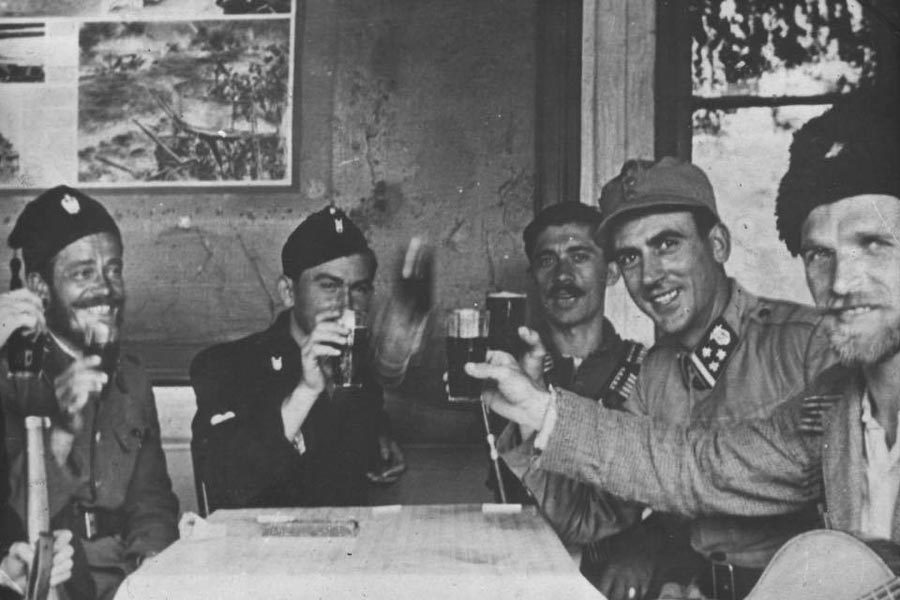
Chetnik commanders meeting with Ustasha authorities and Wehrmacht soldiers in Hotel Bosna, Banja Luka, April-May 1942

Meeting of Chetnik commanders and representatives of Ustasha authorities and NDH armed forces at Hotel "Bosna" in Banja Luka, late April or May 1942

This photograph represents one of the most crucial pieces of evidence documenting Ustasha-Chetnik collaboration in the Independent State of Croatia (NDH). The image captures a meeting between Chetnik commanders and representatives of Ustasha authorities and NDH armed forces at the Hotel "Bosna" in Banja Luka in late April or early May 1942.

Identifying the Collaborators

Seated on the left is Vukašin Marčetić, commander of the Chetnik detachment "Manjača." To his right sits Uroš Drenović, commander of the Chetnik detachment "Kočić." Next to Drenović are two unidentified Chetnik officers. The first one next to Drenović strongly resembles Lazar Tešanović, commander of the Chetnik detachment "Obilić." Standing behind them are representatives of the Ustasha headquarters and the Great Župania of Sana-Luka. On the far right are two Home Guard officers.

The Timing: Three Months After Massacre

The significance of this meeting's timing cannot be overstated. It was held only three months after the Ustasha massacre of Serbian civilians in villages around Banja Luka—Drakulić, Šargovac, Motike, and Rakovac—where 2,216 people were slaughtered, including a very large number of women and children. The meeting occurred one month after Chetniks murdered Dr. Mladen Stojanović, leader of the uprising in Krajina, and during the time when the Germans were preparing a military operation against insurgents on Kozara, in which Marčetić's Chetniks from Manjača assisted the Germans.

Vilko Winterhalter: The Partisan Hero

The brave act of a partisan underground operative exposed these criminals, and the photograph of fascist villains in Chetnik and Ustasha uniforms circulated around the world. The photograph shows Chetnik vojvoda Uroš Drenović drinking beer with his Ustasha colleagues and Wehrmacht soldiers at Hotel "Bosna" in Banja Luka.

The man who unmasked the collaborationists and their mutual cooperation in the city on the Vrbas River, and who is responsible for this photograph, is Vilko Winterhalter, a brave partisan underground operative who obtained the film with this photograph in occupied Banja Luka and sent it to liberated territory.

Biography of Vilko Winterhalter

Vilko Winterhalter was born in Banja Luka on July 17, 1909. He completed gymnasium in Banja Luka and studied at the Law Faculty in Zagreb. He was a member of SKOJ (League of Communist Youth of Yugoslavia), and from 1928 also a member of the Communist Party of Yugoslavia (KPJ).

He participated in the National Liberation War (NOR) from 1941. He organized partisan printing houses and newspapers in the Bosanska Krajina area. He was the editor-in-chief of Glas, the organ of NOF (People's Liberation Front) for Krajina, and Oslobođenje for Bosnia and Herzegovina. After the liberation of the country, he served as, among other positions, director of Oslobođenje in Sarajevo, assistant editor-in-chief of Borba, member of the Executive Council of the People's Republic of Bosnia and Herzegovina and the Central Committee of the League of Communists of Bosnia and Herzegovina, and federal secretary for information.

Historical Erasure and Glorification of War Criminals

In 1993, Vilko Winterhalter Street was erased in Banja Luka, while Chetnik vojvoda Uroš Drenović, the criminal from the photograph, received his own street in the city on the Vrbas River. This represents a deliberate attempt to rewrite history and glorify war criminals while erasing the memory of those who fought against fascism.

Uroš Drenović: Profile of a War Criminal

Early Life and Military Background

Uroš Drenović was born in the village of Sitnica on Manjača and was a Chetnik vojvoda from World War II. He fought on the side of Axis forces against Yugoslav Partisans, particularly distinguishing himself in the attack on Kozara. He collaborated with the NDH.

He entered World War II as a reserve officer with the rank of lieutenant. After the capitulation, he was one of the leaders of the uprising in Bosnia, but he separated from the Partisans and founded Chetnik units. Soon, in 1942, he approached the Ustasha and NDH and concluded an agreement of loyalty and cooperation with them, and also cooperated with the German Nazi occupier. His units participated in attacks on civilians on Kozara. He was killed in 1944 during an Allied attack on German positions.

Character Assessment by Fellow Chetniks

According to an assessment given in his report by Chetnik Major Slavoljub Vranješević on February 3, 1943, Drenović was a pathologically ambitious man who suffered from delusions of grandeur and readily ingratiated himself with both the Ustasha and the Germans. Additionally, he sent a worshipful delegation to the patriarch of the Croatian Orthodox Church, Germogen, in Zagreb. As a fighter, he was brave but a very poor commander because "he lacked the ability to command a larger unit in battle," Vranješević testified.

This assessment from within Chetnik ranks reveals that even his fellow collaborators recognized Drenović's character flaws and limitations, yet he remained a key figure in the criminal alliance between Chetniks, Ustasha, and German forces.

The Banja Luka Agreement: Formalizing Collaboration

Official Documents of the NDH Regime

Official documents from the NDH demonstrate that authorities under war criminal Ante Pavelić financially treated Chetniks the same as Ustasha forces. This equivalence in treatment reveals the depth of collaboration and the extent to which Chetnik units were integrated into the NDH military and administrative apparatus.

Drenović's Declaration of Loyalty (April 27, 1942)

According to sources in Marcia Kurapovna's 2009 book "Shadows on the Mountain," Drenović initially fought with the Partisans as part of the uprising against occupation, but joined the Chetniks by the end of 1941 upon learning that a Chetnik detachment had been formed in his area near Manjača. He quickly rose to prominence in the Chetnik movement and within months signed the first of several agreements with NDH representatives for joint operations against the Partisans.

At the meeting in the "Bosna" hotel with Ustasha commanders in Banja Luka, which concluded with an agreement on April 27, 1942, Vojvoda Drenović stated:

"I hereby declare that I have always recognized the NDH, but that I went into the woods to save the bare lives of the people in this area, as well as myself, whom irresponsible elements began to ruthlessly kill and plunder. At the same time, I declare that together with my armed men, when we clean this entire territory of communist bands together with the Croatian army, according to the orders of the military command, I will place myself and my armed men at the complete disposal of the Home Guard."

Terms of Collaboration

According to the agreement, the NDH committed to:

  • "Croatian armed forces together with Chetniks in the city, as well as in the field, will suppress and destroy communist bands"
  • "Families whose breadwinners are in captivity, and who do not belong to the Communist Party, will immediately receive support in accordance with existing provisions, namely 16 kunas for the wife and 10 kunas per child per day"
  • "Likewise, all widows who suffered during actions to suppress uprisings, and whose breadwinner was not a communist, will immediately receive support from the state"

Expansion of Collaboration (June 1942)

By June 1942, this relationship moved into a phase of formalization across the entire NDH territory. David Sinčić, then 31-year-old deputy prefect of Bribir and Sidraga, selected for this position by Andrija Artuković, Minister of Police in the NDH, was the main negotiator with Chetnik vojvodas regarding their recognition of the NDH.

Already serving as a staff officer, he wrote to Poglavnik Ante Pavelić about measures including to "pay support to families of Orthodox-Chetniks whose members die in battle against the Partisans, just as it is paid to Catholic families for those killed." Pavelić soon approved this. On June 17, 1942, Sinčić sent telegrams announcing he had concluded agreements with vojvodas Bogunović, Đujić, Rokvić, and Rađenović.

Joint Criminal Operations

The Kozara Offensive

Drenović's units participated in the German-led offensive against civilians on Kozara, one of the most brutal operations of World War II in Yugoslavia. His 2,000 Chetniks fought alongside the Wehrmacht and Ustasha forces in this criminal enterprise that targeted civilian populations.

Massacres of Croatian and Serbian Villages

Chetniks operated freely throughout Lika and Dalmatia during the occupation, leaving streams of civilian blood and burned villages wherever they moved:

  • On October 29, 1942, they killed 36 people in the village of Rašćane in Zabioklje
  • 63 people in the village of Kozica
  • 41 more in Dragljani
  • In 1941, Chetniks killed many civilians around Bosanski Grahovo, Drvar, and nuns near Goražde

Collaboration with Multiple Axis Powers

The notorious criminal Drenović became infamous for selling captured Partisan leaders to the Germans and coordinating operations with both Wehrmacht and Ustasha forces. The depth of this collaboration is evidenced by the fact that Drenović was killed in 1944 in Čađavica during an Allied bombing while fighting side by side with a German officer.

Public Displays of Alliance

While Ustasha were slaughtering Serbs, Croats, Roma, and Jews in Jasenovac, and Chetniks were reciprocating with similar savagery in Croatian and Serbian villages, both groups moved freely and cooperated openly. When Chetnik commander Ilija Trifunović-Birčanin died in February 1943, Chetniks of Momčilo Đujić and Ustasha participated together in a parade in his honor in Knin.

Historical Revisionism Today

A Clear Picture of Contemporary Banja Luka

This short story about the Chetnik war criminal and the brave partisan underground operative is a clear picture of today's Banja Luka and the constant attempts to rewrite history. The erasure of Vilko Winterhalter Street in 1993 and the naming of a street after Uroš Drenović represents a deliberate inversion of historical truth and moral values.

The Path to the Abyss

While the democratic authorities in the Bosnian entity of Republika Srpska celebrate Chetnik war criminals, young students and pupils often follow in their footsteps, continuing on a path to the abyss, a path of no return. This glorification of war criminals and collaboration with genocidal regimes represents not just historical falsification, but an active threat to regional peace and reconciliation.

Critical Questions

Why does the political elite in Serbia and Republika Srpska wish to rehabilitate Chetnik butchers with stories of alleged anti-fascist actions, when these same individuals are responsible for unprecedented atrocities? Is this another case of historical revisionism designed to obscure collaboration with Nazi Germany and the Ustasha regime, or is it a cynical political calculation that weaponizes historical memory for contemporary nationalist purposes?

The Importance of Documentary Evidence

The photograph obtained by Vilko Winterhalter, showing Uroš Drenović drinking beer with Ustasha colleagues and Wehrmacht soldiers, demolishes any attempt to portray Chetniks as purely anti-fascist resistance fighters. Combined with official NDH documents showing financial equivalence between Chetnik and Ustasha fighters, formal military agreements, joint operations against civilians, and public ceremonies celebrating their alliance, the evidence reveals an indisputable joint criminal enterprise.

This photographic and documentary evidence represents an insurmountable obstacle to historical revisionism. No amount of contemporary political manipulation can erase the image of Chetnik commanders sitting comfortably with Ustasha authorities and German officers, drinking and planning joint operations against their common enemies—the Communist Partisans and civilian populations.

Historical Interpretation

The Ideological Foundation of Collaboration

The collaboration between Chetniks and the NDH regime, despite the latter's genocidal policies against Serbs, reveals the primacy of anti-Communist ideology over ethnic solidarity. Both movements viewed the Communist-led Partisans as a greater existential threat than each other, leading to a pragmatic alliance that transcended ethnic hatred.

This phenomenon demonstrates how fascist and authoritarian movements, despite superficial ethnic conflicts, can unite against democratic and socialist movements that threaten their hierarchical worldviews and political power. The Chetniks' willingness to collaborate with a regime actively engaged in Serbian genocide exposes the fundamentally anti-democratic and reactionary nature of the Chetnik movement.

The Role of Personal Ambition

The assessment by Chetnik Major Vranješević that Drenović was "pathologically ambitious" and suffered from "delusions of grandeur" highlights the role of individual psychology in collaboration. Many Chetnik commanders were motivated not just by ideology but by personal ambition, desire for power, and opportunism. The NDH offered these commanders recognition, resources, and authority that they could not achieve through pure resistance activity.

The Strategic Calculation

The collaboration must also be understood as a strategic calculation by both sides. The NDH gained auxiliary forces to fight the Partisans while reducing the threat from Serbian nationalist resistance. The Chetniks gained material support, territorial control, and official recognition. Both sides temporarily subordinated ethnic animosity to the perceived greater threat of Communist victory.

However, this strategic calculation had profound moral implications. By collaborating with a genocidal regime, Chetnik commanders became complicit in the broader system of Axis occupation and atrocities, even as they claimed to be defending Serbian populations.

The Significance of the Photograph

The photograph from Hotel "Bosna" serves as irrefutable evidence that demolishes post-war and contemporary narratives of Chetnik resistance to Axis powers. The casual, social nature of the gathering—commanders drinking beer together—suggests a relationship that went beyond mere tactical expedience to something approaching genuine alliance and camaraderie.

The timing of the photograph, shortly after the massacre of 2,216 Serbian civilians by the Ustasha and during preparations for the Kozara offensive, makes the image even more damning. It shows Chetnik commanders socializing with representatives of a regime that had recently slaughtered thousands of their supposed constituents, revealing the hollowness of claims that Chetniks were defending Serbian populations.

Vilko Winterhalter's Legacy

Winterhalter's act of obtaining and disseminating this photograph represents the importance of documentary evidence in historical memory. His courage in exposing collaboration served immediate wartime purposes—helping to shift Allied support from Chetniks to Partisans—but also created a permanent historical record that continues to challenge revisionist narratives today.

The 1993 erasure of Winterhalter Street and the naming of a street after Drenović represents an attempted historical inversion that seeks to transform perpetrators into heroes and heroes into forgotten figures. This deliberate act of historical falsification has profound implications for how younger generations understand World War II and the nature of collaboration, resistance, and genocide.

Sources and Citations

Primary Historical Sources

Kurapovna, Marcia. Shadows on the Mountain: The Allies, the Resistance, and the Rivalries that Doomed WWII Yugoslavia. Hardcover, December 1, 2009.

This comprehensive work examines the complex relationships between various resistance movements in Yugoslavia during World War II, including detailed documentation of collaboration between Chetnik forces and Axis-aligned powers such as the NDH. Kurapovna's research draws on archival materials from multiple countries and provides detailed analysis of how rivalries between resistance movements led to collaboration with occupying forces.

Contemporary Investigative Journalism

Slobodna Bosna. "Vlasti u Srbiji i RS u ovo kriju kao zmija noge: Razotkrivanje udruženog zločinačkog poduhvata koljaća i zločinaca" [Authorities in Serbia and RS hide this like a snake hides its legs: Revealing the joint criminal enterprise of collaborators and criminals]. Slobodna Bosna.

Available at: https://www.slobodna-bosna.ba/vijest/465205/

This investigative article examines how contemporary political authorities in Serbia and Republika Srpska have sought to obscure historical evidence of collaboration between Chetnik forces and other wartime actors, including the NDH and Wehrmacht. The article reveals the continued political sensitivity of this historical topic and ongoing attempts at historical revisionism.

Ljudski.ba. "Tajna večera u hotelu Bosna: Tko stoji iza najpoznatije ratne fotografije u Banjoj Luci" [The Secret Supper at Hotel Bosna: Who is behind the most famous war photograph in Banja Luka].

Available at: https://www.ljudski.ba/drustvo/tajna-vecera-u-hotelu-bosna-tko-stoji-iza-najpoznatije-ratne-fotografije-u-banjoj-luci

This article provides detailed analysis of the famous photograph from Hotel "Bosna" in Banja Luka, identifying the participants and explaining the historical context. It also documents the story of Vilko Winterhalter, the partisan operative who obtained the photograph and ensured its dissemination to liberated territories and Allied forces.

Archival Materials

Official NDH documents regarding financial support for Chetnik units, including orders from Ante Pavelić and reports from David Sinčić regarding agreements with Chetnik vojvodas Bogunović, Đujić, Rokvić, Rađenović, and Drenović. These documents establish the systematic nature of collaboration and the integration of Chetnik forces into NDH military and administrative structures.

Internal Chetnik reports, including the February 3, 1943 assessment of Uroš Drenović by Major Slavoljub Vranješević, providing insight into how Chetnik commanders were viewed by their own colleagues and revealing the opportunistic nature of many collaborators.

Research Note

The Genocide Institute continues to research collaboration during World War II in Yugoslavia, examining archival materials from multiple countries, survivor testimonies, contemporary photographs and documents, and post-war judicial proceedings. This research aims to build a comprehensive understanding of these complex historical relationships and their implications for genocide prevention, historical memory, and contemporary reconciliation efforts.

The Institute is particularly concerned with contemporary attempts at historical revisionism that seek to rehabilitate war criminals and collaborators, erase the memory of resistance heroes like Vilko Winterhalter, and distort the historical record for political purposes. Such efforts not only dishonor the victims of genocide and collaboration but also threaten the foundations of historical truth and regional peace.