First conviction for Bosnian genocide and landmark ruling on universal jurisdiction (1997-1999)
Nikola Jorgić is a Bosnian Serb who served as leader of a Serbian paramilitary unit in the Doboj area during the Bosnian War. From 1969 to 1992, he lived in Germany. In 1992, he traveled to Bosnia to participate in the war. After committing crimes, he returned to Germany—to Bochum—to visit his wife and child, but was arrested at Düsseldorf airport on suspicion of participating in the Doboj massacres.
In 1997, the Higher Regional Court of Düsseldorf concluded in its verdict against Nikola Jorgić that these crimes constituted an act of genocide. This was the first conviction for participation in the Bosnian genocide.
The case represents not only a judicial epilogue for crimes committed in the Doboj region, but also a crucial point in the development of German jurisprudence related to international criminal law. This was the first verdict in which German courts convicted a perpetrator of genocide committed outside German territory, against foreign nationals.
Jorgić was convicted of killing 22 residents in Grabska—women, elderly people, and disabled persons—who had gathered in the open, terrified by the war's destruction. Three captured Bosniaks were forced to carry the corpses to a mass grave.
In Ševarlije, together with his paramilitary unit, he captured 40 to 50 residents and tortured them. Six were arbitrarily executed, while a seventh victim died when burned alive in a barn together with six corpses.
Jorgić also later killed a prisoner in detention by placing a metal can on his head and beating him so brutally with a wooden club that he died on the spot.
He received four consecutive life imprisonment sentences. The European Court of Human Rights rejected his appeal against the verdict in 2007.
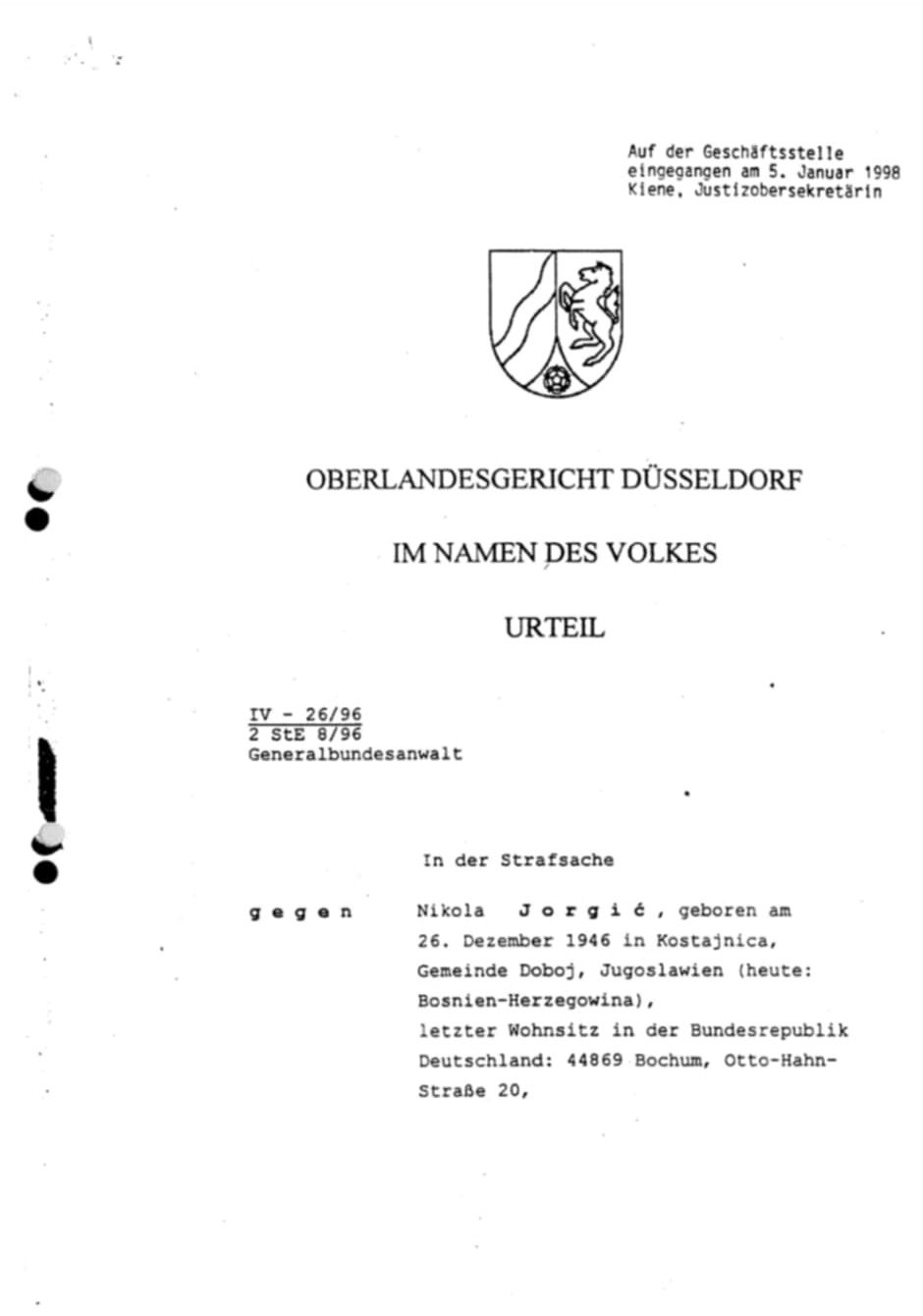
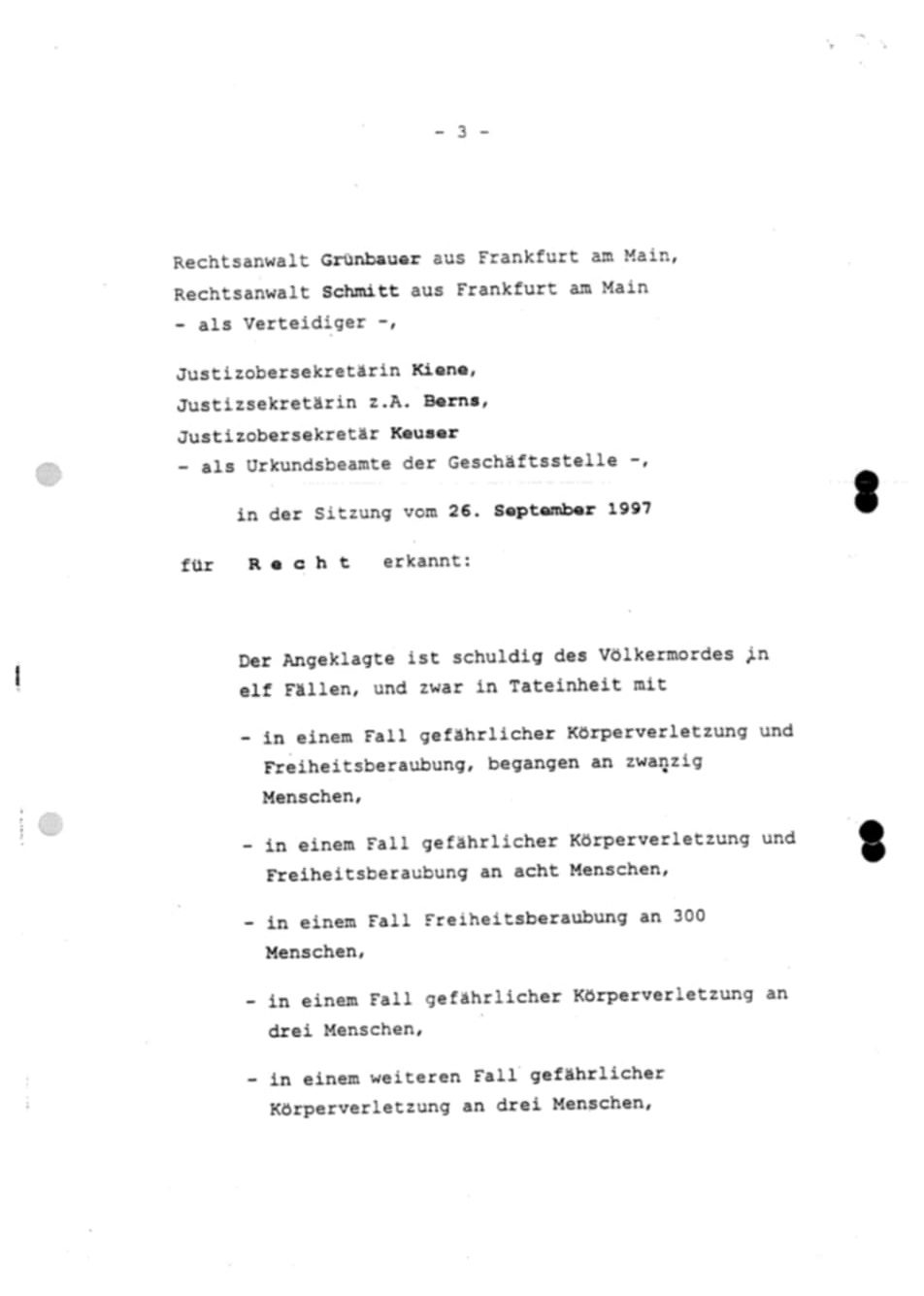
The Higher Regional Court in Düsseldorf (IV 26/96) established that Nikola Jorgić, as leader of a paramilitary formation, participated in systematic ethnic cleansing in the Doboj region in 1992. The court found him guilty of genocide in 11 counts, including massacres in Grabska (22 victims) and Ševarlije (7 victims), as well as unlawful detention and inhumane treatment in camps.
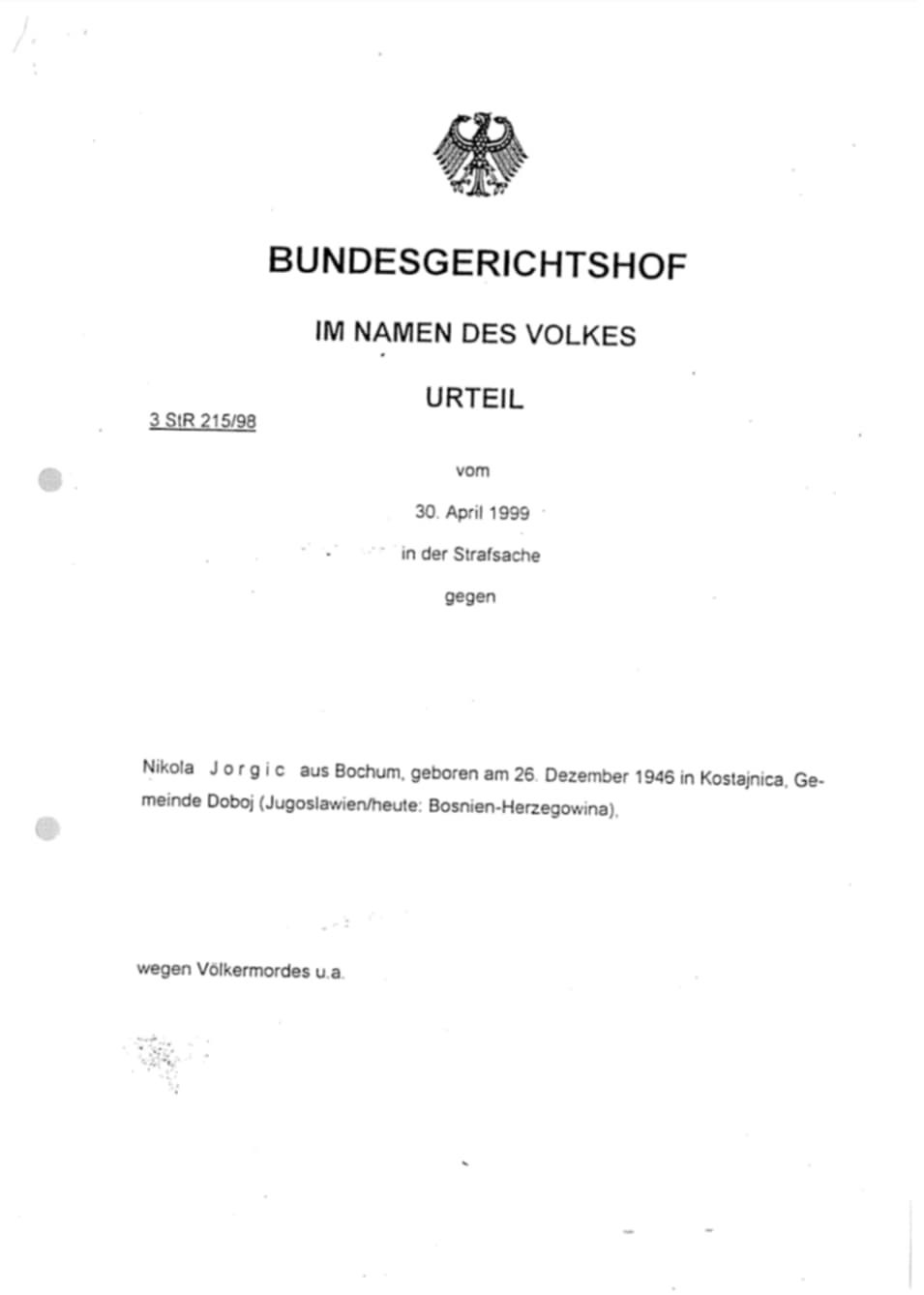
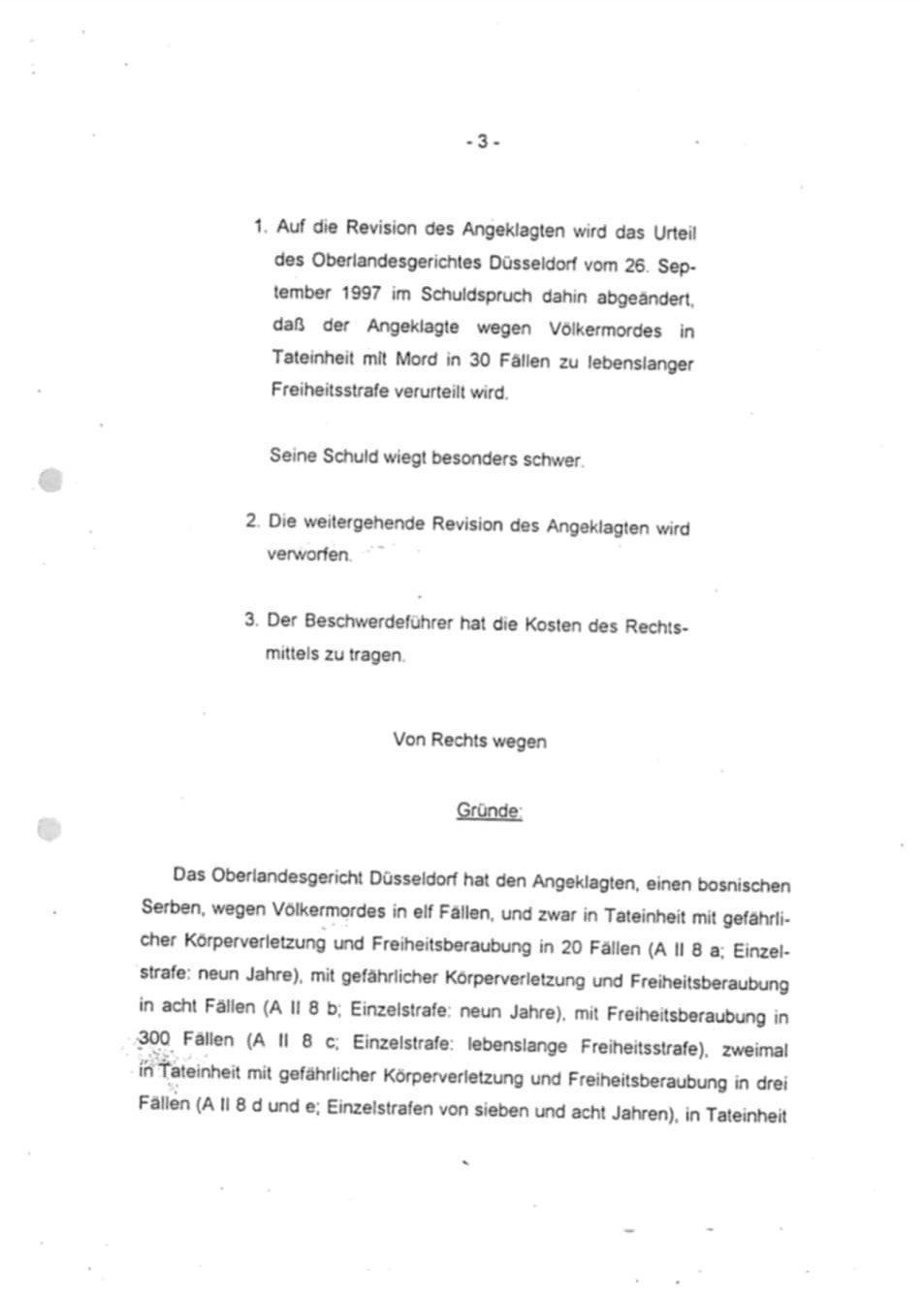
The Federal Supreme Court (Bundesgerichtshof - BGH) in its appellate proceedings (3 StR 215/98) confirmed the application of the principle of universal jurisdiction (Weltrechtsprinzip) according to § 6, paragraph 1 of the German Criminal Code (StGB).
The court took the position that genocide knows no territorial limitations regarding prosecution, whereby Germany assumed the obligation to punish regardless of the place of commission ("Annexkompetenz").
The principle of universal jurisdiction establishes that certain crimes—particularly genocide—are so heinous that any state has the authority and obligation to prosecute perpetrators, regardless of where the crimes were committed or the nationality of the perpetrators or victims.
The special significance of the verdict lies in the application of the institute of "particularly severe guilt" (besonders schwere Schuld) in accordance with § 57a StGB.
Given the brutality and scope of the crimes, the court imposed a sentence of life imprisonment, with legal exclusion of the possibility of automatic conditional release after 15 years, which is standard in German criminal law.
This verdict was later confirmed before the European Court of Human Rights (Jorgić v. Germany, 2007), thereby validating the definition of genocide applied by German courts ("intent to destroy a group as such").
April 30, 1999 - Official Statement
The Federal High Court of Germany announced its fundamental ruling on genocide, establishing several critical legal principles:
This ruling represented a watershed moment in international criminal law, establishing that states need not wait for international tribunals to act—they can and should prosecute genocide themselves under the principle of universal jurisdiction.
On July 12, 2007, the European Court of Human Rights delivered its judgment in the case of Jorgić v. Germany, rejecting Jorgić's appeal and confirming the validity of the German courts' proceedings and verdict.
The European Court examined several critical issues:
The ECHR confirmed that the German courts' interpretation and application of the genocide definition was legally sound and consistent with international law. The court found no violation of Article 7 of the European Convention on Human Rights (no punishment without law).
The court determined that Jorgić had received a fair trial under Article 6 of the Convention, with full opportunity to present his defense and challenge the evidence against him.
The ECHR found that the life imprisonment sentence, including the determination of "particularly severe guilt" preventing automatic release after 15 years, was proportionate to the gravity of the crimes.
Importantly, the ECHR validated Germany's exercise of universal jurisdiction, confirming that states may prosecute genocide committed abroad by foreign nationals against foreign victims.
The ECHR ruling established that universal jurisdiction for genocide is not only permissible under international law, but represents an important mechanism for ensuring accountability when territorial or nationality-based jurisdiction may be unavailable or ineffective.
The Jorgić case represents the first criminal conviction for genocide committed during the Bosnian War. This verdict preceded the International Criminal Tribunal for the former Yugoslavia's (ICTY) genocide convictions and established important legal precedents.
The case definitively established that genocide is subject to universal jurisdiction—that any state can and should prosecute genocide perpetrators regardless of where the crimes occurred or the nationality of perpetrators and victims.
This principle is grounded in the understanding that genocide represents a crime against all of humanity, not merely against the immediate victims or their state. As such, every state has both the legal authority and moral obligation to pursue justice.
The German courts' detailed legal reasoning in the Jorgić case provided a framework that influenced subsequent genocide prosecutions, both in national courts and international tribunals. Key elements include:
The Jorgić verdict sent a powerful message that genocide perpetrators cannot find safety anywhere in the world. States with functioning legal systems have the tools and obligation to prosecute such crimes, ensuring that international borders do not become shields for genocidaires.
The crimes committed by Jorgić and his paramilitary unit exemplify the systematic nature of genocide in Bosnia. The targeting of vulnerable populations—women, elderly, disabled persons—demonstrates that the violence was not incidental to military operations but represented deliberate destruction of the Bosniak community.
The forced participation of Bosniak prisoners in burying victims, the burning of people alive, and the extreme brutality of murders (such as the metal can beating) all indicate intent to terrorize and destroy the group, not merely to achieve military objectives.
The German courts' application of universal jurisdiction reflects a fundamental principle: certain crimes are so heinous that they offend the conscience of all humanity. When a state has custody of a genocide perpetrator, it has both the legal authority and moral obligation to prosecute, regardless of technical jurisdictional limitations.
This principle prevents genocide from becoming a crime that can be committed with impunity simply by crossing international borders. It establishes that sovereignty cannot be used as a shield for mass atrocity.
The German court's application of § 57a StGB—finding "particularly severe guilt"—represents a legal recognition that some crimes are so extreme that normal sentencing provisions are insufficient. By excluding the possibility of automatic release after 15 years, the court acknowledged that genocide represents a category of crime requiring exceptional punishment.
This determination reflects not only the objective severity of the acts—the number of victims, the brutality of methods, the vulnerability of targets—but also the subjective culpability involved in participating in systematic destruction of a people.
The Jorgić case established a model for how national courts can effectively prosecute genocide:
While the ICTY and later the International Criminal Court (ICC) represent important mechanisms for genocide prosecution, the Jorgić case demonstrates the vital role of national courts. Domestic prosecutions offer several advantages:
The European Court of Human Rights' 2007 confirmation of the Jorgić verdict addressed a critical question: can universal jurisdiction be exercised consistent with human rights protections?
The ECHR answered definitively: yes. Universal jurisdiction, when exercised with proper procedural safeguards, fair trial guarantees, and proportionate sentencing, represents a legitimate and necessary tool for combating impunity for the world's worst crimes.
This ruling established that defendants' rights and universal jurisdiction are not in tension—rather, universal jurisdiction prosecutions must scrupulously respect human rights to maintain legitimacy.
The Jorgić precedent remains highly relevant today as genocide and crimes against humanity continue to occur worldwide. The case demonstrates that:
The Jorgić case teaches several crucial lessons about genocide justice and prevention:
1. Documentation Matters: The successful prosecution relied on careful documentation of crimes, witness testimony, and forensic evidence. This underscores the importance of preserving evidence even during ongoing conflicts.
2. Political Will is Essential: Germany's willingness to prosecute demonstrated political commitment to accountability. Other states with similar legal frameworks must show equal courage.
3. Legal Frameworks Must Exist: Universal jurisdiction statutes must be in place before perpetrators arrive. States should enact and maintain such legislation.
4. International Cooperation is Key: Successful prosecution required cooperation between multiple jurisdictions, international organizations, and NGOs. Such networks must be strengthened.
5. Justice Serves Prevention: Prosecutions like Jorgić's send a powerful deterrent message to potential perpetrators: there is no safe haven for genocide.
Ultimately, the Jorgić case rests on a moral foundation: the recognition that genocide represents an assault on human dignity so profound that it cannot be tolerated by the community of nations.
When Nikola Jorgić burned people alive in barns, when he forced prisoners to bury their murdered neighbors, when he beat a man to death with a metal can on his head—he was not merely committing individual murders. He was participating in a systematic attempt to destroy the Bosniak people of Doboj.
The German courts' verdict recognized this truth. The Federal High Court's confirmation established it as law. The ECHR's validation enshrined it in human rights jurisprudence.
The Jorgić case stands as a testament to the principle that genocide will not be tolerated, that perpetrators will be pursued wherever they flee, and that justice—though delayed—will ultimately prevail.
Higher Regional Court at Düsseldorf. National Case Law - Nikola Jorgić, September 26, 1997. Case No. IV 26/96.
"The accused, a Bosnian Serb, was sentenced to life imprisonment. He was found guilty of genocide in eleven cases, in conjunction with several cases of dangerous bodily harm, deprivation of liberty and/or murder. He acted as an accessory to those crimes."
This first-instance verdict established Jorgić's guilt for genocide and set the precedent for universal jurisdiction application in German courts.
Bundesgerichtshof (Federal Supreme Court of Germany). BGHSt 45, 64 - Völkermord und Weltrechtsprinzip [Genocide and Universal Jurisdiction Principle], Judgment of April 30, 1999. Case No. 3 StR 215/98.
Available at: https://www.servat.unibe.ch/dfr/bs045064.html (paragraphs 20-27)
The Federal Supreme Court's appellate decision confirming the genocide conviction and establishing the legal basis for universal jurisdiction in genocide cases.
Federal High Court of Germany. Translation of Press Release into English, No. 39, April 30, 1999: "Federal High Court Makes Basic Ruling on Genocide."
Prevent Genocide International. Available at: http://www.preventgenocide.org/punish/GermanFederalCourt.htm
Official English translation of the German Federal High Court's press release announcing its fundamental ruling on genocide and universal jurisdiction.
European Court of Human Rights. Jorgić v. Germany, Application No. 74613/01, Judgment of July 12, 2007.
Available at: https://hudoc.echr.coe.int/eng?i=001-81608
Final confirmation by the European Court of Human Rights upholding the German courts' genocide conviction and validating the application of universal jurisdiction consistent with human rights protections.
German Criminal Code (Strafgesetzbuch - StGB).
Convention on the Prevention and Punishment of the Crime of Genocide. Adopted by the United Nations General Assembly, December 9, 1948.
The foundational international treaty defining genocide and obligating states to prevent and punish the crime.
The Jorgić case has been extensively analyzed in legal scholarship as a landmark precedent for:
The Genocide Institute continues to research the application of universal jurisdiction for genocide and other international crimes. The Jorgić case represents a crucial precedent demonstrating that:
This case study informs our ongoing work on strengthening national capacity for international crime prosecution and supporting victims' access to justice through multiple legal mechanisms.
The Institute maintains that the Jorgić precedent should inspire other states to enact robust universal jurisdiction statutes, develop expertise in international criminal law, and demonstrate the political courage to prosecute genocide perpetrators found on their territory—regardless of where the crimes occurred.
As the case demonstrates, effective genocide prosecution requires not only legal frameworks but also commitment to justice, cooperation across borders, and recognition that certain crimes are so heinous they offend the conscience of all humanity.