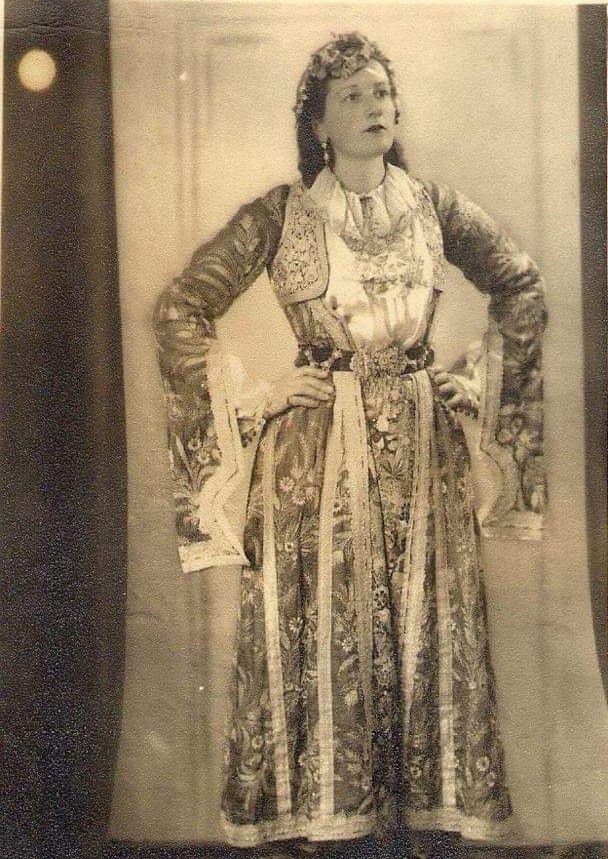
1942 – Tortured, raped and murdered by Chetnik forces while caring for wounded fighters
In the first autumn of the National Liberation Struggle (1941), Ajša Karabegović left her native Banja Luka to join the partisans. On liberated territory, she worked with extraordinary selflessness as a nurse and administrator at the partisan hospital in Jošavka, caring for wounded fighters. Her young life—full of promise and courage—was brutally cut short in May 1942 by Chetnik forces who, in collaboration with Nazi and Ustasha occupiers, attacked the hospital on Čemernica mountain, captured the medical staff, and subjected them to systematic torture and murder.
Ajša's story is not only one of heroic resistance; it is also a testament to the specific gender‑based violence inflicted on women who took up arms against fascism. Her murder—by rape, mutilation, and being torn apart by horses—stands as one of the most horrifying Chetnik atrocities of World War II in Bosnia. Today, her memory faces a second killing: the erasure of her name from the streets of Banja Luka by neo‑Chetnik forces that rehabilitated her executioners.
From Izgubljena revolucija: Žene između mita i zaborava (2022)
"Prve jeseni narodne borbe napustila je rođeni grad Ajša Karabegović. Na slobodnoj teritoriji ona je krajnjom požrtvovnošću njegovala borce u jošavčkoj bolnici. Četnički zlikovci prekidoše i taj divni poletni život."
— Izgubljena revolucija: Žene između mita i zaborava, Univerzitet u Sarajevu, 2022
The partisan hospital in Jošavka, where Ajša served as administrator and nurse, became a primary target during the so‑called "Chetnik Coup" that began on the night of March 31 to April 1, 1942. Coordinated by Chetnik commander Rade Radić, the attack aimed to destroy the Operational Staff of the National Liberation Army for Bosanska Krajina, the District Committee of the Communist Party, the SKOJ, and all partisan medical facilities in the region.
From April 1 to the end of June 1942, in the area between the Vrbas and Bosna rivers and between the Sava river and Vlašić mountain, Chetnik forces—acting in open collaboration with Nazi occupiers and the Ustasha—killed more than 60 prominent communists, SKOJ members, and partisan commanders, and more than 150 fighters and wounded patients. Many were murdered after being taken prisoner, often through treacherous betrayals and direct assaults on hospitals.
On May 16, 1942, Chetnik forces launched a direct attack on the partisan hospital located on Čemernica mountain near Skender Vakuf. The hospital, filled with wounded fighters, was defended by a small security detail and those patients mobile enough to fight. When Chetnik units surrounded the facility, the defenders and ambulatory wounded attempted a breakout. Some were killed in combat; others were captured. All captured wounded—including those immobile and unable to flee—were subsequently murdered. Among the captives were the renowned writer Hasan Kikić and the hospital administrator Ajša Karabegović.
After the capture of the Čemernica hospital, Ajša Karabegović was separated from the other prisoners. What followed was an act of premeditated, bestial cruelty that exemplifies the depths of Chetnik savagery toward captured partisan women.
Ajša was repeatedly raped. Her tormentors then cut off both of her breasts. In a final, grotesque display of violence, her hands were tied to horses and she was torn apart—dismembered alive. This was not a spontaneous act of war; it was a gendered execution designed to terrorize and dehumanize women who defied the patriarchal, fascist order.
The murder of Ajša Karabegović was not an isolated incident. It was part of a systematic Chetnik policy of slaughtering medical personnel, immobile wounded, and particularly women fighters and nurses. Similar atrocities were committed at the same time against other partisan women captured in eastern Bosnia.
The Chetnik movement, led by Draža Mihailović and regional commanders like Rade Radić, formalized its collaboration with the Axis only twelve days after Ajša's murder. On May 28, 1942, Chetnik and Ustasha commanders met in the village of Lipce near Doboj. According to the minutes, the Chetniks recognized the sovereignty of the Independent State of Croatia (NDH), expressed loyalty to the Poglavnik, agreed to receive ammunition from Croatian state authorities, and were granted the right to treatment in NDH hospitals. In June 1942, in coordination with Wehrmacht forces, Chetniks attacked the Proletarian Krajina Battalion from behind on Motajica mountain.
March 31 – April 1, 1942
Chetnik forces launch coordinated attacks on partisan headquarters and hospitals in Bosanska Krajina – the "Chetnik Coup".
April – June 1942
More than 210 partisans, communists, and wounded fighters murdered by Chetnik forces in collaboration with Nazis and Ustasha.
May 16, 1942
Chetnik forces attack the partisan hospital on Čemernica. Ajša Karabegović and Hasan Kikić are captured, tortured and murdered. All immobile wounded are killed.
May 22, 1942
Karlo Rojc, company commander defending the hospital, makes his last stand in a cave above the Vrbas and takes his own life rather than surrender.
May 28, 1942
Formal Chetnik-Ustasha collaboration agreement signed in Lipce.
"People whose busts stare into a city emptied of itself died fighting against all ideologies of blood and soil, fascism and clero‑nationalism, ethnic exclusivity and unfreedom. It seems in vain—such a Banja Luka deserves neither their names nor their heroic deeds."
— "How Banja Luka Killed Its Liberators for the Second Time", Al Jazeera Balkans, 2020
In 1992, neo‑Chetnik forces that seized control of Banja Luka systematically removed the names of Ajša Karabegović, Hasan Kikić, and dozens of other antifascist heroes from streets, schools, and public institutions. Streets that once bore their names were renamed after Chetnik commanders—including Rade Radić, the very man who coordinated the attacks that led to Ajša's murder. The few remaining busts of partisan fighters were gathered into a single "reservation" near the Monument to Fallen Fighters of the National Liberation Struggle, isolated from the city's official memory.
This erasure is not merely symbolic. It is an active rehabilitation of the Chetnik ideology that murdered Ajša Karabegović and 45,000 other Bosniaks and Croats during World War II—the same ideology that drove the genocide of the 1990s.
The murder of Ajša Karabegović and the post‑1992 rehabilitation of her killers are two acts of the same play. The Chetnik movement of World War II and the neo‑Chetnik forces of the 1990s share direct ideological, personal, and operational continuity. Rade Radić, the commander who organized the attacks on partisan hospitals, received a street in Banja Luka in the 1990s. The Serbian Orthodox Church, which blessed Radić's collaborators in the 1940s, blessed Radovan Karadžić and Ratko Mladić in the 1990s.
To erase Ajša's name is to complete the work of her executioners. The Genocide Institute therefore places her story alongside the 1995 Paris court ruling against the Serbian Orthodox Church: both are testimonies to the weaponization of faith and nationalism to justify genocide, and both are systematically suppressed by those who benefit from historical amnesia.
Al Jazeera Balkans. "Kako je Banja Luka po drugi put ubila svoje oslobodioce" [How Banja Luka Killed Its Liberators for the Second Time]. April 21, 2020.
https://balkans.aljazeera.net/opinions/2020/4/21/kako-je-banja-luka-po-drugi-put-ubila-svoje-oslobodioce
Univerzitet u Sarajevu – Gender Resource Centre. Izgubljena revolucija: Žene između mita i zaborava [Lost Revolution: Women Between Myth and Forgetting]. Sarajevo, 2022.
https://unigerc.unsa.ba/wp-content/uploads/2022/07/IZGUBLJENA%20REVOLUCIJA%20AFŽU%20IZMEĐU%20MITA%20I%20ZABORAVA.pdf
International Criminal Tribunal for the former Yugoslavia (ICTY). Testimonies and case files regarding Chetnik-Ustasha collaboration (1941–1945) and the rehabilitation of Chetnik ideology in the 1990s. Relevant documents: Kunarac et al. (Foča), Krajišnik, Plavšić.
Hoare, Marko Attila. Genocide and Resistance in Hitler's Bosnia: The Partisans and the Chetniks, 1941–1943. Oxford University Press, 2006. (Context on Chetnik attacks on partisan hospitals and medical personnel).